
QA7, QA4 and QA2
New Employee Induction
Welcome to NERPSA. This induction will help you understand who we are, how we work, and the key responsibilities connected to your role.
Welcome To NERPSA
We are pleased to welcome you to the North East Regional Pre-School Association. As a NERPSA employee, you are joining a team committed to providing high-quality, inclusive and play-based early childhood education and care across North East Victoria.
NERPSA is the approved provider and employer for our services. This means we are responsible for strong governance, child safe systems, safe staffing, quality practice, compliance, employment processes and supporting staff to understand their responsibilities.
This induction introduces you to NERPSA’s values, child safe commitments, policies, procedures, workplace expectations, systems and support structures. It should be used alongside your Letter of Employment, Position Description, Staff Handbook, Code of Conduct, NERPSA policies, service procedures, the Staff Resources website and the NERPSA App.
Child Safety
Our Highest Priority
Children’s safety, wellbeing, dignity and rights are central to every decision, interaction, routine and environment.
Professional Practice
Your Role Matters
Every employee contributes to safe, respectful, inclusive and high-quality services.
Learning
Ask Early
Work through each section carefully, complete the required induction activities and ask questions whenever something is unclear.
Where This Induction Fits
Your employment journey with NERPSA includes several stages. Each stage has a different purpose and supports you in a different way.
Recruitment
Recruitment includes your application, interview process, referee checks, suitability checks and NERPSA’s decision to offer employment.
Onboarding
Onboarding happens after an offer of employment and before, or at the start of, your role. It includes employment paperwork, payroll information, Staff Record documentation, required certificates, screening checks, registration information, Code of Conduct acknowledgement and any role-specific information required by NERPSA.
Induction — You Are Here
This induction is the NERPSA-wide learning course. It introduces you to our organisation, child safe responsibilities, policies, legal and quality frameworks, workplace conduct, core systems and key expectations.
Orientation
Orientation happens at your service. It introduces you to your specific kindergarten or service, including the team, physical environment, routines, children’s needs, emergency procedures, local expectations and service-specific processes.
Probation
Probation is the supported review period after commencement. It may include check-ins, observations, feedback, support from your Education Manager, completion of induction and orientation requirements, and confirmation that the role and organisation are the right fit.
Ongoing Professional Growth
After probation, staff develop a Professional Development Plan. The plan is reviewed during the year and rewritten yearly to support ongoing professional learning and growth.
Required Induction Activity
How To Use This Induction
Before moving on, take a moment to understand how this induction works.
- Open the Staff Resources website.
- Open the NERPSA App.
- Locate the NERPSA service policies page.
- Check where to find your Position Description and Staff Handbook.
- Open the teal pop-up guides as you see them.
- Complete each teal required induction activity box as you work through the induction.
- Write down any questions to clarify during your service orientation.
Quick Visual Guides
Completing This Induction
This induction is required for NERPSA employees as directed, including permanent, relief and casual staff. Please work through each section carefully and complete the required induction activities.
- Complete each induction section in order.
- Complete the required induction activities shown in the teal boxes throughout the induction.
- Open and read the teal pop-up guides as you work through each section.
- Locate and read linked policies, procedures and resources where directed.
- Ask questions if anything is unclear.
- Complete the final Induction Completion and Acknowledgement Form at the end of the induction.
Induction Time
Claiming Time
New staff induction may be paid up to 8 hours where approved.
If you complete induction during paid rostered or approved work time, you cannot also claim Additional Hours for that time. Only approved induction time completed outside paid work hours can be claimed through an Additional Hours Application.
What This Induction Covers
Safety, Supervision And Reporting
You will learn about NERPSA’s child safe commitments, supervision expectations, ratios, reporting pathways, reportable conduct, mandatory reporting, privacy, confidentiality, digital safety and the importance of escalating concerns immediately.
Systems, Conduct And Responsibilities
You will learn about workplace conduct, NERPSA contacts, policies, procedures, leave, OHS, wellbeing, EAP, health and medical requirements, emergency procedures, inclusion, relationships, self-reflection and professional growth.
Support
Need Help?
If you have questions about the induction, onboarding requirements, employment paperwork, Staff Records or probation, please contact the Human Resources Manager.
Email: hr@nerpsa.com.au
You Are Supported
You are not expected to know everything on your first day. You are supported to ask questions, follow NERPSA policies and procedures, seek guidance when needed, keep your required documents current, and keep children’s safety and wellbeing at the centre of your work.
Where To Find NERPSA Resources
Use current online forms, documents and policies rather than saved, printed or old copies.
We look forward to supporting you as you begin your journey with NERPSA.
QA7, QA4 and QA2
Welcome To NERPSA
Our history, governance, mission, vision, values and commitment to children, families, staff and communities across North East Victoria.
North East Regional Pre-School Association
NERPSA was founded in 2004 to provide a collaborative framework for early childhood services in North East Victoria.
NERPSA was established in response to government funding for group employment models and has since grown to include services across local government areas. Today, NERPSA works as a connected network of services, staff, families and communities.
We Are A Network Of Services And Communities
NERPSA is more than one workplace. Our services sit across Wangaratta and surrounding North East Victorian communities, each with its own team, families, routines and local character. What connects us is a shared commitment to children’s safety, belonging, play-based learning, inclusion and high-quality early childhood education and care.
Quick Visual Guides
Our Mission
Supporting Skilled Staff
Our mission is to support our skilled staff to deliver quality, inclusive, play-based education for the children in our care.
Our Vision
Supporting Every Child
NERPSA aspires to create a nurturing environment where every child is empowered to reach their full potential.
Your Role
You Matter
Every employee contributes to safe, respectful, inclusive and high-quality environments for children and families.
Board And Leadership
NERPSA is an Early Years Manager, approved provider and employer. NERPSA is governed by a Board and supported by organisational leadership, service leaders and staff across our services.
As the approved provider, NERPSA is responsible for governance, policy, systems, staffing, compliance and quality improvement across its services. Nominated Supervisors, persons in day-to-day charge, Educational Leaders, teachers, educators and staff all play an important role in implementing NERPSA policies and procedures in daily practice.
Consistency And Quality
Many services have a parent group or committee that supports local fundraising and maintenance.
NERPSA manages key organisational areas such as staffing, employment, salaries, policies, compliance support and program structure. This centralised approach supports consistency, quality, safety and clear expectations across services.
Our Commitment To Child Safety
Child Safe Organisation
Safety, Wellbeing, Dignity And Rights
As a child safe organisation, NERPSA prioritises the safety, wellbeing, dignity and rights of every child.
NERPSA has zero tolerance for child abuse, racism, discrimination, neglect, grooming, harmful conduct and unsafe practice. Children’s safety and wellbeing are central to every decision, interaction, routine and environment.
All employees are expected to understand and follow NERPSA’s child safety, conduct, privacy, supervision, staffing, digital technology and service procedures. Child safety is everyone’s responsibility.
Staff must maintain active supervision, follow educator-to-child ratio and Responsible Person requirements, use safe and respectful interactions, maintain professional boundaries, protect children’s privacy, and raise concerns promptly.
All staff must report and escalate child safety concerns, disclosures, suspicions of abuse or neglect, unsafe conduct, breaches of professional boundaries, or inappropriate behaviour through the correct pathway. This includes understanding mandatory reporting obligations, failure to disclose, failure to protect, the Reportable Conduct Scheme, and when concerns may need to be reported to Child Protection, Victoria Police, the Commission for Children and Young People, the Regulatory Authority, or another relevant authority.
Staff must also follow NERPSA’s requirements for records, confidentiality, information sharing and digital safety. Information about children and families must be handled carefully and shared only where authorised or required, including under child safety, Child Information Sharing Scheme, Family Violence Information Sharing Scheme, mandatory reporting, Reportable Conduct Scheme or regulatory obligations.
Photos, videos and digital information about children must only be managed in line with NERPSA policy, parent/guardian permissions, children’s rights and child safe practice. Personal devices must not be used to take photos or videos of children. Any approved exception for carrying or using a personal device must be for an authorised essential personal purpose and must not be used for taking images or recordings of children.
NERPSA’s Work Takes Place On Aboriginal Country
We acknowledge the Traditional Owners and Custodians of the lands on which we work and learn, and pay our respects to Elders past and present. We recognise their continuing connection to land, water, culture, children, families and community.
NERPSA services operate across North East Victorian communities, including Chiltern, Benalla, Wangaratta, Moyhu, Whitfield and Whorouly. These communities are located across lands connected with several Aboriginal peoples and Traditional Owner groups.
This acknowledgement is part of NERPSA’s identity. It reminds us that our work with children, families and communities takes place on Country, and that cultural safety, respect, belonging and connection are part of everyday NERPSA practice.
Mission And Vision In Practice
Play-Based Learning
Why Play Matters
NERPSA believes that play is essential for children’s development and learning, and we are committed to providing curriculum and learning environments that are engaging, meaningful, inclusive and responsive to children’s strengths, interests and needs.
Lifelong Learning
Strong Foundations
By providing high-quality early childhood education and care, we aim to foster children’s cognitive, social, emotional and physical development. These formative years lay the foundation for lifelong learning, wellbeing and participation.
Through thoughtful teaching practices, engaging environments and a strong focus on individual needs, we strive to inspire a love of learning in every child.
Our Values In Practice
Respect
We treat all individuals with dignity and respect, regardless of their background, circumstances, culture, identity, ability or family context.
Responsiveness
We are committed to meeting the needs of children, families and staff in a timely, thoughtful and effective manner.
Integrity
We act with honesty, transparency and professionalism in all our dealings.
Impartiality
We provide fair and inclusive opportunities and services to children and families, regardless of socioeconomic status, cultural background, ability, family structure or personal circumstances.
Accountability
We are accountable to children, families, staff, communities, the approved provider, regulators and the broader early childhood education and care framework.
Leadership
We provide leadership and support to staff and services, and we work together to build safe, inclusive and high-quality learning environments.
Human Rights
We are committed to upholding human rights, children’s rights, cultural safety, equity and social justice.
Our Strategic Goals
NERPSA’s work is guided by strategic priorities that support quality, sustainability and positive outcomes for children and families.
Required Induction Activity
Connect This Page To Your Role
Before moving on, take a moment to connect this information with your role at NERPSA.
- Open the NERPSA Service Map visual guide.
- Note that NERPSA is the approved provider and employer for its services.
- Identify one NERPSA value that connects strongly with your role.
- Identify one way your role supports children’s safety, wellbeing, dignity or rights.
- Write down any questions about NERPSA’s services, values, governance or child safe commitment to clarify during service orientation.
Every Role Contributes
Whether you are working directly with children, supporting a service team, leading a program, providing administration or working behind the scenes, your role helps create safe, inclusive and high-quality environments for children and families.
Welcome to the NERPSA team.
QA7, QA4, QA2
New Employee Induction
Welcome to NERPSA. This induction will help you understand who we are, how we work, and the key responsibilities connected to your role.
Welcome to NERPSA
We are pleased to welcome you to the North East Regional Pre-School Association. As a NERPSA employee, you are joining a team committed to providing high-quality, inclusive and play-based early childhood education and care across North East Victoria.
NERPSA is the approved provider and employer for our services. This means we are responsible for strong governance, child safe systems, safe staffing, quality practice, compliance, employment processes and supporting staff to understand their responsibilities.
This induction introduces you to NERPSA’s values, child safe commitments, policies, procedures, workplace expectations, systems and support structures. It should be used alongside your Letter of Employment, Position Description, Staff Handbook, Code of Conduct, NERPSA policies, service procedures, the Staff Resources website and the NERPSA App.
Child safety
Our highest priority
Children’s safety, wellbeing, dignity and rights are central to every decision, interaction, routine and environment.
Professional practice
Your role matters
Every employee contributes to safe, respectful, inclusive and high-quality services.
Learning
Ask early
Work through each section carefully, complete the required induction activities and ask questions whenever something is unclear.
Where this induction fits
Your employment journey with NERPSA includes several stages. Each stage has a different purpose and supports you in a different way.
Recruitment
Recruitment includes your application, interview process, referee checks, suitability checks and NERPSA’s decision to offer employment.
Onboarding
Onboarding happens after an offer of employment and before, or at the start of, your role. It includes employment paperwork, payroll information, Staff Record documentation, required certificates, screening checks, registration information, Code of Conduct acknowledgement and any role-specific information required by NERPSA.
Induction — you are here
This induction is the NERPSA-wide learning course. It introduces you to our organisation, child safe responsibilities, policies, legal and quality frameworks, workplace conduct, core systems and key expectations.
Orientation
Orientation happens at your service. It introduces you to your specific kindergarten or service, including the team, physical environment, routines, children’s needs, emergency procedures, local expectations and service-specific processes.
Probation
Probation is the supported review period after commencement. It may include check-ins, observations, feedback, support from your Education Manager, completion of induction and orientation requirements, and confirmation that the role and organisation are the right fit.
Ongoing professional growth
After probation, staff develop a Professional Development Plan. The plan is reviewed during the year and rewritten yearly to support ongoing professional learning and growth.
Required induction activity
Complete the teal activity boxes as you go
Throughout this induction, you will see teal boxes like this one. These boxes contain required induction activities. Please complete each one as you work through the induction.
- Complete the activity listed in each teal required induction activity box.
- Locate and read linked policies, procedures and resources where directed.
- Check service-specific processes during your orientation at each service where you work.
- Ask your Nominated Supervisor, Responsible Person/person in day-to-day charge, Education Manager or Human Resources Manager if you are unsure how to complete an activity.
- Use the final Induction Completion and Acknowledgement Form to confirm that you have completed the induction and understand the key responsibilities.
Completing this induction
This induction is required for NERPSA employees as directed, including permanent, relief and casual staff. Please work through each section carefully and complete the required induction activities.
- Complete each induction section in order.
- Complete the required induction activities shown in the teal boxes throughout the induction.
- Locate and read linked policies, procedures and resources where directed.
- Ask questions if anything is unclear.
- Complete the final Induction Completion and Acknowledgement Form at the end of the induction.
Induction time
Claiming time
New staff induction may be paid up to 8 hours where approved.
If you complete induction during paid rostered or approved work time, you cannot also claim Additional Hours for that time. Only approved induction time completed outside paid work hours can be claimed through an Additional Hours Application.
What this induction covers
Safety, supervision and reporting
You will learn about NERPSA’s child safe commitments, supervision expectations, ratios, reporting pathways, reportable conduct, mandatory reporting, privacy, confidentiality, digital safety and the importance of escalating concerns immediately.
Systems, conduct and responsibilities
You will learn about workplace conduct, NERPSA contacts, policies, procedures, leave, OHS, wellbeing, EAP, health and medical requirements, emergency procedures, inclusion, relationships, self-reflection and professional growth.
Support
Need help?
If you have questions about the induction, onboarding requirements, employment paperwork, Staff Records or probation, please contact the Human Resources Manager.
Email: hr@nerpsa.com.au
You are supported
You are not expected to know everything on your first day. You are expected to ask questions, follow NERPSA policies and procedures, seek support when needed, keep your required documents current, and keep children’s safety and wellbeing at the centre of your work.
Where to find NERPSA resources
The NERPSA App provides quick access to common staff forms and links. The Staff Resources website is the detailed reference point for staff documents, forms, NERPSA and Department of Education information, position descriptions, staff policies and professional development information.
Use current online forms and documents rather than saved, printed or old copies.
NERPSA App: Open NERPSA App
Staff Resources website: Open Staff Resources
NERPSA service policies: Open NERPSA Service Policies
Required induction activity
Get ready to begin
Before moving on, complete this quick setup check.
- Open the Staff Resources website and NERPSA App.
- Locate the NERPSA service policies page.
- Check that you have access to your Position Description and Staff Handbook.
- Identify who to contact if you need help during induction.
- Write down any questions you want to clarify during your service orientation.
- Only submit an Additional Hours Application for approved induction time completed outside paid rostered or approved work hours.
We look forward to supporting you as you begin your journey with NERPSA.
QA7, QA4, QA2
Welcome to NERPSA
Our history, governance, mission, vision, values and commitment to children, families, staff and communities across North East Victoria.
North East Regional Pre-School Association
NERPSA was founded in 2004 to provide a collaborative framework for early childhood services in North East Victoria.
NERPSA was established in response to government funding for group employment models and has since grown to include services across local government areas. Today, NERPSA works as a connected network of services, staff, families and communities.
We are a network of services and communities
NERPSA is more than one workplace. Our services sit across Wangaratta and surrounding North East Victorian communities, each with its own team, families, routines and local character. What connects us is a shared commitment to children’s safety, belonging, play-based learning, inclusion and high-quality early childhood education and care.
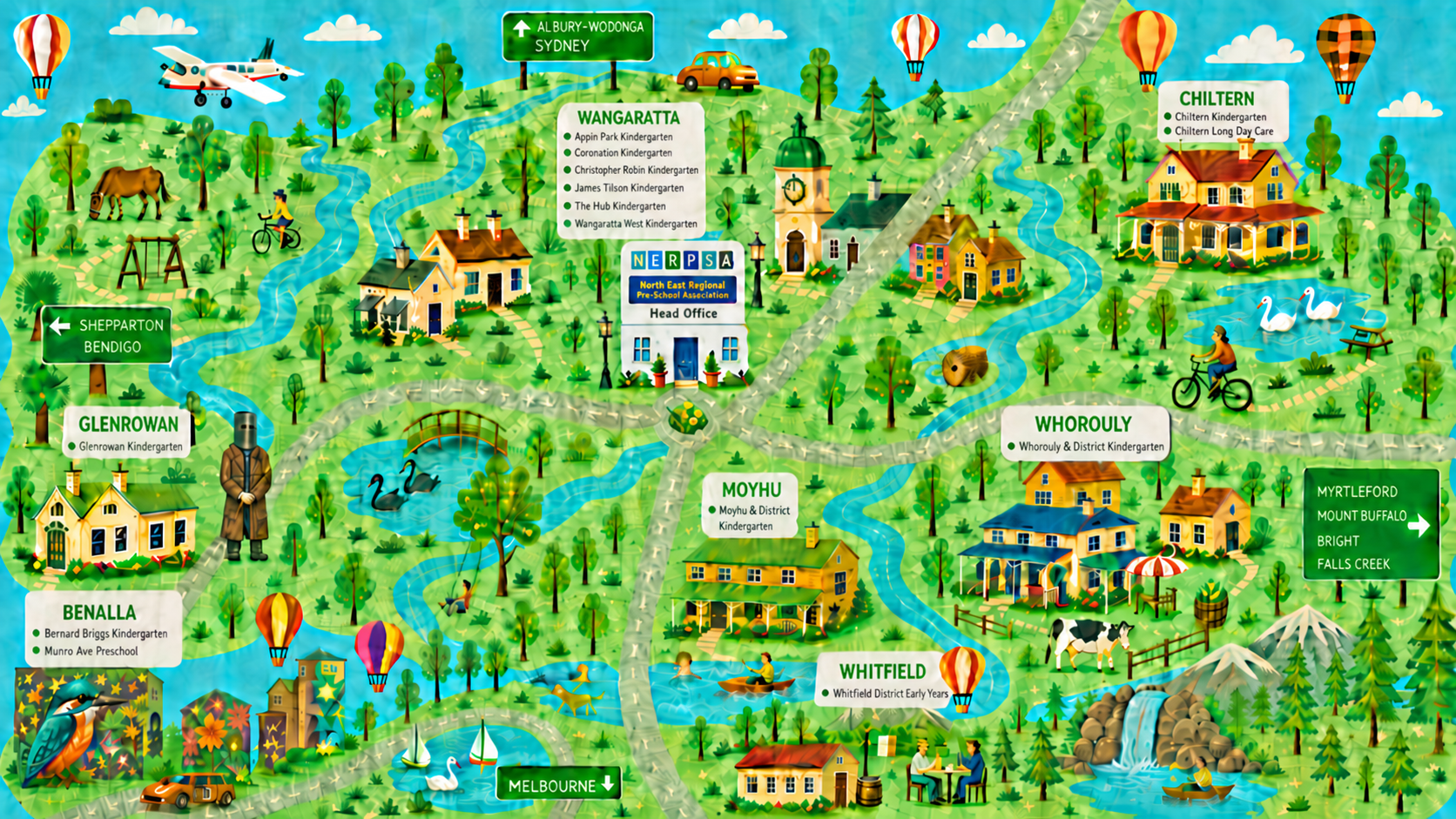
Our mission
Supporting skilled staff
Our mission is to support our skilled staff to deliver quality, inclusive, play-based education for the children in our care.
Our vision
Supporting every child
NERPSA aspires to create a nurturing environment where every child is empowered to reach their full potential.
Your role
You matter
Every employee contributes to safe, respectful, inclusive and high-quality environments for children and families.
Board and leadership
NERPSA is an Early Years Manager, approved provider and employer. NERPSA is governed by a Board and supported by organisational leadership, service leaders and staff across our services.
As the approved provider, NERPSA is responsible for governance, policy, systems, staffing, compliance and quality improvement across its services. Nominated supervisors, persons in day-to-day charge, educational leaders, teachers, educators and staff all play an important role in implementing NERPSA policies and procedures in daily practice.
Consistency and quality
Many services have a parent group or committee that supports local fundraising and maintenance.
NERPSA manages key organisational areas such as staffing, employment, salaries, policies, compliance support and program structure. This centralised approach supports consistency, quality, safety and clear expectations across services.
Our commitment to child safety
Child Safe Organisation
Safety, wellbeing, dignity and rights
As a child safe organisation, NERPSA prioritises the safety, wellbeing, dignity and rights of every child.
NERPSA has zero tolerance for child abuse, racism, discrimination, neglect, grooming, harmful conduct and unsafe practice. Children’s safety and wellbeing are central to every decision, interaction, routine and environment.
All employees are expected to understand and follow NERPSA’s child safety, conduct, privacy, supervision, staffing, digital technology and service procedures. Child safety is everyone’s responsibility.
Staff must maintain active supervision, follow educator-to-child ratio and responsible person requirements, use safe and respectful interactions, maintain professional boundaries, protect children’s privacy, and raise concerns promptly.
All staff must report and escalate child safety concerns, disclosures, suspicions of abuse or neglect, unsafe conduct, breaches of professional boundaries, or inappropriate behaviour through the correct pathway. This includes understanding mandatory reporting obligations, failure to disclose, failure to protect, the Reportable Conduct Scheme, and when concerns may need to be reported to Child Protection, Victoria Police, the Commission for Children and Young People, the Regulatory Authority, or another relevant authority.
Staff must also follow NERPSA’s requirements for records, confidentiality, information sharing and digital safety. Information about children and families must be handled carefully and shared only where authorised or required, including under child safety, Child Information Sharing Scheme, Family Violence Information Sharing Scheme, mandatory reporting, Reportable Conduct Scheme or regulatory obligations.
Photos, videos and digital information about children must only be managed in line with NERPSA policy, parent/guardian permissions, children’s rights and child safe practice. Personal devices must not be used to take photos or videos of children. Any approved exception for carrying or using a personal device must be for an authorised essential purpose and must not be used for taking images or recordings of children.
NERPSA’s work takes place on Aboriginal Country
We acknowledge the Traditional Owners and Custodians of the lands on which we work and learn, and pay our respects to Elders past and present. We recognise their continuing connection to land, water, culture, children, families and community.
NERPSA services operate across North East Victorian communities, including Chiltern, Benalla, Wangaratta, Moyhu, Whitfield and Whorouly. These communities are located across lands connected with several Aboriginal peoples and Traditional Owner groups.
This acknowledgement is part of NERPSA’s identity. It reminds us that our work with children, families and communities takes place on Country, and that cultural safety, respect, belonging and connection are part of everyday NERPSA practice.
Mission and vision in practice
Play-based learning
Why play matters
NERPSA believes that play is essential for children’s development and learning, and we are committed to providing curriculum and learning environments that are engaging, meaningful, inclusive and responsive to children’s strengths, interests and needs.
Lifelong learning
Strong foundations
By providing high-quality early childhood education and care, we aim to foster children’s cognitive, social, emotional and physical development. These formative years lay the foundation for lifelong learning, wellbeing and participation.
Through thoughtful teaching practices, engaging environments and a strong focus on individual needs, we strive to inspire a love of learning in every child.
Our values in practice
Respect
We treat all individuals with dignity and respect, regardless of their background, circumstances, culture, identity, ability or family context.
Responsiveness
We are committed to meeting the needs of children, families and staff in a timely, thoughtful and effective manner.
Integrity
We act with honesty, transparency and professionalism in all our dealings.
Impartiality
We provide fair and inclusive opportunities and services to children and families, regardless of socioeconomic status, cultural background, ability, family structure or personal circumstances.
Accountability
We are accountable to children, families, staff, communities, the approved provider, regulators and the broader early childhood education and care framework.
Leadership
We provide leadership and support to staff and services, and we work together to build safe, inclusive and high-quality learning environments.
Human rights
We are committed to upholding human rights, children’s rights, cultural safety, equity and social justice.
Our strategic goals
NERPSA’s work is guided by strategic priorities that support quality, sustainability and positive outcomes for children and families.
Every role contributes
Whether you are working directly with children, supporting a service team, leading a program, providing administration or working behind the scenes, your role helps create safe, inclusive and high-quality environments for children and families.
Welcome to the NERPSA team.
QA7 and QA4
NERPSA HQ And Key Contacts
Meet the people and contact points that support NERPSA services, staff, children and families.
Where To Find Us
NERPSA Head Office provides organisation-wide support across operations, education, staffing, payroll, finance, human resources, enrolments, policies, systems and staff support.
Street: 52 Burke Street, Wangaratta VIC 3677
Postal: PO Box 3048, Yarrunga VIC 3677
Phone: 03 5721 2755
Email: admin@nerpsa.com.au
Start With The Right Support Person
NERPSA works across multiple services, so not every question goes to the same person. Your Nominated Supervisor or Responsible Person is usually your first support at service level. Your Education Manager supports practice, service-level support, professional learning and probation matters. The Human Resources Manager supports employment, onboarding, induction, staff records and staff systems. Payroll and finance questions can be directed to the relevant finance contact.
Quick Visual Guides
Urgent Child Safety Or Supervision Concerns
If a matter involves immediate child safety, supervision, ratios, a serious incident, a disclosure, suspected abuse, unsafe conduct or concerning adult behaviour toward a child, act promptly and follow NERPSA’s child safety and reporting pathways. These matters should not wait for a routine email response. Reportable Conduct Scheme matters are notified through the Social Services Regulator.
Education Support
Your Education Manager
Your Education Manager supports your practice, wellbeing, probation, professional growth and service-level questions.
Employment Support
Human Resources Manager
The Human Resources Manager supports recruitment, onboarding, induction, probation, employment documentation, staff records, policies and staff systems.
Payroll And Finance
Pay And Records
Payroll and finance support pay enquiries, finance processes and employment-related payment matters.
Who To Contact
Use the contact details below to understand who can support you. Contact details and service allocations may be updated from time to time, so staff should also check the NERPSA App and Staff Resources website for current information.
Leigh Chadban
Manager
Leigh oversees NERPSA’s overall operations and reports to the Board. Leigh provides strategic and operational leadership across the organisation, including support for staffing, relief coordination, payroll management and service operations.
Contact Leigh for organisation-wide operational matters, leadership matters or issues requiring Manager oversight.
Jodi O’Keeffe
Education Manager
Jodi supports early childhood services and staff with pedagogy, staff wellbeing, professional development, probation, service support and compliance.
Susie Furlan
Education Manager
Susie supports early childhood services and staff with pedagogy, staff wellbeing, professional development, probation, service support and compliance.
Rebecca Lowe
Administration And Enrolment Officer
Bek supports administration, enrolments and general head office communication. Bek is often the first point of contact for families and supports the smooth running of NERPSA’s administration systems.
Contact Bek for enrolment, administration or general head office enquiries.
Angelina Cimino
Human Resources Manager
Angelina oversees a wide range of human resources functions, including recruitment, onboarding, induction, probation, employment documentation, staff records, policies and professional development systems.
Contact the Human Resources Manager for employment paperwork, induction, probation, human resources forms, staff records, policy questions or onboarding support.
Sharon Shelley
Finance Officer
Sharon supports payroll and pay-related processes.
Contact Sharon for payroll questions or pay-related enquiries.
Maria Shultz
Finance Officer
Maria supports NERPSA’s finance processes and works closely with the Manager on financial administration.
Contact Maria for finance-related enquiries as directed by NERPSA processes.
Ashraf Zaman
Finance Officer
Ashraf supports NERPSA’s finance processes and works with the finance team on financial administration.
Contact Ashraf for finance-related enquiries as directed by NERPSA processes.
Use Current Online Contact Points
Contact details, roles and service allocations may change over time. Staff should use the NERPSA App and Staff Resources website to check current information, forms and contact pathways.
If you are unsure where to direct a question, start with your Nominated Supervisor, Education Manager or Human Resources Manager and they will guide you to the right person.
Required Induction Activity
Introduce Yourself To Your Education Manager
Before moving on, check the Education Manager details above and identify which Education Manager supports the service you will be working at. Send your Education Manager a short email introducing yourself.
If you are working as relief staff across multiple services, or you are unsure which service you will mainly work at, you can email both Education Managers.
- Include your name and role.
- Let them know which service or services you will be working at, if known.
- If you are relief staff, let them know that you may be working across multiple NERPSA services.
- Share anything you are looking forward to or would like support with as you begin.
- Save or bookmark the NERPSA App and Staff Resources website so you can find current contacts and forms when needed.
Remember
Ask Early
You do not need to know who handles everything straight away. If you are unsure where to direct a question, start with your Nominated Supervisor, Education Manager or Human Resources Manager and they will guide you to the right person.
NERPSA works best when communication is clear, respectful and timely.
QA7 and QA4
NERPSA App And Staff Resources Website
Knowing where to find forms, information, links and resources so you can follow the right process and access support when needed.
The App And Website Support Different Parts Of Your Role
NERPSA uses both the NERPSA App and the Staff Resources website to help staff access information, forms, links and support.
The NERPSA App is designed for quick access to common employment and staff forms. The Staff Resources website is the more detailed place for induction information, staff documents, service resources, policies and forms that support consistent practice across NERPSA services.
Staff should understand what each resource is used for, use current online forms and ask for help if they cannot find what they need.
Use The Right Tool For The Right Task
The app helps staff quickly access everyday employment and staff forms. The Staff Resources website holds more detailed information, policies, staff documents, service forms, professional development information and resources that support consistent practice across services.
Quick Visual Guides
Some Matters Need Immediate Action
If the matter involves urgent child safety, supervision, ratios, a serious incident, suspected abuse or concerning adult conduct, do not wait while looking for a form. Follow NERPSA’s child safety and reporting pathways immediately.
App
Quick Access
Use the NERPSA App for quick access to employment and staff forms, staff links and contact information.
Website
Detailed Resources
Use the Staff Resources website for detailed induction information, staff documents, policies, forms and service resources.
Support
Ask If Unsure
If you cannot find the form, link or information you need, ask your Nominated Supervisor, Education Manager or Human Resources Manager.
NERPSA App
The App Is For Employment And Staff Forms
The NERPSA App gives staff quick access to common employment and staff forms, staff links and contact information. It is useful when you need to submit a leave form, update your availability, check a staff link, access the after-hours urgent staffing communication process or find something quickly.
The app is not intended to replace service procedures, conversations with the correct person, or the more detailed information held on the Staff Resources website.
Leave Forms
Staff can access leave forms through the app when they are unwell, need planned leave or need to record leave information.
Availability Forms
If your availability changes, complete a new Availability Form so NERPSA can update information used for staffing and relief.
After-Hours Contact
The app includes the “Call After Hours Only” process for urgent staffing communication outside usual contact times.
Employment-Related Links
The app provides quick access to key staff links that support day-to-day employment processes.
Staff Resources Website
The Staff Resources Website Is The Detailed Reference Point
The Staff Resources website is where staff can access detailed staff information, induction content, forms, policies, position descriptions, staff policies, the Staff Handbook, professional development information, NERPSA and Department of Education information and service support resources.
Staff should use the current online version of forms, documents and resources rather than saved, printed or old copies.
Forms
The Forms area includes forms used for staff and service processes, including forms linked to employment, service work, exemptions and other NERPSA processes.
Staff Handbook
The Staff Handbook is located under the NERPSA and Department of Education information area and should be read during induction.
Position Descriptions And Staff Policies
Staff can locate current Position Descriptions and staff policy information on the Staff Resources website.
Professional Development Plan
Professional Development Plan information is available for staff to use after probation and as part of ongoing professional growth.
NERPSA And Department Of Education Information
This area includes key NERPSA and Department of Education information, including documents such as the Staff Handbook and relevant award or agreement information.
Service Resources
The website supports staff with detailed resources and forms that may be used for service work, documentation, communication and practice.
Which One Should You Use?
You Need Quick Access
Use the NERPSA App when you need quick access to employment and staff forms, staff links or contact information.
This may include leave, availability, quick staff links, after-hours urgent staffing communication or a staff form you need to submit while on the go.
You Need Detail
Use the Staff Resources website when you need detailed induction information, staff documents, forms for service work, policy links, staff policies, position descriptions, professional development information or NERPSA and Department of Education information.
Common Staff Actions
Submitting Leave
Use the NERPSA App or Staff Resources website to submit the Leave Application Form. A conversation, text message or phone call does not replace the form.
Updating Availability
If your circumstances change, complete a new Availability Form so NERPSA has current information for staffing and relief.
Finding Policies And Staff Documents
Use the Staff Resources website and NERPSA policy page to locate current policies, the Staff Handbook, Position Descriptions and related staff information.
Completing An Exemption Form
For matters such as a personal device exemption, access the NERPSA App or Staff Resources website under Forms and follow the relevant exemption process. Do not use a personal device under an exemption unless it has been approved.
Professional Responsibility
Use Current Forms And Resources
Staff should use current NERPSA online forms, links and resources rather than saved, printed or old copies. If you cannot find the right form or information, ask for help before using an old version or making your own process.
Current Access Points
These are the main online access points for NERPSA staff resources, staff forms and NERPSA service policies.
Use the current online version when you need to locate a form, policy, document or staff resource.
Required Induction Activity
Find A Form And A Policy
Before moving on, use the current online resources to locate the information below. You do not need to submit any forms as part of this activity.
- Locate where you would access a Leave Application Form or Availability Form.
- Locate where you would find the Staff Handbook or Position Descriptions area.
- Open the NERPSA service policies page and locate one policy that is relevant to your role.
- Notice where you would go to find an exemption form, such as a personal device exemption form.
- If you cannot locate a current document, ask your Nominated Supervisor, Education Manager or Human Resources Manager for guidance.
Key Message
The App Is Quick Access. The Website Is The Detailed Reference Point.
Knowing where to find the right form, policy or information helps staff follow the correct process and work consistently across NERPSA services.
The right resource helps you follow the right process.
QA2, QA5, QA6 And QA7
Child Safe Standards
Understanding the Victorian Child Safe Standards and how they shape child safe culture, everyday practice and NERPSA responsibilities.
Child Safety Is Everyone’s Responsibility
The Victorian Child Safe Standards set out the minimum requirements organisations need to meet to help keep children safe. They support a culture where children are respected, listened to, included and protected from harm.
At NERPSA, the Child Safe Standards connect directly with daily practice, including supervision, respectful relationships, reporting concerns, recruitment, staff conduct, inclusion, cultural safety, privacy, documentation, complaints and continuous improvement.
NERPSA has zero tolerance for child abuse, racism, discrimination, neglect, grooming, harmful conduct and unsafe practice. Child safe practice is not separate from education and care. It is part of how staff speak with children, support families, work with colleagues, notice risks, respond to concerns and make decisions every day.
Child Safety Is Built Through Everyday Actions
At NERPSA, child safe practice is seen in how staff welcome children, listen to their voices, support cultural safety, maintain supervision, follow policies, protect privacy, report concerns, challenge unsafe behaviour and keep children’s wellbeing at the centre of decisions.
Concerns about child safety, harm, unsafe practice or adult behaviour toward a child must be raised through NERPSA’s reporting pathway. Detailed reporting steps, including Reportable Conduct Scheme requirements and Social Services Regulator notification requirements, are covered in the next induction section.
Culture
Safety Is Visible
Child safety should be visible in leadership, decisions, policies, communication and daily practice.
Voice
Children Are Heard
Children’s views, comfort, worries, choices and concerns are taken seriously.
Action
Concerns Are Reported
Staff speak up early when something does not feel right or a child may be at risk.
The 11 Victorian Child Safe Standards
Cultural Safety For Aboriginal Children
Organisations establish a culturally safe environment where Aboriginal children’s identities, culture, rights, connections and experiences are respected and valued.
Child Safety And Wellbeing Is Embedded In Leadership And Governance
Child safety is part of leadership, governance, organisational culture, policies, procedures, decision-making and accountability.
Children And Young People Are Empowered
Children are informed about their rights, participate in decisions affecting them, and are taken seriously when they raise concerns.
Families And Communities Are Informed And Involved
Families and communities are engaged in promoting child safety and wellbeing, and information is shared in ways that support participation and understanding.
Equity Is Upheld And Diverse Needs Are Respected
Children’s diverse circumstances, cultures, identities, abilities and needs are recognised and supported so every child can participate and feel safe.
People Working With Children Are Suitable And Supported
Recruitment, screening, supervision, induction, training and ongoing support help ensure staff and volunteers are suitable and understand child safety expectations.
Complaints And Concerns Are Child Focused
Processes for complaints and concerns are accessible, responsive, child focused, understood and used to keep children safe.
Staff And Volunteers Are Equipped With Knowledge And Skills
Staff and volunteers receive information, training and support to keep children safe, identify harm, report concerns and support child safe practice.
Physical And Online Environments Promote Safety
Physical and online environments are managed to promote safety and wellbeing while allowing children to participate, learn and connect.
Implementation Is Reviewed And Improved
Child safe policies, procedures and practices are regularly reviewed, improved and informed by children, families, staff, incidents and feedback.
Policies And Procedures Document Child Safety
Policies and procedures explain how the organisation keeps children safe and how staff, volunteers and others are expected to act.
What The Standards Look Like In NERPSA Services
Children Are Listened To
Staff notice children’s words, body language, behaviour, choices, distress, comfort and concerns, and respond respectfully.
Child Safety Concerns Are Reported
Staff report concerns early, follow NERPSA’s reporting pathway, document concerns as required, and do not wait for proof before speaking up.
Cultural Safety Is Embedded
Aboriginal cultures, identities, rights and connections are respected and embedded in practice, not treated as tokenistic or one-off.
Inclusion Is Active
Children’s cultures, languages, abilities, identities, families and needs are recognised and supported in daily practice.
Supervision Is Active
Staff position themselves well, scan, communicate, anticipate risk and work together so children are supervised safely.
Professional Boundaries Are Clear
Staff follow the Code of Conduct and maintain respectful, safe and professional relationships with children, families and colleagues.
Privacy Is Protected
Children’s photos, records, personal information, medical information and family information are protected and used appropriately.
Complaints Are Taken Seriously
Complaints, concerns, feedback and disclosures are responded to respectfully, documented and escalated where required.
How Staff Contribute To Child Safe Culture
Child Safety Is Shown In Small Decisions
Child safe culture is built through everyday actions. This includes how staff supervise, respond to children, follow routines, support privacy, report concerns, use respectful language, communicate with families and support children’s rights.
Staff should pause and seek guidance when something does not feel right, when a child is distressed, when behaviour crosses a boundary, or when a process is unclear.
Do Not Rely On Assumptions
Child safe practice means using policies, reporting pathways, supervision, documentation and support rather than relying on assumptions, personal preference, memory, gossip or informal arrangements.
Child Safety Links With Other Induction Sections
Reporting Harm
Staff need to know how to raise child safety concerns, disclosures, risk of harm, mandatory reporting concerns and reportable conduct concerns through NERPSA’s reporting pathway. The detailed pathway is covered in the next induction section.
Supervision And Ratios
Active supervision and correct staffing arrangements are central to keeping children safe.
Digital Technology And Privacy
Photos, devices, online environments and confidential information need to be managed safely and professionally.
Personal Care
Toileting, changing, sleep, rest and personal care routines need to protect children’s dignity, privacy and safety.
Inclusion And Cultural Safety
Child safety includes cultural safety, inclusion, equity, belonging, participation and respect for every child.
Policies And Procedures
NERPSA policies explain expectations, responsibilities, reporting pathways and the actions staff need to take.
Professional Responsibility
Child Safety Requires Action, Not Just Awareness
Staff support the Child Safe Standards by noticing concerns, listening to children, reporting early, following policies, maintaining professional boundaries, protecting privacy, supporting inclusion and asking for guidance when something is unclear.
Key Policies And Resources
Use Current Child Safe Policies And Resources
Staff should use current NERPSA policies, service procedures, staff resources and official Victorian Child Safe Standards information when checking child safety expectations.
The Commission for Children and Young People remains a useful source of Child Safe Standards information. Reportable Conduct Scheme notifications are now managed through the Social Services Regulator and are covered in the next induction section.
Use current online policy and resource locations rather than saved, printed or old copies.
Required Induction Activity
Connect The Standards To Your Practice
Before moving on, connect the Child Safe Standards to your everyday role. This activity builds on earlier resource-finding tasks and does not require a form to be submitted.
- Choose three everyday actions in your role that support child safety, such as active supervision, listening to children, protecting privacy, supporting cultural safety or raising concerns early.
- Identify one example of behaviour, practice or a situation that you would raise through NERPSA’s reporting pathway.
- Check that you understand the difference between child safe culture, child safe practice and formal reporting pathways.
- Continue to the next induction section for the reporting pathway for harm, child safety concerns and reportable conduct.
Key Message
Child Safety Is Built Into Everything We Do
The Child Safe Standards guide how NERPSA creates safe, inclusive, respectful and responsive services where children are protected, heard and valued.
Child safe culture is built through everyday decisions, respectful practice and speaking up early.
QA2, QA5, QA6 And QA7
Reporting Harm, Child Safety Concerns And Reportable Conduct
Knowing what to do when a child may be at risk, when something does not feel right, or when adult conduct needs to be reported.
Child Safety Concerns Are Taken Seriously
Every staff member has a role in protecting children from harm. Concerns may relate to abuse, neglect, family violence, sexual abuse, physical harm, emotional harm, grooming, unsafe behaviour, inappropriate conduct, disclosure, risk of harm, supervision, ratios, serious incidents or anything that makes a child’s safety or wellbeing uncertain.
Staff must follow NERPSA policies, child safe processes, mandatory reporting obligations, service procedures and directions from the approved provider, person with management or control, Nominated Supervisor, Responsible Person, person in day-to-day charge, Education Manager, Human Resources Manager, NERPSA Manager / Head of NERPSA or relevant approved provider representative.
If you are worried about a child, speak up early. You do not need to investigate or prove that harm has occurred before reporting a concern. Internal reporting does not remove any personal legal obligation to report to Child Protection or Victoria Police where that obligation applies.
Reporting Is Part Of Protecting Children
At NERPSA, child safety concerns are not kept quiet, managed informally or left for someone else to notice. Staff report concerns early, follow NERPSA’s child safety reporting pathway, document what is required and seek support so children are protected and responsibilities are met.
Notice
Be Alert
Notice signs, disclosures, behaviour changes, injuries, patterns, unsafe conduct or anything that raises concern.
Report
Speak Up Early
Report concerns immediately through NERPSA’s child safety reporting pathway. Do not wait for certainty.
Record
Document Carefully
Record facts, observations, disclosures and actions using the documentation process in NERPSA’s Child Safe Environment and Wellbeing Policy.
If A Child Is In Immediate Danger, Call 000
If a child is in immediate danger, needs urgent medical help, is at immediate risk of serious harm, or police, ambulance or emergency services are needed, call 000.
After immediate safety has been addressed, follow the NERPSA reporting and notification process as soon as possible.
What Might Raise A Child Safety Concern
A Child Says Something Worrying
A child may disclose harm directly, indirectly, through play, behaviour, drawings, comments or changes in how they respond to adults or situations.
Unexplained Injuries Or Patterns
Injuries, marks, bruising, repeated incidents, delayed explanations or explanations that do not seem to fit may need to be reported.
Changes In Behaviour
Sudden withdrawal, fear, aggression, sexualised behaviour, regression, distress, anxiety, tiredness, hunger or changes in toileting may be signs of concern.
Neglect Or Unmet Needs
Concerns may relate to supervision, hygiene, medical care, food, clothing, emotional care, safety, attendance patterns or failure to meet a child’s basic needs.
Family Violence Or Unsafe Home Circumstances
Children may be affected by family violence, threats, unsafe adults, substance misuse, mental health concerns, homelessness or unsafe living arrangements.
Unsafe Adult Behaviour
Concerns may relate to staff, volunteers, students, contractors, agency staff, relief staff, family members, visitors or other adults behaving in ways that are unsafe, inappropriate or boundary-crossing.
If A Child Tells You Something Worrying
Listen Calmly
Stay calm, listen carefully and let the child speak in their own words. Reassure them that they have done the right thing by telling you.
Do Not Investigate
Do not ask leading questions, make promises to keep secrets, confront anyone or try to investigate what happened.
Report Immediately
Report the concern immediately through NERPSA’s child safety reporting pathway, including notifying the approved provider or person with management or control and following the reporting process in the Child Safe Environment and Wellbeing Policy.
Record The Facts
Record what was said, what was observed, who was present, the date and time, and what action was taken. Use the child’s own words where possible and follow the documentation process in the Child Safe Environment and Wellbeing Policy.
Reporting Pathways
Concerns About Abuse, Neglect Or Risk Of Harm
If there is a concern that a child may be experiencing abuse, neglect, family violence or significant risk of harm, staff follow mandatory reporting, child safe and NERPSA reporting processes.
Staff must report immediately through NERPSA’s child safety reporting pathway. Mandatory reporters may also have a personal legal obligation to report to Child Protection. All adults may also have obligations to report information about child sexual abuse to Victoria Police where required.
Concerns About Worker, Volunteer Or Adult Conduct
Concerns about staff, volunteers, students, contractors, agency staff, relief staff or other adults connected with the service may need to be managed under the Reportable Conduct Scheme. Report these concerns through NERPSA’s child safety reporting pathway immediately so the correct internal action, external notification and investigation process can occur.
Reportable Conduct
Adult Conduct Concerns Need To Be Escalated Quickly
Reportable conduct may include allegations involving sexual offences, sexual misconduct, physical violence, behaviour that causes significant emotional or psychological harm, significant neglect, grooming or other child-related misconduct.
Concerns about staff, volunteers, students, contractors, agency staff, relief staff or other adults connected with the service must be reported through NERPSA’s child safety reporting pathway as soon as possible. Staff do not decide alone whether something meets the reportable conduct threshold.
For NERPSA, the head of organisation for Reportable Conduct Scheme purposes is Leigh Chadban, Manager / Head of NERPSA. NERPSA must notify the Social Services Regulator within three business days of the head of organisation becoming aware of a reportable allegation.
Education Managers may submit the Social Services Regulator notification webform as authorised representatives where this has been delegated by the Manager / Head of NERPSA.
NERPSA must also provide further detailed information to the Social Services Regulator within 30 calendar days, including information about the allegation, actions taken and the response of the worker or volunteer.
If the matter involves family violence, immediate safety concerns or potentially criminal conduct, Victoria Police must be contacted. If police involvement is required, NERPSA must not commence its own investigation until Victoria Police have provided clearance.
Social Services Regulator Notification
Reportable Conduct Scheme Notifications Go To The Social Services Regulator
Reportable Conduct Scheme notifications are made to the Social Services Regulator using the online notification webform.
The webform must be completed in one session and cannot be saved for later. The person completing the form should gather the necessary information before starting.
If NERPSA requires a copy of the notification, it should be printed before the notification is submitted.
Members of the public can also notify the Social Services Regulator about allegations of reportable conduct.
Staff must still follow NERPSA’s internal reporting pathway immediately. The Social Services Regulator notification process is managed by the head of organisation or authorised representative.
VECRA / Regulatory Authority Notification
Some Matters May Also Need Regulatory Notification
Some child safety concerns, serious incidents, allegations, complaints or circumstances that pose a risk to children may also require notification to the Victorian Early Childhood Regulatory Authority, also referred to as VECRA or the Regulatory Authority.
Notifications to VECRA / the Regulatory Authority are managed through the appropriate approved provider process, including the National Quality Agenda IT System where required. Staff must report concerns promptly through NERPSA’s child safety reporting pathway so these obligations can be assessed and met.
What Staff Should Do When Concerned
Act On The Concern
If something does not feel right, take it seriously. A concern, disclosure, pattern or unsafe behaviour should be reported.
Follow NERPSA’s Child Safety Reporting Pathway
Notify the approved provider or person with management or control immediately and follow the reporting process in the Child Safe Environment and Wellbeing Policy.
Use The Correct Reporting Process
Follow the NERPSA and service process for child safety concerns, mandatory reporting, reportable conduct, incidents, complaints, serious incidents and regulatory notifications as required.
Keep Information Confidential
Share information only with people who need it for child safety, reporting, investigation, regulatory, legal or support purposes. Avoid gossip or informal discussion.
You Do Not Need Proof To Raise A Concern
Staff are not expected to investigate, prove harm or decide whether an allegation is true. Staff are expected to notice concerns, report them, document appropriately and follow the correct pathway.
Secrecy Is Not Child Safe
Child safety concerns should not be kept private between staff, managed as personal issues, or delayed because the conversation is uncomfortable. Reporting protects children and supports proper process.
Professional Responsibility
Speak Up, Record Facts And Seek Support
If you are worried about a child, an adult’s behaviour or something that has happened at the service, speak up early. Report through NERPSA’s child safety reporting pathway, record factual information using the documentation process in the Child Safe Environment and Wellbeing Policy, and seek guidance from the appropriate NERPSA contact.
Key Policies And Resources
Use Current Child Safety And Reporting Information
Staff should use current NERPSA policies, service procedures, staff resources and official reporting guidance when checking child safety, mandatory reporting, reportable conduct, complaints, incidents and serious incident requirements.
Child safety concern documentation is not completed through the NERPSA App or Staff Resources website. Staff must use the documentation processes and templates attached to the Child Safe Environment and Wellbeing Policy.
Use current online policy and resource locations rather than saved, printed or old copies.
Required Induction Activity
Know Your First Response
Before moving on, check that you can clearly explain your first response if you are worried about a child, receive a disclosure, notice unsafe adult behaviour or become aware of possible reportable conduct.
- Immediate danger or urgent risk requires 000.
- Child safety concerns must be reported immediately through NERPSA’s child safety reporting pathway.
- You do not need proof before raising a concern.
- Do not investigate, ask leading questions, confront anyone or promise secrecy.
- Record factual information using the correct Child Safe Environment and Wellbeing Policy process.
- Reportable conduct concerns must be escalated quickly so NERPSA can meet Social Services Regulator requirements.
Key Message
If You Are Worried, Report It
Reporting early helps protect children, support staff, meet legal obligations and ensure concerns are managed through the correct process.
Child safety depends on adults noticing, speaking up and acting early.
QA2, QA4 And QA7
Supervision, Ratios And Responsible Person
Understanding active supervision, educator-to-child ratios, staffing responsibilities and who is responsible for the service at any given time.
Supervision Is One Of The Most Important Child Safety Responsibilities
Supervision is a legal and child safety responsibility. It is more than being physically present. It means actively knowing where children are, what they are doing, what risks are present and what support is needed.
Staff follow NERPSA policies, service procedures, educator-to-child ratio requirements, risk assessments and directions from the Nominated Supervisor, Responsible Person, person in day-to-day charge, Education Manager, NERPSA Manager or approved provider representative.
Effective supervision protects children’s safety, supports learning and play, helps staff respond early to risk, and contributes to a calm and professional service environment.
Supervision Relies On Teamwork And Respect
At NERPSA, supervision is not just an individual task. It relies on team communication, trust, role clarity, respectful handovers, professional awareness and staff working together. Strong supervision is supported by team cohesion, respect and shared responsibility.
See
Position Yourself Well
Be where you can see children, scan the environment and respond quickly when support is needed.
Know
Know The Children
Know each child’s needs, abilities, risks, interests, routines, medical needs and supervision requirements.
Communicate
Work As A Team
Use clear communication, handovers and shared awareness so supervision is continuous.
What Active Supervision Looks Like
Positioning
Position yourself where you can see, hear and respond. Avoid standing where your view is blocked or where children are out of sight.
Scanning
Regularly scan the whole environment, not just the child or group closest to you.
Listening
Listen for changes in tone, silence, distress, conflict, unsafe play, calls for help or signs that children need support.
Counting And Knowing
Know how many children are present, where they are and who is responsible for each area or group.
Anticipating Risk
Think ahead about what could happen next, especially during transitions, outdoor play, toileting, excursions, meal times and busy periods.
Engaging With Children
Supervision includes meaningful engagement, guidance, support, co-regulation and being available to children.
Communicating With Colleagues
Tell others when you are moving away, taking a child inside, changing supervision zones or noticing a risk.
Adjusting To Risk
Increase supervision when children, environments, routines, weather, behaviour, medical needs or transitions create higher risk.
Ratios And Staffing Arrangements
Ratios Support Safe Supervision, But They Do Not Replace Active Supervision
Educator-to-child ratios set the minimum staffing requirement for the number and age of children being educated and cared for. Ratios help services plan staffing and maintain safe service operation.
Ratios are minimum legal staffing requirements. Meeting ratio does not automatically mean children are adequately supervised. Staff still need to position themselves well, communicate clearly, scan the environment, understand risk and respond to children’s needs.
If you are unsure whether the service is meeting ratio, or whether supervision is adequate for the activity or environment, speak with the Responsible Person, Nominated Supervisor, person in day-to-day charge, Education Manager, NERPSA Manager or approved provider representative immediately.
Ratios Are Minimum Requirements
Some situations need more supervision than the minimum ratio. Higher-risk activities, transitions, excursions, water play, toileting, medical needs, behaviour support, unfamiliar spaces or mixed-age groups may require closer supervision.
Communication Protects Children
Ratios and supervision can be affected when staff move between areas, take breaks, support individual children, speak with families or manage unexpected events. Tell the right person before you move away from a supervision area.
Responsible Person And Day-To-Day Responsibility
Responsible Person
A Responsible Person is present when the service is educating and caring for children. Staff should know who the Responsible Person is during each session or part of the day.
Nominated Supervisor
The Nominated Supervisor has a formal role in supporting service operation, compliance, supervision, safety, communication and implementation of policies and procedures.
Person In Day-To-Day Charge
At times, a person may be placed in day-to-day charge according to service requirements and NERPSA processes.
Staff Responsibility
All staff contribute to supervision and child safety, even when they are not the Responsible Person or Nominated Supervisor.
Supervision During Higher-Risk Times
Transitions
Arrival, departure, pack-up, moving indoors or outdoors, bathroom routines and group changes require clear communication and awareness of where children are.
Outdoor Play
Outdoor play needs active positioning, scanning, risk awareness, attention to equipment, boundaries, weather, gates, blind spots and children’s play choices.
Toileting And Personal Care
Toileting, changing and personal care routines require dignity, privacy, child safe practice and careful supervision of the wider group.
Meal Times
Meal times require awareness of allergies, choking risks, food sharing, seating, supervision and children who may need additional support.
Excursions And Service Events
Excursions and events require risk assessment, clear roles, head counts, family communication, authorisations and close supervision.
Relief And Casual Staffing
Relief and casual staff must ask about supervision arrangements at each service they attend, because arrangements may differ between services.
If Supervision Or Ratio Is A Concern
Speak Up Immediately
If you notice a supervision gap, ratio concern, blind spot, unsafe transition or unclear responsibility, tell the Responsible Person, Nominated Supervisor or person in day-to-day charge straight away.
Support Immediate Safety
Take reasonable steps to support children’s safety while also communicating with the team. This may include repositioning, calling for another staff member, pausing an activity or moving children away from risk.
Follow The Service Process
Follow the service process for reporting supervision concerns, ratio concerns, incidents, near misses, hazards, complaints or serious incidents.
Escalate If The Concern Is Not Resolved
If the concern is not resolved immediately, or if children’s safety may remain at risk, escalate to the Education Manager, NERPSA Manager or approved provider representative.
Some Supervision Concerns Are Also Child Safety Concerns
If a supervision or ratio concern involves actual or possible harm, unsafe adult conduct, neglect, a serious incident, or a failure to protect children, staff must also follow NERPSA’s child safety reporting pathway.
Professional Responsibility
Supervision Is Shared, Active And Professional
Staff should communicate clearly, maintain awareness, respect each other’s roles, support team cohesion and speak up early when supervision or ratio concerns arise. Effective supervision depends on professionalism, respect, trust and shared responsibility.
Key Policies And Resources
Use Current Supervision, Ratio And Staffing Information
Staff should use current NERPSA policies, service procedures, staff resources and official guidance when checking supervision, ratio, staffing and Responsible Person requirements.
Use current online policy and resource locations rather than saved, printed or old copies.
Required Induction Activity
Check Your Service Supervision Arrangements
Before moving on, connect this section to the service or services where you will work. This is not a repeat of the earlier resource-finding activity; it is about knowing the practical arrangements in place at the service.
- Identify who the Responsible Person is during a session or part of the day.
- Ask about supervision zones, blind spots, gates, bathrooms, outdoor areas and higher-risk areas at your service.
- Check how staff communicate before moving away from a supervision area, taking a child inside or taking a break.
- If you are casual or relief staff, ask about the supervision arrangements each time you attend a different service.
- Know who to tell immediately if you notice a supervision gap, ratio concern, unsafe transition or unclear responsibility.
Key Message
Active Supervision Protects Children
Strong supervision depends on positioning, scanning, communication, ratios, teamwork and speaking up early when something does not feel safe.
Supervision is child safety, teamwork and professional awareness in action.
QA2, QA5 and QA7
Personal Care, Toileting, Changing, Sleep and Rest
Supporting children’s dignity, privacy, safety and wellbeing during personal care routines.
Personal care is part of respectful, safe and responsive practice
Personal care routines include toileting, nappy changing, changing clothes, supporting hygiene, managing accidents, sleep, rest and other care routines where children need adult support.
These routines must protect children’s dignity, privacy, safety, hygiene, comfort, agency and wellbeing. Staff must consider each child’s age, development, needs, culture, communication, family information and level of independence.
Staff follow NERPSA policies, organisation-wide procedures, service handover information, child safe expectations, supervision requirements, hygiene and infection control practices, sleep and rest requirements, privacy expectations, and directions from the Nominated Supervisor, Responsible Person, person in day-to-day charge, Education Manager, NERPSA Manager or approved provider representative.
Care routines are relationship moments
At NERPSA, personal care is not treated as a task to rush through. These moments are opportunities to support children’s trust, dignity, communication, independence, hygiene, safety and sense of belonging.
Dignity
Respect the child
Use respectful language, explain what is happening and support privacy during care routines.
Safety
Follow procedure
Use approved processes for toileting, changing, hygiene, sleep, rest, supervision and documentation.
Support
Ask if unsure
If you are unsure what support a child needs or what you are authorised to do, pause and ask.
What respectful personal care looks like
Use respectful language
Speak calmly and respectfully. Avoid shaming, teasing, rushing or making comments that could embarrass a child.
Explain what is happening
Tell the child what you are doing in simple, age-appropriate language and support their participation where possible.
Support privacy and dignity
Use spaces, routines and communication that protect privacy while still maintaining appropriate supervision and safety.
Encourage independence
Support children to do what they can safely do for themselves, including handwashing, dressing, toileting steps and rest routines.
Use hygiene practices
Follow hand hygiene, cleaning, PPE, disposal, laundry and infection control procedures.
Notice signs of distress
If a child is upset, uncomfortable, withdrawn, injured, sore, unusually anxious or resistant during care routines, report this promptly.
Toileting, nappy changing and changing clothes
Use the approved procedure every time
Toileting, nappy changing and clothing changes are completed using NERPSA’s organisation-wide procedure and the practical arrangements used at the service. Staff should know where children’s spare clothing, hygiene supplies, cleaning materials, disposal systems, gloves and documentation are located.
Children should be supported in a way that protects their dignity, gives them as much independence as possible and respects their privacy while maintaining safety and supervision.
Clothing changes are handled calmly and respectfully. If clothing is wet, soiled, unsafe, uncomfortable or unsuitable for the weather or activity, follow the approved procedure and support the child to change in a safe and dignified way.
Check the procedure
Know the procedure for toileting, nappy changing, clothing changes, hygiene, cleaning and documentation.
Prepare the space
Have the required supplies ready, maintain supervision, protect privacy and follow hygiene and infection control practices.
Support the child respectfully
Use calm language, explain what is happening, encourage independence and respond to the child’s cues or discomfort.
Clean, document and report concerns
Follow cleaning, disposal, laundry and documentation processes. Report any injury, rash, soreness, distress, unusual behaviour or concern.
Sleep and rest
Follow the sleep and rest procedure
Know how sleep and rest routines are managed, including supervision, sleep checks, documentation, bedding, positioning and individual child needs.
Consider each child’s needs
Sleep and rest arrangements must consider the child’s age, developmental stage, health, comfort, family information, daily needs and individual circumstances.
Maintain active supervision
Sleep and rest routines require active supervision, including awareness of children’s breathing, colour, temperature, positioning, airway, comfort and wellbeing.
Use safe sleep practices
Follow the procedure and current safe sleep guidance for safe sleep environments, bedding, positioning, checks and responding to concerns.
Communicate with families
Family information helps staff understand routines, comfort needs and expectations, while still following NERPSA policy, service procedure and safe sleep requirements.
Respond immediately to concerns
If a child is breathing unusually, hard to wake, distressed, pale, hot, cold, vomiting, unwell, injured or not themselves, seek help immediately and follow the service process.
Students and volunteers
Students and volunteers can support non-intimate routines
Students and volunteers may support routines such as helping children find belongings, supporting handwashing, encouraging independence, preparing resources, comforting children, tidying spaces and supporting transitions under staff direction.
They may observe personal care routines only where this is appropriate, authorised, respectful, required for learning, and closely supervised by a NERPSA employee.
Students and volunteers do not undertake intimate care
Students and volunteers must not undertake toileting, nappy changing, changing children’s clothing, sleep checks, medication, medical responses or intimate personal care.
The only exceptions are where the person is working as a paid NERPSA employee and is in ratio at that time, or where a specific training or assessment requirement has been approved and is closely supervised by a NERPSA employee for that requirement.
Personal care boundaries need to be clear
Students and volunteers should ask the Nominated Supervisor, Responsible Person, supervising educator or person in day-to-day charge what they can and cannot do before supporting any personal care routine.
Staff are responsible for making sure students and volunteers understand expectations, supervision arrangements, privacy, dignity and child safe practice.
If something does not feel right
Notice the concern
Concerns may include injury, soreness, distress, fear, unexplained marks, unusual behaviour, hygiene issues, unsafe practice, privacy concerns or a child disclosing something worrying.
Respond calmly
Support the child calmly and respectfully. Do not ignore, dismiss, shame or question the child in a way that could cause distress.
Report immediately
Report concerns to the Nominated Supervisor, Responsible Person, person in day-to-day charge, Education Manager, NERPSA Manager or approved provider representative.
Document as required
Follow the correct NERPSA and service process for incident, injury, illness, child safe, wellbeing or reporting documentation.
Some personal care concerns are also child safety concerns
If a personal care, toileting, changing, sleep or rest concern involves possible harm, unsafe adult conduct, a boundary concern, significant neglect, disclosure, injury or a child safety concern, staff must follow NERPSA’s child safety reporting pathway immediately.
Professional Responsibility
Personal care should protect dignity and safety
Staff should approach personal care routines with respect, calm communication, child safe awareness, hygiene, privacy and active supervision. If a child is distressed, uncomfortable, injured, unwell or something does not feel right, seek support immediately.
Key policies and resources
Use current personal care, child safe and health information
Staff should use current NERPSA policies, staff resources and service procedures when checking expectations about personal care, toileting, changing, sleep, rest, hygiene, supervision, child safety and reporting.
Use current online policy and resource locations rather than saved, printed or old copies.
NERPSA service policies: Open NERPSA Service Policies
Staff Resources website: Open Staff Resources
ACECQA — sleep and rest policy guidance: Open sleep and rest guidance
ACECQA — toileting and nappy changing guidance: Open toileting and nappy changing guidance
Required induction activity
Know the personal care procedures at your service
Before moving on, make sure you know how personal care, toileting, changing, sleep and rest are managed at the service or services where you will work.
- Know where the organisation-wide personal care, toileting, changing, sleep and rest procedures are located.
- Know how your service manages practical handover for toileting, changing, hygiene, sleep, rest, supplies and documentation.
- If you are casual or relief staff, ask about personal care and sleep/rest arrangements at each service you attend.
- Know that students and volunteers must not undertake intimate personal care unless one of the approved exceptions applies.
- Know what to do if a child is distressed, injured, unwell, uncomfortable or showing signs of concern during personal care.
- Know where to find NERPSA policies for child safe practice, supervision, incident/injury/trauma/illness, privacy, hygiene, sleep and rest.
Key message
Dignity, privacy, hygiene and supervision matter
Personal care routines are child safe practice in action. They should be calm, respectful, hygienic, supervised and responsive to each child.
Respectful care helps children feel safe, capable and valued.
QA2, QA5 and QA7
Digital Technology, Phones, Photos and Confidentiality
Using technology safely, protecting children’s privacy and following NERPSA expectations for photos, devices, records and confidential information.
Technology needs to be used carefully and professionally
Digital technology can support communication, documentation, learning, administration and service operation. It also creates risks if personal information, photos, records or confidential service information are accessed, stored, shared or used incorrectly.
Staff follow NERPSA policies, privacy and confidentiality requirements, service procedures, family authorisations and any directions given by the Nominated Supervisor, Responsible Person, person in day-to-day charge, Education Manager or Human Resources Manager.
The key principle is simple: protect children, protect privacy, use approved service devices and systems, and check before using technology in a way that is unclear.
Digital safety is part of child safe practice
At NERPSA, digital practice is not just about phones or photos. It is about protecting children’s images, records, stories, locations, family information, staff information and service information. Staff use approved service devices and approved systems and keep children’s privacy and safety at the centre.
Protect
Privacy first
Children’s images, information, records and family details are handled carefully and confidentially.
Use
Approved systems
Use NERPSA-approved service devices, apps, records and communication processes for service work.
Check
Check first
If you are unsure whether a photo, device, app, record or message is appropriate, pause and check with the Nominated Supervisor, Responsible Person/person in day-to-day charge, Education Manager or Human Resources Manager before acting.
Personal devices and phones
Personal devices are kept away from children and service information
Personal phones, smart watches, tablets, cameras and other personal devices are not used for taking photos or videos of children, recording children’s information, documenting learning, communicating with families about service matters, storing service records or accessing confidential information.
Personal devices must be stored away from children during work time and must not affect supervision, professional responsibilities, child safety, privacy or confidentiality.
A personal device exemption is only for limited personal or essential purposes, such as health monitoring, required family alerts, disability-related communication needs, local emergency notifications, or making an emergency call where needed. Approval will not be given for a personal device to take photos or videos of children, record children, document learning, store service information, communicate with families about service matters, or otherwise replace an approved service device or approved service system.
Use service systems
Use approved NERPSA or service systems for documentation, communication, records, photos and service information.
Store devices away from children
Personal devices must be stored away from children during work time and must not be used around children unless a limited personal or essential-purpose exemption has been approved.
Protect supervision
Personal device use must not distract from active supervision, engagement with children or staff responsibilities.
Use the exemption form if needed
If a personal device exemption is needed for a limited personal or essential purpose, follow the exemption process through the NERPSA App or Staff Resources website under Forms. The device must not be used unless the exemption has been approved by the Human Resources Manager, and it must not be used to take photos or videos of children.
Approved service devices, photos and children’s information
Check the approved process for your service
Approved service devices, platforms and systems may differ between services. Staff must check the current service process for the service they are working at, including what service device or system is approved for photos, documentation, communication and records.
Check authorisations first
Before taking, using or sharing images, check the current family authorisations and service process for the intended use, including documentation, displays, learning stories, communication, website, social media or any external platform.
Ask the child too
Children should be asked before their photo or video is taken, in an age-appropriate way, and their choice should be respected.
Use approved service devices
Photos and videos of children for service purposes are taken only on approved service-issued devices or approved service systems. Personal devices are not used to take photos or videos of children.
Turn off geotagging and location data
Geotagging, location data and location services must be turned off on service devices at all times, unless a specific approved service process requires otherwise.
Think before sharing
Children’s images, names, work samples, learning stories, observations and family information are shared only through approved systems and with appropriate authorisation.
Protect dignity
Photos and documentation should respect children’s dignity, privacy, agency, culture, identity and family preferences.
Confidentiality and privacy
Children, families and staff have a right to privacy
Staff may have access to personal, sensitive, medical, behavioural, family, enrolment, staff or service information. This information is handled carefully and used only for appropriate work-related purposes.
The NERPSA Privacy and Confidentiality Policy guides how information is collected, used, stored, discussed, shared and protected.
Be careful where and how you communicate
Confidential information should not be discussed in public areas, sent through personal accounts, stored on personal devices, photographed, screenshotted or shared with people who do not need it for their role.
Digital communication
Use approved channels
Use approved NERPSA or service communication systems when communicating about children, families, staff or service matters.
Keep communication professional
Written messages should be respectful, clear, accurate, professional and appropriate for the audience.
Check recipients carefully
Before sending information, check the recipient, attachment, child name, family details and content carefully.
Report mistakes early
If information is sent to the wrong person, shared incorrectly, lost, accessed in error or stored incorrectly, report it promptly.
Some digital concerns are also child safety concerns
If digital technology use involves possible harm, unsafe adult conduct, image misuse, unauthorised sharing, grooming, sexual misconduct, a boundary concern, significant neglect, privacy breach or any child safety concern, staff must follow NERPSA’s child safety reporting pathway immediately.
When a personal device exemption may be needed
Do not use the device first
Personal devices must not be used around children or for service purposes unless a limited personal or essential-purpose exemption has been approved in advance.
Complete the exemption process
Access the NERPSA App or Staff Resources website under Forms and complete the exemption form for the limited personal or essential purpose, such as health monitoring, required family alerts, disability-related communication needs, local emergency notifications, or emergency communication.
Wait for the Human Resources Manager decision
The form goes to the Human Resources Manager, who will check the request and either approve or not approve the exemption before the device is used.
Follow the approval conditions
If an exemption is approved, follow the limits of the approval. The device must not be used to take photos or videos of children, record children, document learning, store service information, communicate with families about service matters, or replace an approved service device or system.
Professional Responsibility
Digital choices should protect children and privacy
Digital technology should support safe, respectful and professional practice. Staff must use approved service devices and approved systems for service work, protect confidential information, check authorisations, seek children’s permission where appropriate, keep personal devices away from children unless a limited approved exemption applies, and ensure geotagging, location data and location services are turned off on service devices.
Key policies and resources
Use current digital, privacy and confidentiality information
Staff should use current NERPSA policies, service procedures, staff resources and approved systems when checking expectations about digital technology, personal devices, photos, communication, confidentiality and privacy.
Use current online policy and resource locations rather than saved, printed or old copies.
NERPSA service policies: Open NERPSA Service Policies
Staff Resources website: Open Staff Resources
NERPSA App: Open NERPSA App
ACECQA National Model Code — taking images or videos of children: Open National Model Code
Required induction activity
Check your digital practice essentials
Before moving on, complete this quick check for the service or services where you work.
- Confirm where personal devices must be stored away from children during work time.
- Identify the approved service device or approved system used at your service for photos, documentation, communication and records.
- Check how family authorisations and children’s permission are confirmed before photos or videos are taken, used or shared.
- Check that geotagging, location data and location services are turned off on service devices.
- Know that the Human Resources Manager may only approve a personal device exemption for limited personal or essential purposes, not for photos, videos, service records, family communication or learning documentation.
- Know who to notify if information, images, messages or records are shared, stored, accessed or sent incorrectly.
Key message
Protect privacy, use approved systems, check first
Safe digital practice protects children, families, staff and NERPSA. Personal devices are not used for children’s photos, videos, learning documentation, service records or family communication.
Digital safety is child safety, privacy and professionalism in action.
QA1, QA2, QA3, QA4, QA5, QA6 and QA7
National Quality Framework, VEYLDF and Quality Practice
The frameworks that guide high-quality education, care, curriculum, compliance and continuous improvement in NERPSA services.
Frameworks guide what quality looks like
Early childhood education and care is guided by legal, regulatory and curriculum frameworks. These frameworks help services provide safe, inclusive, educationally rich and well-governed programs for children and families.
At NERPSA, staff use these frameworks alongside NERPSA policies, service procedures, the Staff Handbook, Position Descriptions, the Code of Conduct and service-based planning and reflection.
Frameworks are not separate from daily practice. They shape how educators plan, supervise, document, communicate, reflect, include families, manage risks and improve service quality.
Frameworks help us connect practice with purpose
At NERPSA, quality practice is not just about meeting requirements. It is about using the VEYLDF, the National Quality Framework, the National Quality Standard and the Child Safe Standards to make thoughtful decisions that support children’s learning, safety, wellbeing, inclusion and belonging.
Curriculum
VEYLDF
The Victorian framework that guides learning, development, wellbeing and transitions in Victorian funded kindergarten services.
Quality
NQF and NQS
The national system and quality standard that support consistent, safe and high-quality education and care.
Safety
Child Safe Standards
The Victorian standards that guide child safe culture, reporting, participation, equity and protection from harm.
Victorian Early Years Learning and Development Framework
The VEYLDF is central to funded kindergarten practice
NERPSA funded kindergarten services use the Victorian Early Years Learning and Development Framework to guide curriculum, learning, development, wellbeing, assessment, transitions and family partnerships.
NERPSA services also work within the National Quality Framework and approved learning framework requirements. The VEYLDF helps educators think deeply about children’s identity, community, wellbeing, learning and communication, and how practice can support each child’s participation, confidence and development.
Staff should use the current online VEYLDF and NERPSA-approved curriculum resources rather than saved or printed copies, as framework resources may be updated.
Identity
Children have a strong sense of identity and are supported to feel safe, secure, confident and connected.
Community
Children are connected with and contribute to their world through relationships, belonging, respect and active participation.
Wellbeing
Children have a strong sense of wellbeing, including physical, social, emotional and mental wellbeing.
Learning
Children are confident and involved learners who explore, investigate, problem-solve and build understandings.
Communication
Children are effective communicators using language, expression, symbols, movement, play and relationships.
Transitions
The VEYLDF supports continuity of learning and positive transitions between home, early childhood settings and school.
National Quality Framework
The National Quality Framework sets the system
The National Quality Framework is the national system that supports quality and consistency across education and care services.
It includes the National Law, National Regulations, National Quality Standard, approved learning frameworks, assessment and rating, and regulatory oversight.
The National Quality Standard describes quality
The National Quality Standard is organised into seven Quality Areas. These areas help services reflect on practice, identify strengths and plan improvements.
The seven Quality Areas
QA1 Educational program and practice
Curriculum, planning, intentional teaching, assessment, child-centred practice, documentation and learning outcomes.
QA2 Children’s health and safety
Health, safety, supervision, wellbeing, medical conditions, incident response, hygiene, nutrition and protection from harm.
QA3 Physical environment
Safe, suitable, inclusive and engaging indoor and outdoor environments that support learning, play and wellbeing.
QA4 Staffing arrangements
Staffing, ratios, qualifications, continuity, professionalism, teamwork and organisation of educators.
QA5 Relationships with children
Respectful, responsive, warm and supportive relationships that promote children’s dignity, rights, agency and behaviour guidance.
QA6 Collaborative partnerships
Partnerships with families, communities, support services and agencies that strengthen children’s learning and wellbeing.
QA7 Governance and leadership
Governance, leadership, policies, continuous improvement, roles, responsibilities, service management and quality systems.
QIP and continuous improvement
The Quality Improvement Plan helps services identify strengths, priorities, goals and actions for ongoing improvement. It is part of everyone’s responsibility to know where the QIP is located, contribute to reflection, and support review and improvement over time.
Child Safe Standards
Child safety is part of quality practice
The Victorian Child Safe Standards help organisations create child safe cultures, prevent harm, support children’s rights and respond properly to concerns.
These standards connect directly with NERPSA’s Child Safe Environment and Wellbeing Policy, Code of Conduct, supervision expectations, reporting pathways, inclusion practice, recruitment, training and complaints processes.
Staff contribute to child safe practice by listening to children, reporting concerns, maintaining professional boundaries, supporting inclusion, following policies and taking action when something does not feel right.
Detailed reporting pathways for harm, child safety concerns and reportable conduct are covered in the dedicated reporting section of induction.
Quality is visible in everyday decisions
Quality is shown in how staff supervise children, speak with families, plan learning, respond to risk, include children, document practice, maintain confidentiality and work as a professional team.
Improvement is ongoing
Quality improvement is not a one-off task. Services continue to reflect, review, learn, adjust and improve practice over time.
How staff use the frameworks
Connect frameworks to daily practice
Think about how the VEYLDF, NQS and Child Safe Standards apply to routines, curriculum, supervision, environments, relationships, documentation and communication.
Use them in planning and reflection
Use frameworks to guide curriculum planning, observations, assessment, critical reflection, team conversations and quality improvement.
Ask questions about quality
Ask what the framework expects, what children need, what families are telling us, what risks exist, and what could be improved.
Seek support when unsure
If you are unsure how a framework applies to your role or service, ask your Nominated Supervisor, Educational Leader or Education Manager.
Professional Responsibility
Frameworks are there to be used
Staff are not expected to memorise every part of every framework. They are expected to know that the frameworks guide practice, understand the key purpose of each one, use them in reflection and planning, know where the QIP is located, and contribute to continuous improvement.
Key resources
Use current framework and quality resources
Staff should use current NERPSA resources, service procedures and official framework documents when checking curriculum, quality, compliance and child safety expectations.
Use current online resource locations rather than saved, printed or old copies.
Staff Resources website: Open Staff Resources
NERPSA service policies: Open NERPSA Service Policies
Victorian Early Years Learning and Development Framework: Open VEYLDF
ACECQA — Guide to the National Quality Framework: Open Guide to the NQF
ACECQA — National Quality Standard: Open National Quality Standard
ACECQA — National approved learning frameworks: Open approved learning frameworks
Victorian Government — Child Safe Standards information: Open Child Safe Standards information
Commission for Children and Young People — additional Child Safe Standards resources: Open CCYP Child Safe Standards resources
Required induction activity
Connect the frameworks to your role
Before moving on, complete this quick framework check so you know where the key quality documents are and how they connect with your role.
- Open the VEYLDF and identify the five Learning and Development Outcomes.
- Open the National Quality Standard and identify the seven Quality Areas.
- Locate your service’s Quality Improvement Plan and know where it is kept.
- Identify one part of your role that connects with QA1, QA2 and QA5.
- Identify where the VEYLDF is used in curriculum planning, documentation or reflection at your service.
- Know that the QIP is part of everyone’s responsibility to review, update and contribute to over time.
- Continue to use current online framework documents rather than saved or printed copies.
Key message
Quality frameworks support quality decisions
The VEYLDF, National Quality Framework, National Quality Standard and Child Safe Standards help staff make thoughtful, safe and high-quality decisions for children, families and services.
Quality practice is built through reflection, consistency and shared professional responsibility.
QA7, QA2 and QA4
Policies and Procedures
NERPSA policies and procedures help staff understand expectations, meet legal and regulatory requirements, and work consistently across services.
Policies and procedures guide how we work
NERPSA policies and procedures help staff understand what is expected, how decisions are made, how risks are managed and how children’s safety, wellbeing, learning and rights are protected.
Policies should be read together with the Education and Care Services National Law, Education and Care Services National Regulations, the National Quality Standard, Child Safe Standards, NERPSA Staff Handbook, Position Description, Code of Conduct, service procedures and any lawful and reasonable directions given by NERPSA.
Policies are not just documents for compliance. They are practical tools that help staff make consistent, safe and professional decisions.
Policies are used when decisions need to be clear
At NERPSA, policies and procedures help staff know what to do, who to speak to, what forms to use, what needs to be recorded and how matters should be followed up. They support consistency across services while still allowing staff to respond thoughtfully to children, families and local service needs.
Know
Find and read
Staff need to know where NERPSA policies are located and read the policies relevant to their role.
Apply
Use in practice
Policies guide day-to-day decisions, documentation, communication, risk management and escalation.
Check
Use current versions
If a policy, form or process is unclear, check with the Nominated Supervisor, Responsible Person/person in day-to-day charge, Education Manager or Human Resources Manager.
Why policies and procedures matter
Child safety and wellbeing
Policies help staff meet responsibilities for supervision, child safe practice, incident response, reporting, inclusion, health and wellbeing.
Consistency across services
Shared policies support consistent expectations across NERPSA services while still allowing service-specific procedures where needed.
Legal and regulatory requirements
Policies support compliance with the National Law, National Regulations, Child Safe Standards, NQS and other relevant requirements.
Clear decision-making
Policies help staff make decisions that are documented, fair, consistent and aligned with NERPSA expectations.
Professional accountability
Policies clarify staff responsibilities, reporting pathways, confidentiality, conduct and professional practice expectations.
Support and escalation
Policies help staff know when to ask for help, who to contact and how to escalate concerns or incidents appropriately.
Policies staff need to locate and read
During induction, staff should locate and read the NERPSA policies that are central to safe service operation, child safety, staff conduct, legal compliance and everyday professional practice.
Child Safe Environment and Wellbeing
Sets expectations for child safety, wellbeing, risk management, reporting, participation, cultural safety and protection from harm.
Code of Conduct
Outlines professional behaviour, respectful relationships, boundaries, communication, child safe conduct and workplace expectations.
Supervision of Children
Explains active supervision expectations, positioning, scanning, communication, transitions, risk awareness and shared responsibility.
Determining Responsible Person
Explains Responsible Person arrangements, day-to-day responsibility and who staff need to identify during each session or part of the day.
Incident, Injury, Trauma and Illness
Guides how incidents, injuries, illness, trauma, first aid, parent notification, records and escalation are managed.
Dealing with Medical Conditions
Explains requirements for medical management plans, risk minimisation plans, communication plans and safe medical condition management.
Administration of Medication
Sets out medication authorisation, checking, administration, records, storage and staff responsibilities.
Emergency and Evacuation
Explains emergency planning, evacuation, lockdown, shelter-in-place, drills, communication and service-specific emergency procedures.
Delivery and Collection of Children
Guides safe arrival, departure, authorisations, attendance records, collection processes and child safety at transitions.
Excursions and Service Events
Explains risk assessment, authorisations, supervision, transport, communication and planning requirements for events or outings.
Sleep and Rest
Sets out sleep and rest expectations, supervision, safe sleep practices, individual child needs, documentation and responding to concerns.
Nutrition, Food and Beverages
Supports safe food practices, allergies, dietary requirements, mealtime supervision and children’s health and wellbeing.
Safe Use of Digital Technologies and Online Environments
Explains expectations for personal devices, approved service devices, photos, videos, digital communication, online environments, privacy and child safety.
Participation of Volunteers and Students
Explains expectations for students and volunteers, supervision, role boundaries, child safety, privacy and what they can and cannot do.
Compliments and Complaints
Explains how feedback, concerns, complaints and compliments are received, documented, responded to, escalated and closed.
Privacy and Confidentiality
Sets expectations for collecting, using, storing and sharing personal, sensitive, child, family, staff and service information.
How to use policies in practice
Locate the current policy
Use the NERPSA policy page or Staff Resources website so you are using the current version, not an old printed or saved copy.
Read the section that applies
Read the relevant policy carefully, including responsibilities, procedures, documentation, notifications and escalation pathways.
Follow the service procedure
Some policies are supported by service-specific procedures, forms, checklists, risk assessments or local arrangements. Check what applies at your service.
Ask before guessing
If you are unsure what to do, ask the Nominated Supervisor, Responsible Person/person in day-to-day charge, Education Manager or Human Resources Manager.
Some policy matters need immediate reporting
If a policy matter involves child safety, harm, unsafe adult conduct, reportable conduct, a complaint, a serious incident, a privacy breach or a regulatory notification issue, staff must follow the relevant NERPSA reporting pathway immediately.
Policy and procedure work together
A policy explains the expectation. A procedure usually explains how that expectation is carried out in practice. Staff should know both the NERPSA policy and the service procedure that applies to the situation.
Use the current version
Policies and forms can change. Use current online policy and resource locations rather than saved, printed or old copies.
Professional Responsibility
Policies support professional judgement
Professional judgement does not mean making decisions from memory or personal preference. It means using NERPSA policies, service procedures, current information, child safe practice, reasonable judgement and appropriate support when making decisions.
Where to access policies and procedures
Use current NERPSA policy locations
NERPSA service policies are available online. Staff Resources also contains staff information, forms and supporting resources that help staff apply policies in practice.
If you cannot find a policy, form or procedure, ask your Nominated Supervisor, Responsible Person/person in day-to-day charge, Education Manager or Human Resources Manager before relying on an old copy.
Staff should read the policies relevant to their role during induction and return to them whenever they are unsure of a process, responsibility or reporting pathway.
NERPSA service policies: Open NERPSA Service Policies
Staff Resources website: Open Staff Resources
NERPSA App: Open NERPSA App
Required induction activity
Find the policies you need for safe practice
Before moving on, complete this policy check so you know where to find current NERPSA expectations and how to apply them at your service.
- Open the NERPSA service policies page and confirm you can access the current policies.
- Locate the Child Safe Environment and Wellbeing Policy, Code of Conduct Policy and Supervision of Children Policy.
- Locate the Incident, Injury, Trauma and Illness Policy, Dealing with Medical Conditions Policy and Administration of Medication Policy.
- Locate the Emergency and Evacuation Policy and Delivery and Collection of Children Policy.
- Locate the Privacy and Confidentiality Policy, Compliments and Complaints Policy and Safe Use of Digital Technologies and Online Environments Policy.
- Locate the Sleep and Rest Policy, Determining Responsible Person Policy and Participation of Volunteers and Students Policy.
- Identify who to ask about service-specific procedures, forms, risk assessments and checklists at your service.
- Use current online policy locations rather than saved, printed or old copies.
Key message
Policies are there to be used
Knowing where policies are, reading them, and using them in practice helps staff make safe, consistent and professional decisions.
Clear policy practice supports safe, consistent and high-quality services.
QA7 and QA4
Position Descriptions
Your Position Description explains your role, key responsibilities, reporting lines and how your work contributes to NERPSA services.
Your Position Description helps you understand your role
A Position Description sets out the purpose of a role, the key duties attached to the role, the skills and qualifications required, and the responsibilities that support safe, high-quality service delivery.
It should be read alongside your Letter of Employment, Staff Handbook, NERPSA Code of Conduct, NERPSA service policies, staff policies, service procedures and any lawful and reasonable directions given by NERPSA.
NERPSA is the approved provider and employer. This means NERPSA holds the approved provider responsibilities for service operation, governance, compliance and quality across NERPSA services, as well as employer responsibilities for staff employment, role clarity, support and performance processes.
Position descriptions help everyone know how they contribute
At NERPSA, each role supports the work of the whole service. Position descriptions help staff understand their responsibilities, how their role connects with others, when to seek support and how their work contributes to children, families, colleagues and service quality.
Purpose
Know your role
Your Position Description explains the purpose of your role and how it contributes to NERPSA services.
Responsibility
Understand expectations
It helps clarify duties, professional expectations, reporting lines, child safety responsibilities and areas of responsibility.
Support
Ask for guidance
If part of your role is unclear, ask your Nominated Supervisor, Responsible Person/person in day-to-day charge, Education Manager or Human Resources Manager.
Position descriptions used across NERPSA
NERPSA position descriptions may include service-based, leadership, education and support roles. Staff should locate and read the Position Description that applies to their role.
Early Childhood Teacher
Supports funded kindergarten program delivery, curriculum, assessment, documentation, family partnerships, supervision, child safety and high-quality teaching practice.
Educator
Supports children’s learning, wellbeing, supervision, routines, relationships, inclusion, documentation, child safety and day-to-day service operation.
Diploma Educator
Supports education and care practice, program implementation, supervision, routines, documentation, child safety and teamwork within the service.
Certificate III Educator
Supports children’s learning, care, routines, supervision, relationships, safety and participation under service direction and team guidance.
Nominated Supervisor
Supports the day-to-day operation of the service, leadership, compliance, supervision, safety, communication and implementation of NERPSA policies and procedures.
Responsible Person
A Responsible Person is present when the service is educating and caring for children. This may be the approved provider or person with management or control, a Nominated Supervisor, or a person placed in day-to-day charge according to NERPSA requirements.
Educational Leader
Supports curriculum leadership, reflective practice, pedagogy, documentation, mentoring and continuous improvement in teaching and learning.
Additional Educator or Inclusion Support
Supports children’s access, participation, engagement, wellbeing and inclusion in line with service expectations and child-specific supports.
Relief or Casual Educator
Supports safe service operation, supervision, routines, child safety and continuity when covering staff absences or additional staffing needs.
Administration or Support Roles
Support service systems, records, communication, governance, staff processes, families, compliance, confidentiality and organisational operations.
How to use your Position Description
Locate your Position Description
Find your current Position Description on the Staff Resources website under the Position Descriptions and Staff Policies tab.
Read it carefully
Read the role purpose, responsibilities, reporting lines, qualification requirements, child safety responsibilities and key expectations that apply to your role.
Connect it to daily practice
Think about how the responsibilities in your Position Description show up in daily routines, supervision, documentation, communication, teamwork and child safe practice.
Ask questions early
If anything is unclear, speak with your Nominated Supervisor, Responsible Person/person in day-to-day charge, Education Manager or Human Resources Manager so expectations are understood.
Your role connects with others
Position descriptions help clarify individual responsibilities, but service quality depends on teamwork. Staff work together to support children’s safety, learning, inclusion, wellbeing and family partnerships.
Role clarity supports safety
Clear roles help staff know what they are responsible for, when to ask for help, who to report to and how to respond when something needs to be escalated.
Role clarity supports child safety
Each role has specific duties, but child safety is shared by all staff. If a role-related issue involves child safety, harm, unsafe adult conduct, reportable conduct, a complaint, a privacy breach, supervision concern or serious incident, staff must follow the relevant NERPSA reporting pathway immediately.
Responsibilities, direction and support
Approved provider and employer
NERPSA is the approved provider and employer. NERPSA holds approved provider responsibilities for service operation, governance, compliance and quality, and employer responsibilities for staff employment, support and role clarity.
Reporting lines
Your Position Description, service structure and NERPSA processes help show who you report to and who can provide support.
Lawful and reasonable directions
Staff follow lawful and reasonable directions given by NERPSA, their Nominated Supervisor, Responsible Person/person in day-to-day charge, Education Manager or relevant manager.
Role boundaries
Staff should work within their role, qualifications, responsibilities and authorisations, and ask for guidance when a task is unclear.
Qualifications and checks
Some roles require specific qualifications, VIT registration, Working with Children Check, first aid, anaphylaxis, asthma, CPR or other required documents.
Current records
Staff are responsible for keeping required documents current and providing updated copies to NERPSA and the service where required.
Professional Responsibility
Know your role and ask when something is unclear
Position descriptions support clarity, but they cannot cover every situation. If you are unsure whether something is part of your role, whether you are authorised to do it, or who should make a decision, pause and ask for guidance.
Probation and Professional Development Plans
Your role is supported during probation
During probation, staff are supported to understand their role, service expectations, NERPSA processes, child safe practice, documentation requirements and professional responsibilities.
A Professional Development Plan is developed after probation
After probation, staff develop a Professional Development Plan. The plan is reviewed during the year and rewritten yearly to identify goals, strengths, areas for growth, professional learning needs and support for continued development.
Position descriptions and professional development information
Position descriptions are located on the Staff Resources website under the Position Descriptions and Staff Policies tab.
Professional Development Plan information is located on the Staff Resources website under the Professional Development Plan tab.
Use the current online versions rather than saved, printed or old copies.
Staff Resources website: Open Staff Resources
NERPSA service policies: Open NERPSA Service Policies
Required induction activity
Read your Position Description and identify your responsibilities
Before moving on, use the Staff Resources website to locate your current Position Description and connect it with your role.
- Open the Staff Resources website and find the Position Descriptions and Staff Policies tab.
- Locate and read the current Position Description for your role.
- Identify your key responsibilities, reporting lines, qualification requirements and child safety responsibilities.
- Identify who to ask if a duty, decision, direction or role boundary is unclear.
- Locate the Professional Development Plan tab so you know where to find it after probation.
Key message
Role clarity supports confidence and quality
Knowing your Position Description helps you understand your responsibilities, work safely within your role and contribute confidently to your service team.
When your role is clear, your work is stronger, safer and more supported.
QA4, QA7 and QA2
Staff Handbook
Your main NERPSA employment reference for staff expectations, workplace processes, forms and support.
The Staff Handbook supports your employment journey
The NERPSA Staff Handbook is one of your main employment resources. It brings together key information about employment expectations, staff responsibilities, workplace processes, communication, conduct, leave, payroll, professional practice, child safety, documentation, forms and support.
It should be read alongside your Letter of Employment, Position Description, NERPSA Code of Conduct, NERPSA service policies, staff policies, service procedures and any lawful and reasonable directions given by NERPSA.
The handbook does not replace the National Law, National Regulations, awards, agreements, service policies or staff policies. It helps staff understand how NERPSA employment information and workplace expectations are applied in practice.
The handbook helps staff find the right pathway
At NERPSA, the Staff Handbook is designed to help staff know where to find information, which forms to use, who to contact, and how common employment processes work across our services.
Employment
Know the basics
The handbook explains NERPSA employment expectations, staff responsibilities and everyday workplace processes.
Practice
Work professionally
It supports professional conduct, communication, confidentiality, child safe practice and safe workplace expectations.
Support
Know where to go
It helps you understand where to find forms, who to contact, how to claim or apply for things, and how to access support.
What the Staff Handbook covers
The handbook is designed to give staff a clear reference point for common employment and workplace matters.
Employment information
General employment expectations, appointment information, probation, induction, orientation and staff responsibilities.
Workplace conduct
Professional behaviour, communication, respectful relationships, boundaries, teamwork and lawful and reasonable directions.
Child safety and wellbeing
Expectations that support safe, respectful, inclusive and child safe environments for children.
Staff Records
Staff responsibilities for keeping required documents current and providing updated copies to the service and NERPSA.
Leave and absences
How to follow the correct process for planned leave, unplanned leave, leave forms and related communication.
Payroll and additional hours
Information about pay-related processes, leave applications, additional hours, reimbursement and payroll or finance contact points.
Confidentiality and privacy
How staff are expected to protect information about children, families, staff, service matters, records and NERPSA information.
Staff systems and forms
Where to access the Staff Resources website, staff forms, document upload processes and policy links.
Professional development
How staff access professional development information, applications, reimbursement processes and professional support.
Professional support
Where to go for support from your Nominated Supervisor, Responsible Person/person in day-to-day charge, Education Manager, Human Resources Manager, payroll or finance.
How to use the handbook
Find it during induction
The handbook is located on the Staff Resources website under the NERPSA and DE Information tab.
Read it carefully
The handbook should be read during induction so you understand NERPSA’s employment expectations and staff processes.
Return to it when you are unsure
Use the handbook as a reference when you need to check an employment process, form, contact point or expectation.
Ask for clarification
If a handbook section is unclear or does not seem to match your situation, ask the Nominated Supervisor, Responsible Person/person in day-to-day charge, Education Manager, Human Resources Manager, payroll or finance, depending on the issue.
Use it when you are unsure
The Staff Handbook is not just something to read once. It is a resource you can return to when you need to check an employment process, clarify expectations, find a form or work out who to contact.
Use the current version
The Staff Handbook may be updated over time to reflect changes in legislation, awards, agreements, organisational processes, forms or NERPSA expectations. Use the current online version provided by NERPSA rather than saved, printed or old copies.
Some handbook matters need immediate reporting
If a handbook matter involves child safety, harm, unsafe adult conduct, reportable conduct, a complaint, a privacy breach, a supervision concern or a serious incident, staff must follow the relevant NERPSA reporting pathway immediately.
Staff Resources website
The current Staff Handbook is located on the Staff Resources website under the NERPSA and DE Information tab.
If you cannot find the handbook, a form or a process, ask the Human Resources Manager or your Education Manager before relying on an old copy.
If a handbook section appears to conflict with a current policy, award, agreement, legislation or lawful direction, seek clarification before acting.
Staff Resources website: Open Staff Resources
NERPSA service policies: Open NERPSA Service Policies
Professional Responsibility
Read, understand and ask questions
Staff are responsible for reading the handbook, understanding the expectations that apply to their employment, using current NERPSA forms and asking for clarification if anything is unclear.
Required induction activity
Find and use the NERPSA Staff Handbook
Before moving on, open the current Staff Handbook and use it to check the key employment and workplace information you will need.
- Open the Staff Resources website and go to the NERPSA and DE Information tab.
- Locate the current NERPSA Staff Handbook.
- Find the sections on Staff Records, leave, payroll, additional hours, conduct, confidentiality, child safety and staff responsibilities.
- Identify where to find forms and who to contact for employment, payroll, finance or service-based support.
- Use the current online handbook rather than saved, printed or old copies.
- Write down anything you need clarified with the Nominated Supervisor, Responsible Person/person in day-to-day charge, Education Manager, Human Resources Manager, payroll or finance.
Key message
The handbook helps you find your way
You are not expected to remember every detail immediately. You are expected to know where the handbook is, use it as a reference, use current NERPSA forms, and seek support when needed.
The Staff Handbook is there to support clarity, consistency and confidence.
QA2, QA3, QA4 and QA7
Occupational Health and Safety — OHS
A safe workplace is a shared responsibility. Everyone has a role in preventing harm, reporting risks and supporting safe systems of work.
Health and safety is part of everyday practice
In early childhood education and care, occupational health and safety applies to staff, children, families, volunteers, students, contractors and visitors. It includes physical safety, psychological safety, safe systems of work, hazard identification, incident reporting and the way people work together.
NERPSA is responsible for providing and maintaining a working environment that is safe and without risks to health, so far as is reasonably practicable. Staff also have a responsibility to take reasonable care for their own health and safety and for the health and safety of others who may be affected by what they do or do not do at work.
This section should be read together with NERPSA’s Occupational Health and Safety Policy, Occupational Violence and Aggression Policy, Incident, Injury, Trauma and Illness Policy, Emergency and Evacuation Policy, service-specific risk processes and any directions given by the Nominated Supervisor, Responsible Person/person in day-to-day charge, Education Manager, NERPSA Manager, Human Resources Manager or approved provider representative.
Safety depends on communication and teamwork
At NERPSA, occupational health and safety is not just about forms and procedures. It is about staff noticing risks early, communicating respectfully, supporting each other, reporting concerns and working together so children, staff and services remain safe.
Notice
Identify hazards
Look for anything that could cause harm to children, staff, families, visitors or others at the service.
Act
Report promptly
Report hazards, incidents, injuries, near misses, illness concerns and unsafe situations as soon as possible.
Prevent
Work safely
Follow procedures, use equipment safely, cooperate with reasonable safety directions and ask for help before taking unnecessary risks.
Common risks in early childhood services
Early childhood environments are busy and active. Risks can come from the physical environment, manual handling, illness, stress, behaviour, equipment, weather, emergencies and daily routines.
Manual handling
Lifting, carrying, bending, twisting, reaching, moving furniture, setting up equipment and working at children’s level can cause injury.
Slips, trips and falls
Wet floors, toys, bags, uneven surfaces, outdoor areas, children’s furniture, cords, clutter and rushing can all create risks.
Illness and infection
Communicable diseases, hygiene routines, cleaning, bodily fluids, exclusions and illness reporting are part of safe service operation.
Psychological safety
Work-related stress, workload, fatigue, conflict, bullying, harassment, occupational violence and aggression can affect staff wellbeing and safety.
Outdoor and environmental risks
Weather, sun exposure, heat, smoke, storms, animals, insects, plants, water, equipment and outdoor hazards need to be managed.
Emergency situations
Fire, evacuation, lockdown, medical emergencies, aggressive behaviour, missing child concerns and other urgent situations require staff to follow procedures immediately.
What staff need to do
Follow safe work practices
Use equipment correctly, follow service procedures, complete required checks, cooperate with reasonable safety instructions and ask for help with tasks that may be unsafe.
Report hazards and near misses
A near miss is still important. Reporting hazards and near misses helps prevent injuries or incidents before they happen.
Report injuries, illness and incidents
Report any injury, illness, incident, unsafe situation or concern to the Nominated Supervisor, Responsible Person/person in day-to-day charge, Education Manager, NERPSA Manager or Human Resources Manager, depending on the matter.
Take reasonable care
Consider how your actions may affect your own safety, children’s safety, your colleagues and others at the service.
Do not ignore small concerns
Small hazards can become serious incidents. If you notice something unsafe, take reasonable immediate steps if it is safe to do so, and report it through the approved NERPSA or service process.
Safety includes wellbeing
Occupational health and safety includes psychological health. If you are experiencing stress, fatigue, conflict, bullying, harassment, occupational violence, aggression or unsafe behaviour, seek support early.
Some safety matters are also child safety concerns
If a safety matter involves child safety, harm, unsafe adult conduct, reportable conduct, a complaint, a serious incident, a supervision concern, a privacy breach or a regulatory notification issue, staff must follow the relevant NERPSA reporting pathway immediately.
Incident, injury, trauma and illness records
Child-related incidents need to be recorded
If a child is injured, becomes ill, is involved in an incident or experiences trauma while being educated and cared for, staff follow the NERPSA Incident, Injury, Trauma and Illness Policy and service procedure.
Required records and parent or authorised nominee notifications are completed according to NERPSA procedures and the National Regulations.
Staff injuries also need to be reported
Staff injuries, hazards, near misses and unsafe conditions are reported through the approved NERPSA or service process.
If you are injured at work, report it promptly and complete the required NERPSA documentation, including the Register of Injury on the Staff Resources website and any other incident forms as directed.
Professional Responsibility
Safe workplaces rely on communication
Staff should speak up about hazards, unsafe systems, incidents, near misses, injuries, workload risks and wellbeing concerns. Reporting is not about blame. It is about prevention, support, compliance and improvement.
Key policies and resources
Use current OHS, incident and emergency information
Staff should use current NERPSA service policies, staff resources, service procedures and recognised guidance when checking occupational health and safety, occupational violence and aggression, incident, injury, illness, emergency and risk management requirements.
Use current online policy and resource locations rather than saved, printed or old copies.
NERPSA service policies: Open NERPSA Service Policies
Staff Resources website: Open Staff Resources
WorkSafe Victoria — early childhood safety basics: Open WorkSafe early childhood guidance
WorkSafe Victoria — employee OHS information: Open employee OHS information
Required induction activity
Check how OHS is managed at your service
Before moving on, complete this quick OHS check so you know how to report hazards, injuries, incidents, near misses, illness and unsafe situations.
- Open the NERPSA Occupational Health and Safety Policy.
- Open the Incident, Injury, Trauma and Illness Policy and Emergency and Evacuation Policy.
- Locate the Occupational Violence and Aggression Policy.
- Identify how hazards, near misses, staff injuries, child incidents, illness and unsafe situations are reported at your service.
- Find the Register of Injury on the Staff Resources website and locate any incident, hazard or service reporting forms you may need.
- Check who to notify immediately if something is unsafe or unresolved.
- Know that immediate danger, serious risk or urgent medical need requires 000.
Key message
Report early, even if you are unsure
You do not need to wait until someone is injured to report a safety concern. Early reporting helps keep children, staff and services safe.
A safe service is created through daily awareness, teamwork and prompt reporting.
QA2, QA4 and QA7
Health, Hygiene, Medication, Food and Medical Conditions
Supporting children’s health and safety through safe routines, clear procedures, approved plans and prompt reporting.
Health responsibilities are part of daily practice
Staff play an important role in protecting children’s health, safety and wellbeing. This includes hygiene, illness response, first aid, medication, food safety, allergies, anaphylaxis, asthma, diabetes and other medical conditions.
Staff follow NERPSA policies, service procedures, children’s medical management plans, risk minimisation plans, communication plans and directions from the Nominated Supervisor, Responsible Person/person in day-to-day charge, Education Manager, NERPSA Manager, Human Resources Manager or approved provider representative, depending on the matter.
Health and medical procedures are followed carefully. Staff should check the current procedure, plan or authorisation rather than relying on memory, informal advice or “how it was done before”.
Health information needs to be known before it is needed
At NERPSA, safe health practice means knowing where children’s medical management plans, risk minimisation plans, communication plans, allergy information, dietary requirements, emergency medication, first aid supplies and incident records are located at the service before an urgent situation occurs.
Notice
Watch for changes
Notice signs that a child may be unwell, injured, distressed, reacting to food or at medical risk.
Follow
Use the plan
Follow approved procedures, medication authorisations, medication records, medical management plans, risk minimisation plans and communication plans.
Report
Report immediately
Report illness, injury, medication issues, allergy risks, food risks, hygiene risks or safety concerns immediately.
If a child appears unwell, injured or distressed
Tell the right person immediately
If a child appears unwell, injured, distressed, pale, unusually tired, struggling to breathe, vomiting, coughing excessively, has a rash, has swelling, has had a possible allergic reaction, or is not acting like themselves, report it immediately to the Nominated Supervisor, Responsible Person/person in day-to-day charge or appropriate educator.
Follow service procedure
Follow the incident, injury, trauma, illness, first aid, medication, anaphylaxis, asthma, diabetes or medical conditions procedure that applies to the situation.
Observe, report and document
Observe and report what you notice, follow the service procedure, complete required documentation and avoid relying on guesses, assumptions or informal advice.
Escalate urgent concerns
If there is immediate danger, difficulty breathing, collapse, serious injury, suspected anaphylaxis or urgent medical need, call 000 and follow emergency procedures.
Medical conditions, allergies, asthma, anaphylaxis and diabetes
Medical condition plans must be current, accessible and understood
Children with a specific health care need, allergy or relevant medical condition must have the required medical management plan, risk minimisation plan and communication plan in place.
Staff need to know where these service-based plans are kept, how to follow them, where emergency medication is stored, how the child’s medical information is communicated, and what to do if information appears missing, unclear or out of date.
Keep relevant staff informed
Medical information is communicated to relevant staff in a way that supports child safety while still respecting privacy. Relief and casual staff must be shown where relevant child health, allergy, dietary and medical information is located at each service they attend.
Medication
Administer medication only through the approved NERPSA process
Medication must only be administered through the approved NERPSA and service process, with the required authorisation, medication record, child plan, medication label, dosage, timing, storage and checking requirements in place.
The medication record must be completed according to NERPSA policy and the National Regulations, including details such as the medication administered, time, date, dosage, manner of administration, and the required staff signatures or checks.
Medication is administered by authorised NERPSA employees. Students and volunteers do not administer medication. If you are unsure who is authorised to administer medication, ask the Nominated Supervisor, Responsible Person/person in day-to-day charge, Education Manager or NERPSA Manager before medication is administered.
Check authorisation
Medication is administered only when the required written authorisation, medication record and documentation are in place.
Follow the child’s plan
Children with medical conditions may have a medical management plan, risk minimisation plan and communication plan that needs to be followed.
Check the medication carefully
Follow service procedure for checking the child, medication, dosage, timing, expiry, labelling, storage and administration requirements.
Use correct documentation
Medication, illness, injury, first aid, trauma or incident records are completed according to service procedure and NERPSA policy.
Know emergency medication
Know where emergency medication is stored and what procedure applies for asthma, anaphylaxis, diabetes or other emergency medical responses.
Stop if unsure
If anything is unclear, stop and ask the Nominated Supervisor, Responsible Person/person in day-to-day charge, Education Manager or NERPSA Manager before acting.
Food, drink, allergies and dietary requirements
Check before giving food or drink
Before giving a child food or drink, check the service process, child’s requirements and any allergy, medical or dietary information that applies.
Know allergy and anaphylaxis risks
Children may have allergies, anaphylaxis, intolerances, cultural requirements, family preferences or medical dietary requirements.
Follow food safety practices
Use safe food handling, hand hygiene, cleaning, storage, temperature and cross-contamination practices as required by the service.
Supervise mealtimes
Mealtimes require active supervision, awareness of choking risks, allergy risks, food sharing and children’s individual needs.
Use current information
Check current child information, enrolment details, allergy lists, dietary information and service systems before making decisions about food or drink.
Report food concerns
Report incorrect food, suspected allergic reaction, choking, vomiting, contamination, food refusal concerns or unsafe food practices immediately.
Hygiene and infection control
Hand hygiene
Wash or sanitise hands as required, including before food, after toileting or nappy changing, after wiping noses, after outdoor play and after contact with bodily fluids.
Cleaning routines
Follow service procedures for cleaning surfaces, toys, bodily fluids, toileting areas, food areas, rest spaces and frequently touched surfaces.
Illness prevention
Support exclusion, hygiene, cleaning and infection prevention procedures to reduce the spread of illness.
Use PPE when required
Use gloves or other protective equipment according to procedure, especially for bodily fluids, cleaning, medication, first aid and personal care routines.
Medical plans are known before they are needed
Staff should know where medical management plans, risk minimisation plans, communication plans, medication records and emergency medication are kept at their service before an emergency occurs.
Food and medication are high-risk areas
If you are unsure about food, drink, medication, allergies, asthma, anaphylaxis, illness or medical conditions, stop and ask before acting.
Some health matters are also child safety concerns
If a health, medication, food, hygiene or medical condition matter involves child safety, harm, unsafe adult conduct, reportable conduct, a complaint, a serious incident, a supervision concern, a privacy breach, failure to follow a medical plan or a regulatory notification issue, staff must follow the relevant NERPSA reporting pathway immediately.
Incident, injury, trauma and illness records
Health, illness and injury records are completed properly
Illness, injury, trauma, first aid, medication administration, allergic reactions, choking incidents, suspected infectious illness and other health-related matters are documented according to NERPSA policy and service procedure.
Families and authorised nominees are notified where required, and serious incidents are escalated through the correct NERPSA and regulatory processes.
Professional Responsibility
Act early when a child may be unwell
Early reporting protects children. If a child appears unwell, injured, distressed, unusually tired, pale, struggling to breathe, vomiting, coughing excessively, reacting to food, has a rash or is not themselves, tell the appropriate educator, Nominated Supervisor, Responsible Person/person in day-to-day charge immediately.
Key policies and resources
Use current health, hygiene, medication and food safety information
Staff should use current NERPSA service policies, staff resources and service procedures when checking health, medical, medication, food, allergy, hygiene and infection control requirements. Policy names may be updated over time, so use the current online NERPSA policy page rather than saved, printed or old copies.
Relevant policies include Dealing with Medical Conditions, Administration of Medication, Incident/Injury/Trauma/Illness, Dealing with Infectious Diseases, Food/Oral Health/Nutrition, Administration of First Aid, and any child-specific medical condition policies or service procedures that apply.
NERPSA service policies: Open NERPSA Service Policies
Staff Resources website: Open Staff Resources
Required induction activity
Check the health and medical procedures at your service
Before moving on, complete this health and medical safety check for the service or services where you work.
- Open the current NERPSA policies for Dealing with Medical Conditions, Administration of Medication, Incident/Injury/Trauma/Illness, Dealing with Infectious Diseases and Food/Oral Health/Nutrition.
- Locate where children’s medical management plans, risk minimisation plans and communication plans are kept at your service.
- Locate emergency medication, first aid supplies, medication records and the medication authorisation process at your service.
- Check how allergies, anaphylaxis, asthma, diabetes, dietary requirements and food restrictions are communicated to staff, including casual and relief staff.
- Identify the process for reporting illness, injury, trauma, first aid, medication, allergic reactions, choking, food errors and suspected infectious illness.
- Know that students and volunteers do not administer medication.
- Know that immediate danger, suspected anaphylaxis, difficulty breathing, collapse, serious injury or urgent medical need requires 000.
Key message
Check first, follow the plan, report immediately
Health, medication, food and medical conditions are managed carefully, consistently and through approved NERPSA and service procedures.
Children’s health and safety relies on careful routines, clear plans and prompt action.
QA2, QA3, QA4 and QA7
Emergency Procedures and Occupational Violence and Aggression
Knowing what to do during urgent situations, drills, evacuations, lockdowns, shelter-in-place responses and unsafe behaviour.
Emergencies require calm, immediate and coordinated action
Emergency procedures help protect children, staff, families, visitors, students, volunteers, contractors and anyone else at the service. Emergencies may include fire, smoke, severe weather, flood, bushfire risk, medical emergencies, missing children, lockdowns, shelter-in-place events, intruders, occupational violence and aggression, evacuation or other urgent safety situations.
Staff follow NERPSA policies, service-specific emergency and evacuation procedures, emergency floor plans, risk assessments, rehearsal requirements, directions from the Responsible Person/person in day-to-day charge, Nominated Supervisor or emergency services, and any directions from the Education Manager, NERPSA Manager, Human Resources Manager or approved provider representative where required.
Emergency procedures need to be understood before an emergency occurs. Staff should learn exits, assembly areas, lockdown processes, communication systems and their role before they are needed.
Preparation makes emergency responses calmer
At NERPSA, emergency readiness means knowing the procedure before it is needed. Staff should know the evacuation routes, assembly areas, lockdown process, communication systems, emergency bags, medication arrangements and who to follow during drills and real emergencies.
Prepare
Know the procedure
Know where to go, what to do, who to follow and how to support children during emergencies.
Respond
Act immediately
During drills and real emergencies, follow directions promptly and keep children calm and supervised.
Report
Communicate concerns
Report hazards, confusion, missing information, unsafe behaviour or emergency concerns immediately.
Emergency and evacuation procedures
Know the plan
Each service has service-specific emergency and evacuation procedures. Staff need to know where these are located and what they are required to do.
Know the exits and assembly areas
Know the evacuation routes, exits, emergency floor plans, assembly areas and any alternative arrangements used at your service.
Know the lockdown and shelter-in-place process
Know how your service manages lockdowns, shelter-in-place responses, severe weather, bushfire or external threat situations.
Follow directions immediately
During drills or real emergencies, follow the directions of the Responsible Person/person in day-to-day charge, Nominated Supervisor and emergency services.
Maintain supervision
Children continue to be actively supervised during evacuations, lockdowns, shelter-in-place responses, transitions and emergency responses.
Support children calmly
Use calm communication, reassurance and clear instructions. Children may need extra support during unfamiliar or stressful situations.
Know the essential items
Know how attendance records, emergency contacts, medication, first aid items, phones, communication devices and evacuation bags are managed at your service.
Participate in rehearsals
Emergency and evacuation rehearsals must be conducted at least every 3 months. Staff take rehearsals seriously, support children calmly and report anything that needs to be improved.
During an emergency or drill
Stop and listen
Pay attention to the alarm, announcement or direction being given. Do not delay because you are unsure.
Follow the service procedure
Follow the emergency, evacuation, lockdown or shelter-in-place procedure that applies to the situation.
Keep children supervised and calm
Support children to stay together, follow instructions and move or remain safely. Continue to scan, count and communicate.
Report concerns immediately
Tell the Responsible Person/person in day-to-day charge, Nominated Supervisor or emergency services if a child, staff member, visitor, medication, attendance record, emergency item or essential information is unaccounted for.
If there is immediate danger, call 000
If a child, staff member, family member, visitor or any other person is in immediate danger, or there is an urgent medical, fire, police or ambulance emergency, call 000.
Do not wait for certainty if immediate emergency assistance is needed.
Occupational violence, aggression or unsafe behaviour
Occupational violence, aggression or unsafe behaviour may include yelling, verbal abuse, intimidation, threats, harassment, physical aggression, unsafe behaviour, property damage, stalking, repeated hostile communication or behaviour that makes staff, children or others feel unsafe.
Keep yourself and others safe
Stay calm where possible, create distance, seek support, follow service procedures and remove children from exposure to the behaviour if safe to do so.
Report the behaviour immediately to the Responsible Person/person in day-to-day charge, Nominated Supervisor, Education Manager, NERPSA Manager, Human Resources Manager or approved provider representative, depending on the matter.
Reduce escalation
Use calm, brief communication, create space, seek support and focus on safety. If the behaviour creates immediate danger, call 000 and follow emergency procedures.
If someone becomes aggressive or threatening
Prioritise safety
Keep yourself, children and others as safe as possible. Move away, create distance or move children away if safe to do so.
Call for support
Alert the Responsible Person/person in day-to-day charge, Nominated Supervisor or another staff member immediately. Do not manage serious aggression alone.
Use calm, brief communication
Speak calmly if communication is needed. Keep statements short, create space, avoid blocking exits and focus on safety.
Escalate if there is danger
If there is immediate danger, violence, threat of harm, stalking, property damage or urgent risk, call 000 and follow emergency procedures.
Some emergencies are also child safety or reportable concerns
If an emergency, aggressive behaviour, unsafe adult conduct, threat, family violence concern, missing child concern, serious incident, supervision concern, privacy breach or other safety matter involves child safety, harm, reportable conduct or regulatory notification, staff must follow the relevant NERPSA reporting pathway immediately.
Professional Responsibility
Drills are part of safety practice
Staff take emergency rehearsals seriously. They help services test procedures, practise communication, support children’s confidence and identify improvements before a real emergency occurs.
Key policies and resources
Use current emergency, evacuation and safety information
Staff should use current NERPSA service policies, service-specific emergency procedures, staff resources and recognised sector guidance when checking emergency, evacuation, lockdown, shelter-in-place, occupational violence and aggression, and unsafe behaviour requirements.
Use current online policy and resource locations rather than saved, printed or old copies.
NERPSA service policies: Open NERPSA Service Policies
Staff Resources website: Open Staff Resources
WorkSafe Victoria — occupational violence and aggression: Open WorkSafe guidance
Required induction activity
Know the emergency procedures at your service
Before moving on, complete this emergency readiness check for the service or services where you work.
- Open the NERPSA Emergency and Evacuation Policy and Occupational Violence and Aggression Policy.
- Locate your service’s emergency and evacuation procedures, floor plans, exits and assembly areas.
- Identify the lockdown and shelter-in-place process used at your service.
- Locate emergency bags, attendance records, emergency contacts, first aid items, phones, communication devices and emergency medication arrangements.
- Identify your role during evacuation, lockdown, shelter-in-place and emergency drills.
- Check how emergency rehearsals are recorded, reviewed and followed up at your service.
- Know who to notify immediately if a child, person, medication, attendance record, emergency item or essential information is unaccounted for.
- Know that immediate danger, urgent medical need, violence, threat of harm or serious risk requires 000.
Key message
Follow the procedure, stay calm, seek help early
Emergencies and unsafe behaviour are managed through calm communication, clear procedures, active supervision and immediate escalation when safety is at risk.
Emergency readiness protects children, staff, families and visitors.
QA4, QA7 and QA2
Mental Health, Wellbeing and EAP
Supporting staff wellbeing, psychological safety and access to help when it is needed.
Your wellbeing matters
Working in early childhood education and care is meaningful and rewarding, but it can also be physically, emotionally and mentally demanding. NERPSA recognises that staff wellbeing is important to safe, respectful and high-quality services.
Mental health and wellbeing are part of occupational health and safety. This includes psychological safety, respectful communication, reasonable support, early reporting of concerns, safe systems of work and access to appropriate support pathways.
Staff are encouraged to seek support early, speak up about concerns and use the support systems available. You do not need to wait until a concern becomes serious before asking for help.
Notice
Pay attention
Notice stress, fatigue, conflict, workload pressure, distress or changes in your wellbeing.
Speak up
Ask early
Raise concerns early with an appropriate support person before they become harder to manage.
Support
Use help
Use your service supports, Education Manager, Human Resources Manager, EAP or other appropriate services.
What wellbeing support may relate to
Work-related stress
Feeling overwhelmed, under pressure, overloaded, fatigued, emotionally drained or unable to switch off from work.
Conflict or communication issues
Difficulty with workplace relationships, team communication, unresolved concerns or uncertainty about how to raise an issue.
Bullying, harassment or unsafe behaviour
Any behaviour that feels intimidating, repeated, unreasonable, unsafe, discriminatory, aggressive or inappropriate should be raised.
Personal stress
Life outside work can affect wellbeing. Support may help with personal, family, relationship, grief, financial or other stressors.
Critical incidents
Distressing events, emergencies, child safety disclosures, injuries, serious incidents or aggressive behaviour can affect staff wellbeing.
Change and adjustment
Starting a new role, moving services, returning from leave, changing teams or adjusting to new expectations can take time.
Wellbeing is part of OHS
Occupational health and safety includes psychological health. Staff should report psychosocial hazards such as excessive or sustained workload pressure, poor support, conflict, bullying, harassment, occupational violence, fatigue or unsafe systems of work.
Support should be handled respectfully
Wellbeing and personal information must be handled respectfully and confidentially. Information should only be shared with people who need to know so support, safety or workplace obligations can be managed appropriately.
Employee Assistance Program options
NERPSA provides access to Employee Assistance Program support. EAP can provide confidential support for work-related or personal matters.
TELUS Health
Employee Assistance Program option
TELUS Health provides access to confidential support, counselling and wellbeing resources.
Staff can use this option when they would like flexible, external EAP support.
Access details should be checked through NERPSA’s current EAP information on the Staff Resources website or the NERPSA App.
Hume Psychology and Counselling
Employee Assistance Program option
Hume Psychology and Counselling provides a local EAP support option, including counselling services.
Staff may prefer this option if they would like a more local provider pathway.
Access details should be checked through NERPSA’s current EAP information on the Staff Resources website or the NERPSA App.
EAP is there for early support
You do not need to wait until a situation is serious before accessing EAP. It can be useful for stress, decision-making, grief, conflict, wellbeing, personal matters or work-related concerns.
Immediate risk needs immediate help
EAP is not an emergency response service. If there is immediate danger, urgent medical need, risk of harm, serious safety concern or crisis situation, contact emergency services on 000 or seek urgent professional support.
If there is immediate risk, do not wait
If you or someone else is in immediate danger, call 000.
If you need urgent mental health or crisis support, contact an appropriate crisis support service or seek urgent medical support.
If a workplace matter creates an immediate safety concern at a service, tell the Nominated Supervisor, Responsible Person/person in day-to-day charge, Education Manager, Human Resources Manager or NERPSA Manager as soon as it is safe to do so.
Wellbeing support does not replace reporting obligations
If a wellbeing matter relates to child safety, harm, unsafe adult conduct, reportable conduct, family violence, a complaint, a serious incident, a supervision concern, a privacy breach or a regulatory notification issue, staff must follow the relevant NERPSA reporting pathway immediately. EAP can provide support, but it does not replace required reporting or emergency response.
Professional Responsibility
Wellbeing and professionalism work together
Seeking support early can help you stay safe, professional and connected. If your wellbeing is affecting your work, communication, safety or ability to meet role expectations, speak with your Nominated Supervisor, Education Manager, Human Resources Manager or another appropriate support person.
Key policies and resources
Use current wellbeing and EAP information
Staff should use current NERPSA wellbeing information, Employee Assistance Program Policy, EAP information, staff policies, service policies and OHS resources when checking support options or workplace wellbeing processes.
Use current online information rather than saved, printed or old copies.
Staff Resources website: Open Staff Resources
NERPSA App: Open NERPSA App
NERPSA service policies: Open NERPSA Service Policies
WorkSafe Victoria — psychological health: Open WorkSafe psychological health information
WorkSafe Victoria — psychosocial hazards: Open WorkSafe psychosocial hazards information
Lifeline: Open Lifeline
Beyond Blue: Open Beyond Blue
Required induction activity
Know where to access wellbeing and EAP support
Before moving on, complete this wellbeing support check so you know where to find help and how to raise concerns early.
- Open the Staff Resources website and locate the current wellbeing and EAP information.
- Locate the Employee Assistance Program Policy on the Staff Resources website.
- Open the NERPSA App and check where EAP access information is located.
- Check how to access TELUS Health EAP support.
- Check how to access Hume Psychology and Counselling EAP support.
- Locate the Occupational Health and Safety Policy and Occupational Violence and Aggression Policy.
- Identify who you can speak with at work if you are experiencing stress, fatigue, conflict, bullying, harassment, aggression or unsafe behaviour.
- Know that EAP does not replace child safety, reportable conduct, serious incident, OHS, family violence, police or emergency reporting pathways.
- Know that immediate danger, urgent medical need, crisis situation or serious risk of harm requires 000 or urgent professional support.
Key message
Support is available
You are not expected to manage every challenge alone. Asking for support early is a professional and protective step.
Staff wellbeing supports safe, respectful and high-quality services.
QA4, QA7 and QA2
Leave Procedure and Absence Notification
What to do when you are unwell, cannot attend work, need time away, or need to let NERPSA know about planned leave or an absence.
Leave needs clear communication and the right form
Leave processes help NERPSA and services maintain safe staffing arrangements, arrange relief where required, support continuity for children and keep employment and payroll records accurate.
Whether leave is planned or unplanned, staff need to follow the relevant service procedure and submit the NERPSA Leave Application Form as soon as possible.
A phone call, conversation, text message or verbal discussion may be required so the service can act quickly, but it does not replace the NERPSA Leave Application Form or any evidence required under the applicable award, agreement, NES, NERPSA process or lawful and reasonable request.
Leave information helps services plan safely
At NERPSA, leave forms are not just paperwork. They help us organise relief, maintain ratios, support service teams, keep payroll records accurate and reduce last-minute pressure on colleagues and children’s routines.
Unwell today
Notify early
If you are unwell or cannot attend work, follow your service process as early as possible so relief and safe staffing can be managed.
Future leave
Let us know early
Submit planned leave as early as possible so NERPSA can organise staffing, relief and service coverage.
Forms
Submit the form
A verbal conversation, call or text message does not replace the NERPSA Leave Application Form.
Unplanned leave
Unplanned leave may include illness, unexpected personal circumstances, carer responsibilities or another urgent situation where you cannot attend work as planned. If you are sick or genuinely unable to attend work, NERPSA’s focus is on being notified early so safe staffing and relief can be arranged.
Know your service procedure
As part of orientation, confirm the service process for unplanned absences, including who to notify, how early to notify them, and what to do if it is outside normal contact times.
Notify the right person early
Let your service know as early as possible that you will not be in. Early notice helps the service and NERPSA arrange relief, maintain ratios and support children’s supervision and continuity.
Use the after-hours process if required
If it is outside normal contact times, or you cannot reach the service through the usual service procedure, use the “Call After Hours Only” number in the NERPSA App so relief can be organised. Also notify the service according to its process as soon as possible.
Submit the Leave Application Form
Access the NERPSA App or Staff Resources website and submit a Leave Application Form as soon as possible. If evidence is required or requested, provide it through the approved process.
Planned leave
Planned leave is how you let NERPSA know about time away from work in advance. Once the Leave Application Form is submitted, NERPSA will organise the leave process. You will be contacted if there are any concerns, questions or service coverage issues. If a number of staff from the same service request leave at the same time, NERPSA may need to discuss staffing, timing, relief options or service coverage before arrangements can be finalised.
Think about timing
Before submitting planned leave, think about the date, time, service needs, term events, known staffing pressures and whether several colleagues from your service may also be taking leave around the same time.
Give as much notice as possible
Early notice gives NERPSA the best chance of organising relief and maintaining safe, settled service operation.
Submit the Leave Application Form
Submit the Leave Application Form through the NERPSA App or Staff Resources website. The form lets NERPSA know what leave you are taking so it can be sorted and recorded correctly.
Include helpful information
If there is information that may help with relief or service planning, include it in the form or discuss it with the appropriate service contact.
Leave records, communication and availability
Notice matters
Staff should notify the service as soon as they can if they are unable to attend work. Late notice can affect relief, ratios, supervision and service operation.
Forms support payroll
Leave forms help NERPSA process leave correctly and keep employment and payroll records accurate.
Evidence may be required
Evidence such as a medical certificate, statutory declaration or other reasonable evidence may be required under the applicable award, agreement, NES, NERPSA process or where requested.
Availability can change
If your circumstances change, complete a new Availability Form so NERPSA can update your information for organising relief and staffing.
Leave information is confidential
Leave may involve personal, medical, family or sensitive information. Use approved forms and communication pathways, and only share information with people who need it for staffing, payroll, safety or employment purposes.
Ask if unsure
If you are unsure which leave type applies, how leave will be recorded, what evidence is required or how to complete the form, contact the Human Resources Manager, payroll, Education Manager or NERPSA Manager, depending on the matter.
Submitting the form starts the process
For planned leave, submitting the Leave Application Form lets NERPSA know what leave you are taking so it can be organised. You will be contacted if there are concerns, questions or service coverage issues.
Relief supports safe staffing
Early communication helps services maintain safe staffing, ratios, continuity and supervision for children.
Leave communication supports child safety
Early and accurate leave communication helps NERPSA maintain ratios, supervision, continuity and safe service operation. If a leave or absence matter also involves child safety, harm, unsafe adult conduct, family violence, a serious incident, reportable conduct or a regulatory notification issue, staff must follow the relevant NERPSA reporting pathway immediately.
Professional Responsibility
Communication matters
If you cannot attend work, need time away, or your availability changes, communicate early, follow the correct service process and submit the relevant NERPSA form. This supports safe staffing, payroll accuracy and respectful teamwork.
Leave entitlements and key links
Use current NERPSA forms and leave information
Leave entitlement information can be found in the relevant award or agreement. Staff can access the VECTEA and the Children’s Services Award through the Staff Resources website under the NERPSA and DE Information page.
Staff should use current NERPSA leave forms, app links, staff resources and payroll or Human Resources Manager information when requesting or recording leave.
Use current online forms rather than saved, printed or old copies.
NERPSA App: Open NERPSA App
Staff Resources website: Open Staff Resources
Required induction activity
Know how to report absences and submit leave
Before moving on, complete this leave and absence check so you know what to do if you are unwell, cannot attend work, need planned leave or need to update your availability.
- Confirm the unplanned absence process for your service, including who to contact and what to do outside normal contact times.
- Locate the “Call After Hours Only” number in the NERPSA App.
- Find the Leave Application Form in the NERPSA App or Staff Resources website.
- Know that the Leave Application Form must still be submitted even if you have called, texted or spoken to the service.
- Check where to find evidence requirements for personal/carer’s leave, including medical certificates or statutory declarations where required or requested.
- Find the Availability Form so you know how to update NERPSA if your circumstances change.
- Locate the NERPSA and DE Information page on the Staff Resources website so you know where to access VECTEA and Children’s Services Award information.
- Identify who to contact about leave type, leave recording, payroll questions, evidence or forms.
Key message
Tell the right people, use the right form
Clear leave communication protects children, supports your service team and helps NERPSA keep records accurate.
When leave is needed, communicate early and follow the process.
QA1, QA5, QA6 and QA7
Inclusion, Cultural Safety and Respectful Practice
Creating environments where every child and family is respected, included, safe and able to belong.
Every child has the right to feel safe, respected and included
Inclusion and cultural safety are not separate from child safety. They are central to it. Children are safer when their identity, culture, language, family, abilities, experiences, communication, strengths and ways of being are respected and valued.
NERPSA expects staff to support respectful, inclusive and culturally safe practice in everyday interactions, environments, curriculum, communication, supervision, behaviour guidance and decision-making.
NERPSA has zero tolerance for child abuse, racism, discrimination and harm. Racism, discrimination, exclusion, bias, unsafe language or disrespectful behaviour should be taken seriously, responded to safely and reported through the correct NERPSA or service process.
Inclusion is shown in everyday choices
At NERPSA, inclusion is not just about having the right words in a policy. It is shown in how we greet families, pronounce children’s names, choose books and resources, respond to bias, adapt routines, include home languages, support children’s participation and reflect on whether every child can see themselves as belonging in the service.
Culture
Respect identity
Children’s culture, language, family, community and identity are respected and valued.
Equity
Remove barriers
Inclusive practice means noticing and reducing barriers to access, participation, learning and belonging.
Voice
Listen to children
Children’s views, comfort, choices, communication, cues and concerns are noticed and taken seriously.
Cultural safety and inclusion
Cultural safety is part of everyday practice
Victorian early childhood guidance states that all early childhood services create a culturally safe environment for Aboriginal children. This applies even if no children who identify as Aboriginal currently attend the service.
Aboriginal cultural safety means creating a safe and respectful environment where Aboriginal children’s diverse and unique identities, experiences, culture, rights and connections are respected and valued.
Inclusion and cultural safety also mean respecting the cultures, languages, family identities, migration experiences, faiths, traditions, abilities and lived experiences of all children and families who are part of the service.
This should be visible in governance, environments, curriculum, relationships, resources, communication, reflection, policies and everyday practice.
Respect Aboriginal cultures and identities
Use respectful language, value Aboriginal perspectives and avoid tokenistic, stereotyped or one-off approaches.
Respect all cultures and languages
Learn about the children and families in the service and reflect their cultures, languages and traditions respectfully and meaningfully.
Support cultural rights
Children should be supported to express their culture and feel proud, safe and included in who they are.
Build cultural safety into daily practice
Cultural safety should be visible in environments, relationships, curriculum, planning, reflection and communication.
Challenge racism and bias
Racism, discrimination, jokes, assumptions, stereotypes or culturally unsafe behaviour should be addressed and reported.
Avoid tokenism
Meaningful inclusion is ongoing and embedded. It is not limited to special days, posters or one-off activities.
What inclusion looks like in NERPSA services
Audit books and stories
Check whether books and stories reflect diverse cultures, Aboriginal perspectives, languages, abilities, family structures, genders, ages and experiences in respectful and non-stereotyped ways.
Review displays and resources
Look at posters, dolls, puzzles, home corner items, music, art materials, dress-ups and images. Ask whether children can see themselves and others represented respectfully.
Use children’s names and words correctly
Learn correct pronunciation of children’s names and use key words from home languages where families are comfortable sharing them.
Adapt routines and environments
Adjust transitions, group times, sensory spaces, visual supports, communication methods, seating, rest options or expectations so children can participate safely and meaningfully.
Partner with families
Ask families what matters to their child, what helps their child feel safe, and how they would like culture, language, identity or family practices reflected.
Use inclusive language
Use language that respects different family structures, abilities, cultures, genders, experiences and communication styles.
Check who participates
Notice whether any child is regularly left out of play, routines, conversations, excursions, group times or learning experiences, and adjust practice to support participation.
Reflect as a team
Use team meetings, planning, critical reflection and the Quality Improvement Plan to ask what is working, what feels tokenistic, what barriers exist, and what could be more inclusive.
Inclusive practice with children and families
Use respectful and inclusive language
Use language that respects children, families, cultures, abilities, identities, family structures and experiences.
Value home languages
Children’s home languages are strengths and part of their identity, belonging and connection to family and culture.
Support children with disability
Inclusive practice includes supporting participation, making reasonable adjustments and working with families and support professionals where appropriate.
Respect diverse family structures
Families may look different. Staff should use respectful language and avoid assumptions about family roles, relationships or circumstances.
Adapt communication
Families may need information shared in different ways. Clear, respectful and accessible communication supports trust, access and participation.
Promote belonging
Children should see themselves, their families, cultures, languages and communities reflected respectfully in the service.
Equity, access and participation
Inclusion is part of quality practice
The National Quality Standard includes expectations about inclusive environments, respectful relationships, partnerships with families and support for children’s access and participation.
Inclusion is not an extra task. It is part of providing safe, high-quality education and care for each child.
Participation may need support
Some children may need adjustments to routines, communication, environments, resources, transitions, sensory supports, supervision or expectations so they can participate safely and meaningfully.
Responding to racism, discrimination or exclusion
Take it seriously
Do not dismiss racism, discrimination, exclusion or culturally unsafe behaviour as a joke, misunderstanding, personality issue or “just the way someone talks”.
Respond safely
If it is safe and appropriate, interrupt the behaviour and support the child, family member or staff member affected.
Report it
Report racism, discrimination, culturally unsafe behaviour, exclusion or repeated disrespect to the Nominated Supervisor, Responsible Person/person in day-to-day charge, Education Manager or Human Resources Manager.
Reflect and improve
Work with leadership to improve practice, environments, communication, resources, routines or team understanding where needed.
Inclusion concerns may also be child safety concerns
If racism, discrimination, cultural unsafety, exclusion, unsafe adult conduct, bullying, harm, emotional abuse, neglect, a complaint, reportable conduct, a supervision concern, a privacy breach or a regulatory notification issue is involved, staff must follow the relevant NERPSA reporting pathway immediately.
Equal does not always mean equitable
Treating every child exactly the same may not meet every child’s needs. Equity means recognising what each child needs to participate, belong, learn and feel safe.
Inclusion is active
Inclusion is not just allowing children to attend. It means actively supporting belonging, participation, dignity, access, safety and respect.
Professional Responsibility
Respect should be visible in everyday practice
Staff are expected to use respectful language, challenge unsafe behaviour, avoid assumptions, protect children’s dignity and actively support culturally safe and inclusive environments.
Key policies and resources
Use current inclusion, cultural safety and child safe resources
Staff should use current NERPSA policies, service procedures, child safe guidance and sector resources when checking inclusion, cultural safety, access, participation and respectful practice expectations.
Use current online policy and resource locations rather than saved, printed or old copies.
NERPSA service policies: Open NERPSA Service Policies
Staff Resources website: Open Staff Resources
Victorian Government — cultural safety for Aboriginal children: Open cultural safety guidance
CCYP — Child Safe Standard 1: Open Child Safe Standard 1
ACECQA — inclusive environments: Open ACECQA inclusive environments information
Victorian Early Years Learning and Development Framework: Open VEYLDF
Required induction activity
Check inclusion and cultural safety in practice
Before moving on, complete this inclusion and cultural safety check for the service or services where you work.
- Open the NERPSA Child Safe Environment and Wellbeing Policy, Code of Conduct and Inclusion and Equity Policy.
- Identify how Aboriginal cultures, perspectives and connection to Country are respectfully embedded in the service.
- Check whether children’s home languages, abilities, family structures, cultures and identities are reflected in environments, resources, routines and curriculum.
- Review books, displays and resources for respectful, diverse and non-stereotyped representation.
- Identify who to report to if you notice racism, discrimination, exclusion, bias, culturally unsafe behaviour or repeated disrespect.
- Identify one practical change you could make to support belonging, participation or cultural safety.
- Know where inclusion, equity and cultural safety are reflected in planning, critical reflection or the Quality Improvement Plan.
Key message
Every child deserves to belong
Inclusive and culturally safe practice helps children feel seen, respected, protected and confident to participate.
Belonging is built through respectful everyday practice.
QA5, QA6, QA4 and QA7
Building Strong Relationships
Positive relationships with children, families and colleagues are central to respectful, safe and high-quality early childhood practice.
Strong relationships support belonging, trust and quality practice
Relationships sit at the heart of early childhood education and care. The way staff communicate, collaborate and respond to others shapes children’s sense of safety, families’ confidence in the service and the culture of the workplace.
At NERPSA, strong relationships are built through warmth, professionalism, respect, clear communication, reliability and shared responsibility. They support children’s learning and wellbeing and help services work in a connected, reflective and respectful way.
Positive relationships do not mean everyone always agrees. They mean people communicate well, listen carefully, raise concerns appropriately and keep children and families at the centre.
Relationships are seen in the everyday moments
At NERPSA, relationship-building is shown in how we greet families, speak with colleagues, include others in decision-making, share information respectfully, respond to concerns calmly and create environments where children and adults feel welcomed, heard and valued.
Children
Safe and responsive
Children thrive when relationships are warm, predictable, respectful and responsive to their needs and cues.
Families
Partnership matters
Families are children’s first teachers and important partners in learning, wellbeing and continuity of care.
Colleagues
Respect supports teamwork
Services work best when colleagues communicate honestly, support one another and approach differences professionally.
Relationships with children
Be warm and responsive
Use calm, respectful and responsive communication. Notice children’s cues, comfort, interests, emotions and needs.
Respect children’s dignity and rights
Speak with children in ways that protect their dignity, privacy, agency, confidence and sense of belonging.
Support emotional safety
Help children feel secure through predictable routines, calm responses, reassurance and respectful guidance.
Listen to children
Take children’s words, behaviour, body language, choices, discomfort and concerns seriously.
Guide behaviour respectfully
Support children with positive guidance, co-regulation, clear expectations and developmentally appropriate support.
Maintain professional boundaries
Relationships with children must always be safe, professional, child-centred and consistent with NERPSA’s Code of Conduct and child safe expectations.
Relationships with families
Welcome families warmly
First impressions matter. Families should feel acknowledged, respected and comfortable approaching staff.
Communicate clearly
Use clear, respectful and accessible communication. Listen carefully and check for understanding where needed.
Value family knowledge
Families know their child deeply. Their insights help staff understand children’s routines, interests, needs, strengths and experiences.
Support partnership
Partnership means working with families, not just communicating to them. It includes collaboration, shared understanding and mutual respect.
Respect privacy
Family conversations should be handled sensitively and respectfully, with privacy and confidentiality in mind.
Stay child-centred
Conversations with families should keep the child’s wellbeing, development, safety and dignity at the centre.
Relationships with colleagues
Communicate respectfully
Use professional, clear and considerate communication with colleagues across all roles and services.
Listen well
Respect includes listening, not interrupting, seeking to understand and making space for other perspectives.
Work collaboratively
Strong teams share information, support one another, solve problems together and stay focused on children and families.
Be reliable
Follow-through matters. Reliability helps build trust with colleagues and supports consistent service operation.
Respect roles and responsibilities
Each role contributes something important. Good teamwork includes understanding role boundaries and working together respectfully.
Seek support early
If something is not working, speak with the right person early so it can be addressed constructively.
What respect looks like in practice
Respect is more than keeping the peace
Sometimes people think harmony automatically means respect, but they are not always the same. Silence, avoidance or “just letting it go” may keep things calm on the surface, but that does not always support safe, honest or professional practice.
Respect includes speaking honestly and kindly, listening carefully, addressing concerns appropriately, being open to feedback and working through differences professionally.
Respect is active
In everyday practice, respect might look like pausing before responding, asking clarifying questions, acknowledging another perspective, giving feedback thoughtfully, following agreed processes, protecting privacy and keeping children’s wellbeing at the centre.
Difficult conversations and resolving concerns
Start respectfully
Where appropriate, begin with respectful direct communication. Focus on the issue, not the person.
Be clear and calm
Use factual language, explain the concern clearly and stay focused on what needs to be understood or improved.
Seek support when needed
If the issue cannot be resolved directly, or if it is not appropriate to manage it directly, seek support from the Nominated Supervisor, Responsible Person/person in day-to-day charge, Educational Leader, Education Manager or Human Resources Manager.
Keep it professional
Protect privacy, avoid gossip and keep the focus on professional practice, respectful communication and service quality.
Some relationship concerns need immediate escalation
If a relationship concern involves child safety, harm, unsafe adult conduct, reportable conduct, bullying, harassment, discrimination, racism, family violence, a complaint, a supervision concern, a privacy breach or a regulatory notification issue, staff must follow the relevant NERPSA reporting pathway immediately.
Professional Responsibility
Relationships should be respectful, thoughtful and child-centred
Strong relationships do not mean avoiding hard conversations. They mean communicating respectfully, raising concerns appropriately, protecting privacy, supporting one another professionally and keeping children’s safety and wellbeing at the centre.
Key policies and resources
Use current relationship, family partnership and professional guidance
Staff should use current NERPSA policies, service procedures and recognised sector guidance when checking expectations relating to relationships with children, partnerships with families, professional relationships, communication and respectful workplace practice.
Use current online locations rather than saved, printed or old copies.
NERPSA service policies: Open NERPSA Service Policies
Staff Resources website: Open Staff Resources
Early Childhood Australia Code of Ethics: Open the Code of Ethics
Victorian Early Years Learning and Development Framework: Open VEYLDF
ACECQA — Quality Area 5 relationships with children: Open ACECQA Quality Area 5
ACECQA — Quality Area 6 collaborative partnerships with families and communities: Open ACECQA Quality Area 6
Required induction activity
Connect relationships with safe and respectful practice
Before moving on, complete this relationship practice check for the service or services where you work.
- Open the NERPSA Code of Conduct, Child Safe Environment and Wellbeing Policy, Privacy and Confidentiality Policy and Compliments and Complaints Policy.
- Identify what respectful, responsive and child-safe communication looks like with children, families and colleagues.
- Check how your service welcomes families, shares information and protects privacy.
- Identify who to speak with if you need support with a child, family or colleague relationship concern.
- Know when a relationship concern needs to be escalated through a child safety, complaint, conduct, privacy, OHS or reportable conduct pathway.
- Explore the relationship and family partnership resources linked above.
Key message
Respect strengthens relationships
Warmth, honesty, professionalism and thoughtful communication help create the kind of relationships children, families and colleagues can trust.
Strong relationships are built through everyday respectful practice.
QA1, QA4 and QA7
Self-Reflection and Professional Growth
Using reflection to strengthen practice, support child safety, build professional judgement and contribute to continuous improvement.
Self-reflection is part of being a professional educator
Self-reflection means taking time to think honestly about your own practice, decisions, interactions and learning. It helps educators notice what is working well, what could be improved and what may need to be done differently next time.
At NERPSA, reflection supports child safety, respectful relationships, planning, communication, inclusion, supervision, professional growth and continuous improvement.
Reflection is not about being perfect. It is about being thoughtful, open, accountable and willing to keep learning.
Reflection helps us learn from everyday practice
NERPSA encourages educators to ask good questions, talk through practice, seek support, share ideas, notice strengths and identify areas for growth. Reflective teams are more able to respond to children’s needs, improve routines, strengthen communication and speak up when something needs attention.
Notice
What happened?
Notice a real moment in practice, including what worked, what was challenging, what felt unclear or what stood out.
Think
Why did it happen?
Consider the child’s needs, environment, routine, relationships, communication, team context and your own response.
Act
What comes next?
Decide what to continue, what to change, what support is needed or what learning goal could be developed.
Why reflection matters
Children’s safety and wellbeing
Reflection helps educators notice risks, strengthen supervision, respond to concerns and keep children’s safety and wellbeing at the centre.
Quality practice
Reflection supports planning, curriculum decisions, routines, communication, inclusion and the way educators respond to children’s learning and development.
Professional judgement
Reflection helps educators make thoughtful decisions rather than relying only on habit, assumption or “how it has always been done”.
Respectful relationships
Reflection helps staff think about how they communicate with children, families, colleagues and other professionals, including during difficult conversations.
Learning and confidence
Reflection helps educators identify strengths, learning needs, confidence gaps, mentoring needs and areas for further development.
Service improvement
Reflection can support team discussions, quality improvement, service goals, program planning and professional development planning.
What reflection is and is not
Honest, useful and connected to action
Good reflection helps you understand what happened, why it may have happened and what could happen next. It can support practice, planning, team conversations, professional growth and service improvement.
Reflection includes strengths as well as areas for improvement. It should help staff learn, not feel embarrassed or defensive.
Blame, criticism or paperwork for the sake of it
Reflection is not about blaming yourself, blaming others, sounding perfect, avoiding responsibility or creating a written record with no purpose. It should be respectful, professional and focused on learning and improvement.
How to reflect
Start with something real
This may be a positive moment, a challenge, a conversation, a child’s behaviour, a routine, a transition, a planned experience, a safety concern or something you felt unsure about.
Describe what happened
Keep this simple and factual. Think about what happened, who was involved, what you noticed, what you did and how the child, family or team responded.
Think more deeply
Consider what influenced the situation, including the child’s needs, environment, routine, relationships, communication, assumptions, barriers or team context.
Connect it to professional practice
Think about whether it links to child safety, inclusion, behaviour guidance, relationships, curriculum, supervision, communication, service procedures, team practice or quality improvement.
Choose one next step
This may be continuing a strategy, trying something different, asking for support, raising something with the team, seeking guidance or noting a possible future professional development goal.
Simple reflection questions
What happened?
Briefly describe the situation, routine, interaction, experience or concern.
What did I notice?
Think about the child, group, environment, relationship, communication, timing, routine or your own response.
What worked well?
Name the strengths or positive parts of the practice. Reflection should include what is working, not only what needs improvement.
What could be improved?
Be honest and constructive. Think about what might need to change, be adjusted or be better understood.
What will I do next?
Choose one practical next step so the reflection leads to action.
Who can I talk to?
Consider whether you need support from your Educational Leader, Nominated Supervisor, Responsible Person/person in day-to-day charge, Education Manager or Human Resources Manager, depending on the matter.
Reflection and Professional Development Plans
Your Professional Development Plan should connect to real practice
Self-reflection and Professional Development Plans work together. A Professional Development Plan should grow out of your role, your strengths, your interests, your current practice and the areas where you want to keep developing.
After probation, staff develop a Professional Development Plan. The plan is reviewed during the year and rewritten yearly. Professional Development Plan information is available on the Staff Resources website under the Professional Development Plan tab.
A reflection may become a future professional development goal when it shows a pattern, an area of interest, a confidence gap, a skill you want to strengthen or a practice area that would benefit from further learning.
Reflection
I feel unsure when supporting children with big emotions.
Possible future goal
Build confidence in behaviour guidance, emotional regulation and trauma-informed practice.
Reflection
I want to improve the way I document children’s learning.
Possible future goal
Strengthen confidence in meaningful documentation, assessment and planning.
Reflection
I find difficult conversations with families challenging.
Possible future goal
Develop confidence in respectful, clear and professional communication with families.
Reflection as part of our culture
Culture
Reflective teams are learning teams
At NERPSA, we want reflection to feel normal, safe and useful. Educators should be able to ask questions, talk through practice, share ideas and seek support without feeling embarrassed or defensive.
A reflective culture helps us move away from “this is how we have always done it” and towards thoughtful practice, shared learning and continuous improvement.
Safe professional conversations
“I tried this and it worked.” “I tried this and it did not work.” “I am not sure what to do next.” “Can I talk this through with you?” “I noticed something we could improve.”
Reflection does not mean always agreeing
Respectful reflection can include different views. It means being willing to think, listen, question, learn and improve while keeping children’s safety and wellbeing at the centre.
When reflection happens
During everyday practice
A quick thought after an interaction, routine, transition, planned experience or moment with a child.
With colleagues
A conversation with a colleague, Educational Leader, Nominated Supervisor, Responsible Person/person in day-to-day charge or Education Manager.
In planning and documentation
Part of curriculum decisions, observations, assessment, inclusion planning, program review or environment planning.
In team conversations
A way to talk about practice, routines, challenges, strengths, communication and service improvement.
In professional growth
A way to identify future professional goals, learning needs, mentoring opportunities and areas of interest.
In quality improvement
A way to contribute to service goals, continuous improvement and the Quality Improvement Plan.
When reflection should be documented
Not every reflection needs to be written down
Reflection can happen through thinking, conversation, planning, mentoring or team discussion. Not every reflection needs to become a written record.
Important reflections should be documented when they connect to children’s learning, planning, safety, inclusion, professional development, team practice, service improvement or the Quality Improvement Plan.
If reflection is written down, it should be factual, respectful and useful. Written reflection should help explain thinking, support decisions or guide what happens next, while protecting privacy and avoiding unnecessary personal or sensitive detail.
Reflection does not replace required reporting
If reflection identifies child safety, harm, unsafe adult conduct, reportable conduct, a complaint, a serious incident, a supervision concern, a privacy breach or a regulatory notification issue, staff must follow the relevant NERPSA reporting pathway immediately.
Example reflection
Transition to group time
During pack-up time, several children became unsettled and one child refused to move to the mat.
I noticed the transition felt rushed. I gave the instruction to the whole group, but some children needed more warning and individual support.
When I moved closer to the child and used a calm voice, they responded better. Next time, I will give an earlier warning before pack-up and speak with the team about making transitions more predictable. This may link to a future professional development goal around supporting regulation and improving routines and transitions.
Key resources
Use current NERPSA resources
Staff should use current NERPSA resources, service procedures, professional learning information, reflective practice guidance and quality improvement processes when connecting reflection to practice and professional growth.
Use current online resource locations rather than saved, printed or old copies.
Staff Resources website: Open Staff Resources
NERPSA service policies: Open NERPSA Service Policies
Victorian Government — reflective practice: Open reflective practice guidance
ACECQA — reflective practice: Open ACECQA reflective practice information
EYLF V2.0 — critical reflection: Open EYLF critical reflection information
Required induction activity
Practise using reflection to improve practice
Before moving on, complete this short reflection activity.
- Choose one recent moment from practice, training, a conversation or a routine.
- Use these questions: What happened? What did I notice? What worked well? What could be improved? What will I do next?
- Identify whether the reflection links to child safety, supervision, inclusion, relationships, curriculum, team practice or quality improvement.
- Identify one practical next step or one person you may need to speak with.
- Know that reflection does not replace required reporting if a concern needs escalation.
- After probation, use reflection to help develop, review and rewrite your Professional Development Plan.
Key message
Reflection helps us understand, learn and improve
Self-reflection is part of professional practice. It helps us think about what we do, why we do it and how we can keep improving for children, families, colleagues and the service.
Reflective practice helps build thoughtful educators, strong teams and better outcomes for children.
QA7, QA4 and QA2
Induction Completion and Acknowledgement
Confirm that you have completed the NERPSA New Employee Induction, completed the required reading and understand the key responsibilities connected to your role.
Complete your final acknowledgement
The final step of the NERPSA New Employee Induction is to complete the induction acknowledgement form. This form records that you have completed the induction, engaged with the required reading and understand the key responsibilities that apply to your role.
Your acknowledgement sits alongside your Code of Conduct, employment documents, Position Description, Staff Handbook, NERPSA policies, service procedures and ongoing orientation at your service.
Completing this acknowledgement does not mean you are expected to know everything. It means you know where to find information, understand the main requirements, and will ask for clarification before acting if you are unsure.
Complete
Finish the induction
Make sure you have worked through each induction section and completed the required induction activities.
Confirm
Submit the form
Use the acknowledgement form to confirm your completion, understanding and agreement to key responsibilities.
Clarify
Ask before acting
If anything is unclear, ask your Nominated Supervisor, Responsible Person/person in day-to-day charge, Education Manager or Human Resources Manager.
Before you complete the acknowledgement
Before submitting the acknowledgement form, check that you have completed the required reading and know where to find current NERPSA information, forms, policies and reporting pathways.
NERPSA and key contacts
You know who to contact for education support, employment matters, payroll, finance, urgent staffing communication and general support.
Staff Resources and NERPSA App
You know where to find current forms, policies, staff resources, employment information and key contact pathways.
Child safety and reporting
You understand that child safety is everyone’s responsibility and that concerns must be reported through the correct NERPSA pathway.
Supervision and ratios
You understand that children must be actively supervised and that educator-to-child ratios and safe staffing arrangements must be maintained.
Personal care and routines
You understand that toileting, nappy changing, sleep, rest, health and hygiene routines must protect children’s dignity, privacy, safety and wellbeing.
Digital safety and devices
You understand personal device restrictions, service-issued device requirements, photos, videos, privacy, confidentiality and geotagging/location expectations.
Policies, procedures and role documents
You understand that NERPSA policies, service procedures, your Position Description and the Staff Handbook guide your role and responsibilities.
OHS, health and medical responsibilities
You know how to report safety concerns and understand the importance of medical plans, medication records, food safety, hygiene and emergency responses.
Emergency procedures
You know that every service has specific emergency procedures, and that immediate danger, urgent medical need, violence or serious risk requires 000.
Wellbeing, EAP and leave
You know where to find wellbeing and EAP information, and how to follow NERPSA leave, absence notification and additional hours processes.
Inclusion and respectful relationships
You understand the importance of cultural safety, inclusion, respectful communication, confidentiality and professional boundaries.
Self-reflection and professional growth
You understand that reflective practice supports child safety, quality improvement, professional development and continuous learning.
Do not sign the acknowledgement if something is unclear
If you do not understand a requirement, policy, service procedure, role responsibility, child safety expectation or reporting pathway, ask for clarification before signing the acknowledgement.
Speak with your Nominated Supervisor, Responsible Person/person in day-to-day charge, Education Manager, Human Resources Manager or NERPSA Manager, depending on the matter.
What you will be asked to acknowledge
The acknowledgement form will ask you to confirm the following key statements. These statements do not replace the Code of Conduct, policies or procedures. They summarise key responsibilities from the induction.
Completion of induction
I confirm that I have completed the NERPSA New Employee Induction, including the required induction pages, readings, tasks and linked resources.
Clarification where needed
I confirm that I have sought clarification where I required further information, and I understand that I must ask for guidance before acting if I am unsure.
Policies, procedures and role responsibilities
I understand that I am responsible for following NERPSA policies, service procedures, child safe expectations, lawful and reasonable directions, the Code of Conduct, my Position Description and the Staff Handbook.
Child safety
I understand that NERPSA is a child safe organisation with zero tolerance for child abuse, racism, discrimination and harm. I understand that child safety is everyone’s responsibility.
Reporting and escalation
I understand that concerns about child safety, harm, unsafe adult conduct, reportable conduct, supervision, serious incidents, complaints, privacy breaches, family violence, criminal conduct or immediate safety risks must be reported through the correct NERPSA pathway immediately.
Reportable Conduct Scheme
I understand that reportable conduct concerns must be escalated immediately through NERPSA’s reporting pathway so the Head of Organisation can meet any required notification obligations to the Social Services Regulator.
Victoria Police and immediate danger
I understand that where there is immediate danger, family violence risk, potentially criminal conduct, violence, urgent medical need or serious risk of harm, Victoria Police or emergency services must be contacted.
Supervision and ratios
I understand that children must be actively supervised at all times and that educator-to-child ratios must be maintained. I understand that I must raise concerns immediately if supervision, staffing, environments, transitions or routines appear unsafe.
Personal care, sleep, rest and dignity
I understand that personal care, toileting, nappy changing, rest, sleep, health and hygiene routines must protect children’s dignity, privacy, safety and wellbeing and must be carried out in line with NERPSA policies and service procedures.
Personal devices
I understand that I must not use a personal phone, smartwatch, tablet, camera or other personal electronic device to take, store, share, upload, send or access images, videos or recordings of children.
Personal device exemptions
I understand that any approved personal device exemption is for personal purposes only, such as required health, safety or family-alert reasons, and does not allow me to use a personal device for service purposes or to take photos or videos of children.
Service-issued devices
I understand that photos and videos of children may only be taken using approved service-issued devices and only in line with NERPSA policy, family permissions and service procedures. I understand that geotagging/location settings must be turned off for devices used to take or store images of children.
Privacy and confidentiality
I understand that I must protect the privacy and confidentiality of children, families, staff and NERPSA information. I understand that information must only be accessed, used, recorded or shared where authorised and required for my role, child safety, service operation, legal obligations or approved reporting pathways.
Medication, health and food safety
I understand that medication, medical conditions, allergies, anaphylaxis, asthma, diabetes, food, drink, hygiene, illness and first aid requirements must be managed strictly in line with NERPSA policies, service procedures, child-specific plans, authorisations and records. I understand that students and volunteers do not administer medication.
Emergency procedures and OHS
I understand that I must know and follow the emergency, evacuation, lockdown, shelter-in-place, occupational health and safety, and occupational violence and aggression procedures at each service where I work.
Inclusion and respectful practice
I understand that I am expected to use respectful, inclusive and culturally safe practice with children, families, colleagues, students, volunteers and visitors. I understand that racism, discrimination, bullying, harassment, exclusion, unsafe language or disrespectful behaviour must be taken seriously and reported through the correct pathway.
Current forms and resources
I understand that I am responsible for using current NERPSA forms and current online resources rather than saved, printed or old copies. I understand where to access the Staff Resources website, the NERPSA App where relevant, required forms, policies, procedures and employment information.
Ongoing learning
I acknowledge that completing induction does not mean I know everything. I understand that I am expected to continue asking questions, seeking support, using current NERPSA policies and procedures, and following service-specific processes as I continue in my role.
The form is a formal record
Your completed acknowledgement form becomes part of NERPSA’s induction and employment records. It records that you completed the induction and acknowledged key responsibilities.
Ask early
If something is unclear, ask before acting. This is especially important for child safety, supervision, medication, food, sleep and rest, privacy, complaints, incidents, emergencies, OHS and reportable conduct.
Professional Responsibility
Your acknowledgement matters
By completing the induction acknowledgement, you confirm that you understand your responsibility to follow NERPSA policies, service procedures, child safe expectations, lawful and reasonable directions, and the requirements connected to your role.
Required induction activity
Submit your induction acknowledgement form
When you have completed the induction pages and required reading, submit the NERPSA New Employee Induction Completion and Acknowledgement Form.
- Review any section you are unsure about before signing.
- Ask for clarification if you do not understand a requirement or pathway.
- Complete all required acknowledgement statements in the form.
- Sign and submit the form so NERPSA has a record of completion.
- Submit an Additional Hours form if you are eligible to claim approved induction time.
Key message
You are part of the NERPSA team
Thank you for taking the time to complete your induction. We are glad to have you as part of NERPSA and look forward to supporting you in your role.
Welcome to NERPSA.