
QA7, QA4, QA2
New Employee Induction
Welcome to NERPSA. This induction introduces the key information, expectations, and responsibilities that support your role.
Welcome to North East Regional Pre-School Association
Welcome to the North East Regional Pre-School Association. As a NERPSA employee, you are joining a team committed to providing high-quality, inclusive, and play-based early childhood education and care across North East Victoria.
NERPSA is the Approved Provider and employer for our services. This means NERPSA is responsible for strong governance, child safe systems, safe staffing, quality practice, compliance, employment processes, and supporting staff to understand their responsibilities.
This induction introduces NERPSA’s values, child safe commitments, policies, procedures, workplace expectations, systems, and support structures. It sits alongside your Letter of Employment, Position Description, Staff Handbook, Code of Conduct, NERPSA policies, service procedures, the Staff Resources website, and the NERPSA App.
Our highest priority
Children’s safety, wellbeing, dignity, rights, and best interests are paramount.
They are central to every decision, interaction, routine, and environment.
Your role matters
Every employee contributes to safe, respectful, inclusive, and high-quality services.
Your actions help shape children’s safety, belonging, learning, and wellbeing.
Ask early
You are not expected to know everything on your first day.
You are expected to ask questions, follow NERPSA policies and procedures, and seek guidance when needed.
Look for the teal Required Action boxes
Teal areas are used for required actions, pop-ups, and key interactive prompts. As you move through the induction, teal Required Action boxes will show the practical activity for that section.
These activities are designed to help you connect the induction information with your role, your service, and your day-to-day practice. Education Managers may discuss induction content with staff during probation visits.
Induction, service orientation, and local practice
This induction gives you the NERPSA-wide information that all staff need to understand. It introduces NERPSA’s child safe expectations, key policies, legal and quality frameworks, reporting responsibilities, professional conduct, systems, employment expectations, and practical responsibilities connected to your role.
It does not replace your service orientation. Service orientation happens at your service and shows you how NERPSA’s expectations apply in the local environment, routines, team, children, families, and procedures where you will be working.
NERPSA-wide induction
Introduces organisation-wide expectations, responsibilities, systems, policies, and child safe practice.
Service orientation
Shows how NERPSA expectations apply in your actual service environment, team, routines, and local procedures.
Probation and professional growth
Continues the learning through support, feedback, reflective practice, and professional development.
Your service orientation is recorded separately using NERPSA’s Service Orientation Form, which is available on the Staff Resources website.
During service orientation, you should be shown:
- the layout of the service;
- emergency exits, evacuation routes, emergency equipment, and assembly areas;
- where first aid kits, emergency medication, medical management plans, risk minimisation plans, and communication plans are kept;
- where children’s attendance records, enrolment information, authorised nominees, court orders, and collection information are accessed;
- supervision zones, bathroom and personal care areas, outdoor areas, sleep and rest spaces, blind spots, and higher-risk transition points;
- the process for signing in and out, breaks, staff movement, and handover;
- who the Nominated Supervisor, Responsible Person, person in day-to-day charge, Educational Leader, and direct service contacts are;
- where the current Responsible Person display or record is kept;
- local routines, children’s individual needs, family communication processes, and service-specific procedures;
- how to raise a concern, ask for help, or escalate an urgent matter.
Service orientation helps connect NERPSA’s organisation-wide expectations with the actual children, families, team, environment, routines, and risks at your service.
Induction is one part of starting safely.
This online induction gives you the organisation-wide information. Your service orientation records how that information is introduced and applied at your service.
Where this induction fits
Recruitment
Recruitment includes your application, interview process, referee checks, suitability checks, and NERPSA’s decision to offer employment.
Onboarding
Onboarding happens after an offer of employment and before, or at the start of, your role. It includes employment paperwork, payroll information, Staff Record documentation, required certificates, screening checks, registration information, Code of Conduct acknowledgement, and any role-specific information required by NERPSA. Most onboarding paperwork is completed through the NERPSA App.
Induction — you are here
This NERPSA-wide induction introduces the organisation, child safe responsibilities, policies, legal and quality frameworks, workplace conduct, systems, practical employment information, and core expectations that support your role.
Service orientation
Service orientation happens at your service. It introduces your team, physical environment, routines, children’s needs, emergency procedures, local expectations, and service-specific processes.
Probation
Probation is a supported review period and part of NERPSA’s child safe and quality system. During probation, NERPSA may check how you are settling into your role, what support you need, and whether key expectations are being applied in practice.
This may include active supervision, educator-to-child ratios, professional boundaries, Code of Conduct expectations, reporting pathways, privacy, record keeping, service orientation completion, and confidence using NERPSA policies and procedures.
PDP and professional growth
Child safety does not finish when induction is completed. Staff continue to build their knowledge through service orientation, probation, supervision, team discussions, staff meetings, policy updates, professional learning, reflective practice, and the annual Professional Development Plan process.
Three sources of truth
Main NERPSA website
The main NERPSA website provides public information about NERPSA, services, families, enrolments, communities, governance, and current NERPSA service policies.
Staff Resources website
The Staff Resources website is where this induction is completed. It is also the staff-facing reference point for the Staff Handbook, Position Descriptions, PDP information, EAP Policy, staff resources, and staff forms.
https://www.nerpsa.orgNERPSA App
The NERPSA App is used for onboarding, staff links, quick forms, document submission, contact information, and practical staff resources.
Where NERPSA service policies are located
Current NERPSA service policies are located on the main NERPSA website, not the Staff Resources website.
The service policies page includes policies such as Child Safe Environment and Wellbeing, Code of Conduct, Compliments and Complaints, Supervision of Children, Determining Responsible Person, Incident, Injury, Trauma and Illness, Inclusion and Equity, Privacy and Confidentiality, Safe Use of Digital Technologies and Online Environments, and Participation of Volunteers and Students.
Policy links are included in later sections where they are directly relevant to the topic.
Completing this induction
Who completes this induction
This induction is required for NERPSA employees as directed, including permanent and casual staff.
Work through each section carefully, complete the required induction activities as you go, and ask questions whenever something is unclear.
Induction is one part of starting well
This induction provides NERPSA-wide information. Your service orientation, recorded separately through NERPSA’s Service Orientation Form on the Staff Resources website, shows how these expectations apply at your service.
What this induction covers
Safety, supervision, and reporting
You will learn about NERPSA’s child safe commitments, supervision expectations, ratios, reporting pathways, reportable conduct, mandatory reporting, privacy, confidentiality, digital safety, and the importance of escalating concerns promptly.
Systems, conduct, and responsibilities
You will learn about workplace conduct, NERPSA contacts, policies, procedures, leave, Additional Hours, OHS, wellbeing, EAP, health and medical requirements, emergency procedures, inclusion, reflection, and professional growth.
Need help?
If you have questions about the induction, onboarding requirements, employment paperwork, Staff Records, or probation, please contact the Human Resources Manager.
Email: hr@nerpsa.com.au
You are supported
You are not expected to know everything immediately. You are expected to ask questions, follow the correct process, and keep children’s safety, wellbeing, dignity, rights, and best interests paramount.
QA7, QA6, QA5, QA1
Welcome to NERPSA
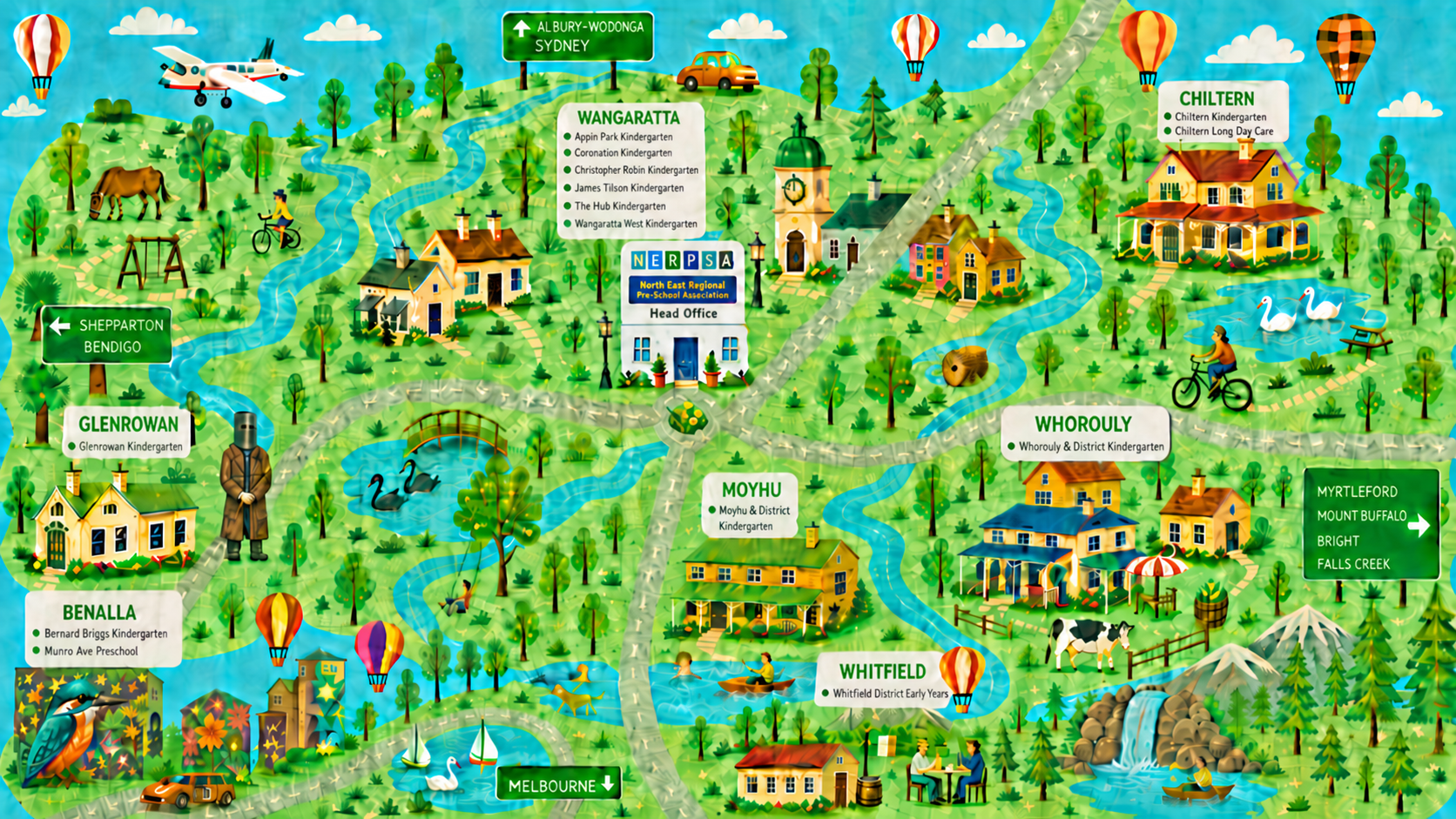
NERPSA services are connected by shared governance and purpose, while each service reflects its own local community, history, families, and place across North East Victoria.
North East Regional Pre-School Association
NERPSA was founded in 2004 to provide a collaborative framework for early childhood services in North East Victoria.
NERPSA was established in response to government funding for group employment models and has since grown to include services across three local government areas. Today, NERPSA works as a connected network of services, staff, families, and communities.
NERPSA across three local government areas
Rural City of Wangaratta
- Appin Park Kindergarten
- Christopher Robin Kindergarten
- Coronation Kindergarten
- Glenrowan Kindergarten
- James Tilson Kindergarten
- Moyhu & District Kindergarten
- The Hub Kindergarten
- Wangaratta West Kindergarten
- Whitfield District Early Years
- Whorouly & District Kindergarten
Benalla Rural City
- Bernard Briggs Kindergarten
- Munro Ave Preschool
Indigo Shire
- Chiltern Kindergarten
- Chiltern Long Day Care
Different communities, shared purpose
NERPSA services are connected by shared governance, employment systems, child safe expectations, and a commitment to high-quality early childhood education and care. Within that shared framework, each service has its own community identity.
Local geography, history, families, town centres, community events, farming areas, tourism, rivers, wineries, landmarks, and local relationships all help shape the daily life of a service. These local differences influence how services build connections, plan programs, celebrate community, and create a sense of belonging for children and families.
Staff are encouraged to learn about the community connected to their service. Local knowledge supports meaningful curriculum decisions, respectful family partnerships, and learning environments where children can recognise their own lives, places, and experiences.
NERPSA in practice
NERPSA is more than one workplace. Our services sit across Wangaratta and surrounding North East Victorian communities, each with its own team, families, routines, and local character.
What connects us is a shared commitment to children’s safety, belonging, play-based learning, inclusion, and high-quality early childhood education and care.
Supporting skilled staff
NERPSA’s mission is to support skilled staff to deliver quality, inclusive, play-based education for the children in our care.
Supporting every child
NERPSA aspires to create a nurturing environment where every child is empowered to reach their full potential.
Mission and vision in practice
Why play matters
NERPSA believes that play is essential for children’s development and learning. We are committed to curriculum and learning environments that are engaging, meaningful, inclusive, and responsive to children’s strengths, interests, and needs.
Lifelong learning
High-quality early childhood education and care supports children’s cognitive, social, emotional, and physical development. These formative years help lay the foundation for lifelong learning, wellbeing, and participation.
Thoughtful teaching and engaging environments
Through thoughtful teaching practices, engaging environments, and a strong focus on individual needs, NERPSA strives to inspire a love of learning in every child.
Governance and shared expectations
One Approved Provider
NERPSA is an Early Years Manager, Approved Provider, and employer. NERPSA is governed by a Board and supported by organisational leadership, service leaders, and staff across our services.
As the Approved Provider, NERPSA is responsible for governance, policy, systems, staffing, compliance, and quality improvement across its services.
Different services, shared responsibilities
Nominated Supervisors, Responsible Persons, persons in day-to-day charge, Educational Leaders, teachers, educators, and other staff all contribute to implementing NERPSA expectations in daily practice.
Services may look and feel different because their communities are different, but child safety, quality practice, professional conduct, inclusion, and employment expectations are shared across NERPSA.
NERPSA’s work takes place on Aboriginal Country
We acknowledge the Traditional Owners and Custodians of the lands on which we work and learn, and pay our respects to Elders past and present. We recognise their continuing connection to land, water, culture, children, families, and community.
NERPSA services operate across North East Victorian communities located on Aboriginal Country. This acknowledgement is part of NERPSA’s identity.
It reminds us that our work with children, families, and communities takes place on Country, and that cultural safety, respect, belonging, and connection are part of everyday NERPSA practice.
Our values in practice
Respect
We treat people with dignity and respect, including children, families, staff, and community members.
Responsiveness
We respond thoughtfully to the needs of children, families, staff, and services.
Integrity
We act with honesty, transparency, and professionalism.
Impartiality
We support fair and inclusive opportunities for children and families.
Accountability
We are accountable to children, families, staff, communities, and the early childhood framework.
Leadership
We support staff and services to build safe, inclusive, and high-quality learning environments.
Human Rights
We uphold human rights, children’s rights, cultural safety, equity, and social justice.
Our strategic goals
NERPSA’s work is guided by strategic priorities that support quality, sustainability, and positive outcomes for children and families.
Think about your local community
Think about how your local community contributes to your service program and the relationships your service builds with children and families.
Every service is part of a bigger network
Each NERPSA service has its own local identity, while also being part of a shared organisation with common values, systems, responsibilities, and commitment to children, families, staff, and communities.
QA7 and QA4
NERPSA HQ, key contacts, and support
Meet the Head Office team and learn who supports different parts of NERPSA’s work with services, staff, children, and families.
NERPSA Head Office
NERPSA Head Office provides organisation-wide support across operations, education, staffing, payroll, finance, human resources, enrolments, policies, systems, and staff support.
Street address
52 Burke Street
Wangaratta VIC 3677
Postal address
PO Box 3048
Yarrunga VIC 3677
Phone
03 5721 2755
Main email
Head Office team
Leigh Chadban
Leigh is the driving force behind NERPSA and oversees all aspects of the Early Years Management organisation. Reporting directly to the Board, Leigh provides strategic leadership and supports the smooth and effective operation of NERPSA.
Leigh is also closely involved in day-to-day operations, including staffing, casual staffing coordination, payroll oversight, service operations, and broader organisational support. Her role helps ensure services are consistently supported by a dedicated and capable team.
Jodi O’Keeffe
Jodi is an experienced early childhood teacher and one of NERPSA’s Education Managers. Jodi previously taught at Wangaratta West Kindergarten, where she developed a strong understanding of child development, curriculum, and effective teaching practice.
As an Education Manager, Jodi supports staff and services with pedagogy, staff wellbeing, professional development, compliance, probation, and professional practice.
Current service support
Appin Park Kindergarten, Bernard Briggs Kindergarten, Christopher Robin Kindergarten, Moyhu & District Kindergarten & Occasional Care, Munro Ave Preschool, and Whitfield Long Day Care.
Susie Furlan
Susie is one of NERPSA’s dedicated Education Managers and brings more than 30 years of experience in the early childhood sector. Her background in running early childhood services makes her a valuable support for staff and service teams.
Susie supports teams with pedagogy, staff wellbeing, professional development, compliance, service operations, and professional practice. You may also see Susie assisting with casual staffing support when services need additional coverage.
Current service support
Chiltern Kindergarten, Chiltern Long Day Care, Coronation Kindergarten, Glenrowan Kindergarten, James Tilson Kindergarten, The Hub Kindergarten, Wangaratta West Kindergarten, and Whorouly & District Kindergarten.
Rebecca Lowe
Rebecca, also known as Bek, is NERPSA’s Administration and Enrolments Officer and is often the first point of contact for families. When families call Head Office, Bek is often the friendly voice on the other end of the phone.
Bek supports enrolments, family enquiries, administration, Head Office communication, and the smooth running of office processes. Her work helps families and services stay connected, informed, and supported.
Angelina Cimino
Angelina is NERPSA’s Human Resources Manager. New staff will usually have had contact with Angelina during recruitment, onboarding, employment paperwork, or induction.
Angelina supports recruitment, onboarding, induction, probation, professional development systems, staff records, employment documentation, placement processes, staffing matters, Human Resources forms, and policy-related staff systems.
Before moving into Human Resources, Angelina was an Early Childhood Teacher with experience in long day care, occasional care, sessional kindergarten, and integrated services. Angelina values continued learning and welcomes feedback to help improve NERPSA’s staff systems and everyday employment experience.
Sharon Shelley
Sharon is one of NERPSA’s Finance Officers and works part-time. Sharon supports payroll processes and is the key contact for payroll queries.
If you have a payroll question, email Sharon through the payroll email address and include enough detail for the query to be checked, such as the pay period, date, service, shift, leave, Additional Hours, or issue you are asking about.
Sharon is also a familiar local face, with many years of experience in the Wangaratta business community, including previously owning Shelley’s Country Bakehouse.
Maria Shultz
Maria is one of NERPSA’s Finance Officers. While staff may not always see Maria in the office because she works remotely, she plays an important role behind the scenes.
Maria works closely with Leigh and the finance team to support the financial aspects of NERPSA’s operations. Her work helps keep financial processes organised, accurate, and moving in the background.
Ashraf Zaman
Ashraf is the most recent member of the NERPSA Head Office team and supports finance processes and financial administration.
While Ashraf is technically part of the finance team, he also supports Head Office in many practical ways. This can include helping with IT tasks, connecting phones, troubleshooting small systems issues, and assisting with the many random jobs that help keep the office and services supported.
Which pathway should I use?
Use this quick pathway guide when you are unsure where to start. It helps you match the question or concern to the right type of support without needing to memorise every contact.
Who to contact first
Start with the person closest to the matter
The best contact depends on the type of question or concern. Starting with the person closest to the matter helps information move through the correct process and avoids delays.
Service routines or local procedures
Start with your Nominated Supervisor, Responsible Person, person in day-to-day charge, Educational Leader, Director, or service leader.
Practice, pedagogy, wellbeing, or probation
Contact the Education Manager who supports your service.
Employment, staffing, placement, or staff records
Contact the Human Resources Manager.
Payroll or finance
Use the payroll or finance contact listed above.
Ask early rather than guess
Asking early helps protect children, staff, families, service operations, and NERPSA’s compliance responsibilities. This is especially important where a question relates to child safety, supervision, ratios, privacy, staffing, payroll, employment records, incidents, complaints, or service procedures.
Some concerns need immediate action
If a matter involves immediate child safety, supervision, ratios, a serious incident, a disclosure, suspected abuse, unsafe conduct, or concerning adult behaviour toward a child, act promptly and follow NERPSA’s child safety and reporting pathways.
These matters should not wait for a routine email response.
If a child is in immediate danger, needs urgent medical help, or emergency services are required, call 000.
Introduce yourself to your Education Manager
Send a short introduction email to the Education Manager who supports your service. This helps your Education Manager learn a little about you and gives you an early connection point for practice, wellbeing, probation, and professional support.
Include:
- your name, role, and the service you are joining;
- something you are looking forward to in your role;
- an area of early childhood education and care that interests you;
- anything you would appreciate support with as you settle into the role.
Check the current Education Manager service allocation on the NERPSA App or Staff Resources website before sending your email.
You are not expected to know everything straight away
Start with the correct service or organisational contact, ask early, and escalate urgent child safety, supervision, or serious incident matters immediately.
QA7 and QA4
Staff Resources, NERPSA App, newsletters, and communication
Knowing where to find current staff information, forms, newsletters, links, and resources helps staff follow the right process and stay connected with NERPSA updates.
Where staff information lives
NERPSA uses the Staff Resources website, the NERPSA App, and the main NERPSA website for different types of information. These sources were introduced earlier in the induction, and this section focuses on how staff use them in day-to-day practice.
Current online information should be used rather than saved, printed, downloaded, or old copies, unless you have been specifically directed to use them.
NERPSA App
The NERPSA App gives staff quick access to onboarding paperwork, common staff forms, availability, leave forms, staff links, document submission, contact information, and practical staff resources.
Open NERPSA AppStaff Resources website
The Staff Resources website is the staff-facing reference point for induction pages, staff documents, Position Descriptions, the Staff Handbook, professional development information, EAP information, service resources, and staff guidance.
You are hereMain NERPSA website
The main NERPSA website provides public information about NERPSA, services, families, enrolments, communities, governance, and current NERPSA service policies.
Open websiteUse current online information
Staff should use current online forms, documents, newsletters, policies, and staff resources. If you cannot find the right form, link, document, or information, ask before using an old version or creating your own process.
This helps NERPSA keep information consistent and reduces the risk of staff using outdated forms or instructions.
NERPSA staff newsletters
NERPSA staff newsletters are published each term, usually around Week 8 or Week 9. They are an important source of organisation-wide updates, key dates, reminders, training information, and shared staff news.
Newsletters are published on the NERPSA App and the Staff Resources website. Previous newsletters are also available in both places.
When a new newsletter is published, an email is sent to each service with a request to forward it to staff. Staff are also encouraged to keep an eye on the NERPSA App and Staff Resources website so they do not miss current updates.
Staff are welcome to contribute to future newsletters. Contributions might include a short reflection, a book review, a professional learning takeaway, a program idea, a service story, or something positive to share from your service.
Where would you go?
Use the source that matches the task
Current service policies
Use the main NERPSA website and go to the service policies page.
Onboarding paperwork
Use the NERPSA App.
Staff Handbook or Position Description
Use the Staff Resources website.
Leave forms or availability
Use the NERPSA App or the current staff forms link provided by NERPSA.
Education Manager service allocation
Use the NERPSA App or Staff Resources website to check the current allocation.
Staff newsletters
Use the NERPSA App or Staff Resources website to read current and previous newsletters.
NERPSA service policies
NERPSA service policies are located on the main NERPSA website. The policies page is the current source for NERPSA service policies and procedures.
The main policy page is included here because staff need to know where current service policies are located. Later induction sections link to specific policies only where they are directly relevant to that topic.
Policy page: https://www.nerpsa.com.au/policies-kindergartens-north-east-victoria.html
Find current staff information
Make sure you know where to find:
- the current NERPSA staff newsletter;
- the current NERPSA service policies;
- one staff form you may need in your role;
- the Education Manager service allocation information.
Using current information helps staff follow the correct process and avoid relying on old forms, saved copies, or outdated instructions.
Use current staff information
The Staff Resources website, NERPSA App, and main NERPSA website each have a different purpose. Using the right source helps staff access current information and follow the correct process.
QA2, QA5, QA6, and QA7
Child Safe Standards and Child Safe Culture
Child safety is everyone’s responsibility. At NERPSA, children’s safety, wellbeing, dignity, rights, and best interests are paramount.
What are the Child Safe Standards?
Victoria’s Child Safe Standards set out the minimum requirements organisations must meet to keep children and young people safe. They require organisations to have child safe policies, procedures, systems, culture, leadership, and everyday practices that prevent and respond to child abuse and harm.
The Standards are not separate from daily work in early childhood education and care. They are reflected in the way staff supervise children, listen to children, work with families, respond to concerns, use technology safely, maintain professional boundaries, and follow NERPSA policies and procedures.
Children come first
Children’s safety, wellbeing, dignity, rights, and best interests guide decisions and actions at every level of the organisation.
Safety is built daily
Child safety is built through everyday interactions, respectful relationships, active supervision, safe environments, listening to children, and speaking up early.
Everyone has a role
Every staff member contributes to child safety, whether they work directly with children, support services, lead programs, or work behind the scenes.
Behaviour inconsistent with NERPSA’s child safe commitment
Any behaviour inconsistent with this commitment will be responded to promptly, proportionately, and in line with NERPSA’s policies, legal obligations, reporting requirements, and procedural fairness.
Depending on the nature and seriousness of the matter, this may include immediate risk management, internal review or investigation, external notification, referral to police or relevant authorities, disciplinary action, legal action, limits on attendance at the service, or termination of engagement or employment.
The 11 Victorian Child Safe Standards
1. Cultural safety for Aboriginal children
Organisations establish a culturally safe environment where Aboriginal children can express their culture and enjoy their cultural rights.
2. Leadership, governance, and culture
Child safety and wellbeing are embedded in organisational leadership, governance, and culture.
3. Child and student empowerment
Children are informed about their rights, participate in decisions affecting them, and are taken seriously.
4. Family engagement
Families and communities are informed and involved in promoting child safety and wellbeing.
5. Equity and diverse needs
Equity is upheld, diverse needs are respected, and children are supported to participate safely and fully.
6. Suitable staff and volunteers
People working with children are suitable and supported to reflect child safety and wellbeing values in practice.
7. Complaints and concerns
Processes for complaints and concerns are child-focused, accessible, and responsive.
8. Knowledge, skills, and awareness
Staff and volunteers are equipped with the knowledge, skills, and awareness needed to keep children safe.
9. Physical and online environments
Physical and online environments promote safety and wellbeing while minimising opportunities for children to be harmed.
10. Review and improvement
Implementation of the Child Safe Standards is regularly reviewed and improved.
11. Policies and procedures
Policies and procedures document how the organisation is safe for children and young people.
Cultural safety for Aboriginal children
Cultural safety is a child safe responsibility
Child Safe Standard 1 requires organisations to create a culturally safe environment where Aboriginal children can express their culture and enjoy their cultural rights.
In practice, this means staff need to respect Aboriginal culture, support children’s identity and belonging, challenge racism, build respectful relationships, and contribute to environments where Aboriginal children and families feel safe, valued, and included.
First Nations Cultural Awareness course
The First Nations Cultural Awareness course is for all staff who work in Early Childhood Education and Care, including administrators, educators, and any other staff.
Through this course, staff will learn about the impact of colonisation on the First Peoples of Australia, hear about the experiences of First Nations Australians in our community and ECEC settings, and discover actions that can be taken in the ECEC environment to support First Nations children, families, staff, and communities.
What this means in everyday practice
Listen to children
Children’s words, behaviour, body language, emotions, silence, play, and changes in presentation can all communicate something important. Staff should listen respectfully and take children seriously.
Support cultural safety
Staff contribute to cultural safety by respecting Aboriginal culture, supporting children’s identity and belonging, using inclusive practice, and seeking guidance when they are unsure.
Maintain active supervision
Active supervision includes positioning, scanning, listening, knowing children, anticipating risk, responding early, and speaking up if staffing, transitions, environments, or routines create safety concerns.
Use professional boundaries
Staff must use safe, respectful, and professional interactions with children, families, colleagues, students, volunteers, visitors, and external providers.
Protect privacy and digital safety
Children’s personal information, images, records, and stories must be handled carefully. Personal devices must not be used to photograph children. Service devices and digital systems must be used in line with NERPSA policy.
Speak up early
Child safety concerns, unsafe practice, concerning adult conduct, breaches of professional boundaries, supervision concerns, and possible harm must be reported through the correct pathway promptly.
If this content feels upsetting
Child safety content can be confronting. If you read, watch, or hear something during induction that feels upsetting, pause and access appropriate support. NERPSA’s Employee Assistance Program information is available on the NERPSA App and the Staff Resources website.
Other child safety training requirements
NERPSA staff are also required to complete other child safety and child protection training, including national child safety training through Geccko and Victorian EC PROTECT training where this applies to their role.
These requirements are managed through onboarding and ongoing staff compliance processes. If you have already completed these training requirements as part of onboarding, you do not need to repeat them as an activity for this section.
Certificates for required training should be submitted through the Document Submission Form on the Staff Resources website or the NERPSA App.
NERPSA policies connected to child safety
Policies turn expectations into practice
NERPSA’s child safety expectations are supported by service policies and procedures. Staff should use the current policies on the main NERPSA website and ask questions if they are unsure how a policy applies in practice.
Key policies connected to this section include Child Safe Environment and Wellbeing, Code of Conduct, Inclusion and Equity, Supervision of Children, Privacy and Confidentiality, Safe Use of Digital Technologies and Online Environments, and Participation of Volunteers and Students.
Useful resources
The 11 Child Safe Standards
Commission for Children and Young People information about the 11 Standards.
Open resourceCultural safety for Aboriginal children
Victorian guidance on Child Safe Standard 1 in early childhood services.
Open resourceGeccko
Australian Government online learning platform used for early childhood education and care training.
Open Geccko informationNational Child Safety Training
Information about national child safety training requirements for the ECEC sector.
Open informationComplete First Nations Cultural Awareness training
Complete the First Nations Cultural Awareness course through Geccko using the link provided by NERPSA.
First Nations Cultural Awareness course
This course is for all staff who work in Early Childhood Education and Care, including administrators, educators, and any other staff.
- Learn about the impact of colonisation on the First Peoples of Australia.
- Hear about the experiences of First Nations Australians in our community and ECEC settings.
- Discover some actions that can be taken in the ECEC environment to support First Nations children, families, staff, and communities.
After completing the course, download your certificate of completion and submit it through the Document Submission Form. The Document Submission Form is available on the Staff Resources website and the NERPSA App.
Keep a copy of your certificate for your own records.
Child safety is active, ongoing, and shared
Child safety is built through culture, leadership, systems, policies, relationships, supervision, cultural safety, reporting, and the everyday decisions staff make with children’s safety, wellbeing, dignity, rights, and best interests as the paramount consideration.
QA2, QA5, QA6, and QA7
Reporting Harm, Child Safety Concerns, and Reportable Conduct
Staff must respond to concerns promptly, follow the correct pathway, and keep children’s safety, wellbeing, dignity, rights, and best interests paramount.
Reporting is part of keeping children safe
Child safety concerns must be taken seriously. Concerns may come from something a child says, something a child does, a change in behaviour, an injury, a family concern, a staff observation, a disclosure, an incident, unsafe practice, or concerning conduct by an adult.
Staff do not need to investigate or prove that harm has occurred before reporting a concern. The staff role is to respond safely, record factually, and report through the correct NERPSA pathway.
Child protection law awareness
NERPSA advises staff, volunteers, and students who work with children of the existence and application of current child protection law and any obligations they may have under that law.
This includes understanding that concerns about a child’s safety, wellbeing, abuse, neglect, family violence, disclosure, unexplained injury, or risk of harm must be taken seriously and reported through the correct pathway.
Staff are not expected to manage child protection concerns alone. If you are unsure whether a matter requires a child protection report, seek guidance immediately through NERPSA’s child safety pathway.
Regulation 84 requires approved providers to ensure nominated supervisors, staff members, volunteers, and students at the service who work with children are advised of the existence and application of current child protection law and any obligations they may have.
If there is immediate danger, call 000 first
If a child is in immediate danger, needs urgent medical help, or emergency services are required, call 000 first.
Be alert
Pay attention to children’s words, behaviour, injuries, interactions, changes in presentation, family information, adult conduct, and environmental risks.
Act calmly
Stay calm, keep the child safe, listen respectfully, avoid asking leading questions, and seek guidance through the correct reporting pathway.
Do not wait
Report concerns promptly. Delays can place children at risk and may affect NERPSA’s legal, regulatory, and child safety obligations.
What needs to be reported?
Immediate risk or emergency
If there is immediate danger, call 000 first.
Child safety concern
Any concern about a child’s safety, wellbeing, harm, abuse, neglect, disclosure, unexplained injury, family violence, or risk of harm must be reported promptly.
Unsafe practice
Concerns about supervision, ratios, unsafe environments, privacy breaches, digital safety, inappropriate behaviour, or poor practice must be reported early.
Concerning adult conduct
Conduct by a staff member, volunteer, student, contractor, visitor, family member, or other adult that may place a child at risk must be reported.
If a child tells you something
Listen, reassure, and report
If a child tells you something that raises a safety concern, stay calm and listen. Reassure the child that they have done the right thing by telling you. Do not promise secrecy.
Do not investigate, confront the person involved, or ask detailed leading questions. Record the child’s words as accurately as possible, including the date, time, context, who was present, and what you observed. Report through NERPSA’s child safety pathway as soon as possible.
NERPSA reporting pathway
Make the child safe
Respond to immediate safety needs first. If there is immediate danger, call 000 first. If medical attention is required, follow emergency and incident procedures.
Report internally promptly
Follow NERPSA’s child safety reporting pathway and notify the appropriate service or organisational leader as soon as possible. Child safety matters must not be left until a routine meeting, newsletter, handover note, or informal conversation.
Record clearly
Use NERPSA’s required record, form, incident process, or concern documentation. Keep records factual, objective, timely, and confidential.
Follow direction and maintain confidentiality
Follow NERPSA direction about next steps. Information must only be shared with people who need it for child safety, legal, regulatory, reporting, investigation, service management, or support purposes.
Do not investigate or manage serious concerns alone
Staff must not investigate allegations, interview children or adults, confront a person who is the subject of a concern, or decide that a concern is not serious enough to report.
Staff are responsible for responding safely, reporting promptly, recording factually, and following NERPSA’s child safety and reporting processes.
Reportable Conduct
Allegations against workers or volunteers
The Reportable Conduct Scheme applies to allegations of certain conduct by workers or volunteers involving a child or young person. Reportable conduct can include sexual offences, sexual misconduct, physical violence, behaviour that causes significant emotional or psychological harm, and significant neglect.
Staff do not decide alone whether an allegation meets the reportable conduct threshold. If you become aware of concerning conduct by a staff member, volunteer, student, contractor, visitor, or other adult connected to the service, report it promptly through NERPSA’s child safety pathway.
NERPSA’s external notification responsibilities
The Social Services Regulator receives reportable conduct notifications in Victoria. Organisations must notify the Social Services Regulator within three business days of the head of organisation becoming aware of a reportable allegation.
Within 30 calendar days after becoming aware of a reportable allegation, the head of organisation must provide the Social Services Regulator with detailed information about the allegation, any disciplinary or other action undertaken, and the response of the worker or volunteer to the allegation.
At NERPSA, staff must report concerns internally promptly so the organisation can assess and meet any external reporting, notification, investigation, or risk management obligations.
Before a Reportable Conduct notification is submitted
The Social Services Regulator notification is made through the secure webform. The webform must be completed in one session and cannot be saved to submit later.
Information should be gathered before starting the webform. The latest version of Google Chrome is recommended. If a copy of the notification is required, a copy should be printed before submitting.
Staff are not expected to complete the Social Services Regulator notification themselves unless they have been specifically authorised to do so. Staff should report concerns internally through the correct NERPSA pathway.
Mandatory reporting, information sharing, and family violence
Mandatory reporting
Some roles have mandatory reporting obligations. Even where a staff member is not a mandatory reporter, child safety concerns must still be taken seriously and reported through the correct NERPSA pathway.
If you are unsure whether a matter requires a child protection report, seek guidance immediately through NERPSA’s child safety pathway. If there is immediate danger, call 000 first.
CISS and FVISS
The Child Information Sharing Scheme and Family Violence Information Sharing Scheme support appropriate information sharing to promote child wellbeing and safety and to assess or manage family violence risk.
Staff must not share sensitive information informally. Follow NERPSA procedures and seek guidance where information sharing may be required for child safety, wellbeing, or family violence risk.
Mandatory reporting does not replace internal reporting
Some roles have mandatory reporting obligations. NERPSA’s internal reporting pathway still applies because it helps the organisation meet child safety, regulatory, record keeping, reportable conduct, risk management, family communication, and support responsibilities.
Privacy, confidentiality, and records
Records must be factual and confidential
Records about child safety concerns, incidents, disclosures, injuries, supervision concerns, adult conduct, or family information must be factual, timely, accurate, and kept confidential.
Use the correct NERPSA form, incident process, record, or reporting pathway. Avoid opinions, assumptions, blame, or unnecessary detail. Record what was seen, heard, said, reported, and done.
Child safety information must only be shared with people who need to know for child safety, legal, regulatory, reporting, investigation, service management, or support purposes.
If this content feels heavy
Child safety, family violence, abuse, and reportable conduct content can be confronting. Staff can pause and access support if needed.
NERPSA’s Employee Assistance Program information is available on the Staff Resources website and the NERPSA App. Staff wellbeing and EAP support are covered further in the wellbeing section of this induction.
NERPSA policies connected to reporting
Policies that support reporting
Key connected policies include Child Safe Environment and Wellbeing, Code of Conduct, Compliments and Complaints, Incident, Injury, Trauma and Illness, Supervision of Children, Determining Responsible Person, Privacy and Confidentiality, Safe Use of Digital Technologies and Online Environments, Inclusion and Equity, and Participation of Volunteers and Students.
Use the current policy links on the main NERPSA website. If a concern involves a child’s safety, wellbeing, harm, unsafe adult conduct, or immediate risk, follow the reporting pathway rather than waiting to check every policy first.
Useful resources
PROTECT guidance
Victorian guidance for child protection and child safety in early childhood.
Open resourceCISS and FVISS
Victorian information sharing schemes for child wellbeing, safety, and family violence risk.
Open resourceKnow your first step
Think through what you would do if you were worried about a child’s safety, an adult’s conduct, or an immediate risk. Make sure you know the correct NERPSA reporting pathway.
Report concerns promptly
Staff are not expected to investigate or decide the outcome. Staff are expected to respond safely, report promptly, record factually, maintain confidentiality, and keep children’s safety, wellbeing, dignity, rights, and best interests paramount.
QA2, QA4, QA5, and QA7
Supervision, Ratios, and Responsible Person
Safe supervision is active, intentional, and responsive. It protects children from harm and supports children’s learning, wellbeing, dignity, and participation.
Supervision is more than watching
Supervision is one of the most important child safety responsibilities in an education and care service. It includes knowing where children are, what they are doing, who they are with, what risks are present, and what support or intervention may be needed.
Active supervision is not passive. It requires staff to position themselves well, scan the environment, listen, anticipate risk, stay engaged with children, respond to changing needs, communicate with the team, and speak up early when staffing, routines, environments, or transitions affect safe supervision.
Be present
Supervision requires attention, movement, communication, and professional judgement. It cannot happen effectively if staff are distracted, clustered together, or disconnected from children.
Know the risk
Supervision changes depending on children’s ages, abilities, relationships, activities, environments, routines, weather, transitions, and individual needs.
Communicate
Staff need to communicate clearly about supervision zones, transitions, breaks, toileting, movement between spaces, and children who need closer support.
Supervision, ratios, and Responsible Person at a glance
These three concepts work together, but they are not the same thing. Open the summary to check the difference between active supervision, educator-to-child ratios, and the Responsible Person requirement.
Active supervision in practice
Positioning
Place yourself where you can see and hear children, support play, respond quickly, and reduce blind spots.
Scanning
Regularly scan the full environment, not just the group or child directly in front of you.
Listening
Listen for changes in noise, tone, movement, silence, distress, conflict, or sounds from areas that are harder to see.
Knowing children
Use knowledge of children’s ages, abilities, interests, relationships, communication, health, trauma history, and support needs.
Anticipating risk
Think ahead during transitions, toileting, rest times, outdoor play, water play, climbing, excursions, arrivals, and departures.
Responding early
Step in early when supervision, behaviour, environment, staffing, or routines create risk or uncertainty.
Educator-to-child ratios
Ratios support safety, but they are not the whole picture
Educator-to-child ratios set the minimum number of educators required for the number and ages of children being educated and cared for. Ratios need to be maintained whenever education and care is being provided, including during transitions, breaks, routines, indoor and outdoor play, excursions, and other program activities.
Victorian educator-to-child ratios
In Victoria, the centre-based educator-to-child ratios are:
| Age of children | Minimum educator-to-child ratio |
|---|---|
| Birth to 24 months | 1 educator to 4 children |
| Over 24 months and less than 36 months | 1 educator to 4 children |
| 36 months up to and including preschool age | 1 educator to 11 children |
| Over preschool age | 1 educator to 15 children |
For most NERPSA kindergarten programs, the ratio staff will commonly use is 1 educator to 11 children for children aged 36 months up to and including preschool age.
Where younger children, occasional care, long day care, or mixed-age groups are involved, the applicable ratio must be checked for the age of the children attending.
Ratios are minimum requirements
Educator-to-child ratios are minimum legal requirements. They do not replace active supervision, professional judgement, or the need to adjust supervision when children, staffing, routines, environments, or risks change.
Staff must still consider children’s ages, individual needs, medical conditions, communication, behaviour, trauma history, support plans, the layout of the environment, visibility, blind spots, transitions, toileting, sleep and rest, mealtimes, outdoor play, water play, excursions, breaks, and changes to the usual roster.
If ratio requirements are technically met but supervision does not feel safe, staff must speak up immediately.
Additional staffing supports quality, but should not be relied on as the plan
NERPSA does its best to overstaff services where possible. Additional staffing can support safer supervision, smoother routines, staff breaks, transitions, children’s individual needs, and the overall quality of the program.
However, additional staffing should not be relied upon as the built-in plan for routine practice. Rosters, routines, transitions, breaks, and supervision arrangements still need to be planned so the service can operate safely if additional staffing changes, a staff member is absent, or staff need to be moved to respond to service needs.
If additional staffing changes and this affects supervision, ratios, breaks, routines, or children’s safety, staff must speak up early so the service can adjust the plan.
Breaks need planning
Breaks, lunches, planning time, meetings, administration, or other time away from direct work with children need to be managed so ratios and supervision remain safe.
Staff should follow the roster, communicate before leaving an area, and make sure supervision is clearly handed over.
Transitions need attention
Supervision can change quickly during arrivals, departures, toileting, indoor-outdoor movement, sleep and rest routines, packing up, group transitions, and changes to the usual program.
These are times to slow down, communicate clearly, and check where every child is.
Who can be counted in ratios
To be counted in educator-to-child ratios, a person must be employed, rostered, approved, working directly with children, and able to perform the educator role safely and appropriately.
Staff should not assume another adult can be counted in ratios. If you are unsure, check before relying on that person.
Responsible Person
Responsible Person does not replace everyone’s responsibility
A Responsible Person must be present whenever education and care is being provided. The Responsible Person supports safe service operation, decision-making, incident response, staffing arrangements, and escalation.
Every staff member must still actively supervise children, follow NERPSA policies and procedures, communicate clearly, and speak up if something is unsafe or unclear.
Staff should know who the Responsible Person is during their shift and where this is displayed or recorded at the service.
Know who is responsible
Staff should know who the Responsible Person is during their shift. If the Responsible Person changes during the day, the handover should be clear and recorded according to service procedure.
Raise gaps immediately
If you are unsure who the Responsible Person is, or if staffing, ratios, supervision, or a transition does not feel safe, speak up immediately through the service pathway.
When supervision needs extra attention
Some times need closer planning
Some routines, environments, and activities need closer supervision because risks can change quickly. Staff should plan, communicate, and adjust supervision during:
- arrivals and departures;
- toileting, nappy changing, personal care, sleep, and rest routines;
- transitions between indoor and outdoor spaces;
- water play, climbing, outdoor play, messy play, and loose parts play;
- mealtimes and food-related routines;
- excursions, regular outings, and visitors attending the service;
- staff breaks, lunches, meetings, and changes to the usual roster;
- times when a child needs additional support, closer supervision, or a risk management response.
What staff are expected to do
Stay connected to children
Supervision works best when staff are engaged with children, aware of the environment, and actively supporting play and learning.
Use clear handover
Let colleagues know before moving away, supporting a child elsewhere, taking a break, changing areas, or adjusting supervision responsibilities.
Raise concerns early
If supervision, ratios, staffing, behaviour, environment, or routines create concern, speak up promptly. Do not wait for the situation to become unsafe.
NERPSA policies connected to this section
Policies that support safe supervision
Key connected policies include Supervision of Children, Determining Responsible Person, Child Safe Environment and Wellbeing, Code of Conduct, Incident, Injury, Trauma and Illness, Excursions and Service Events, Sleep and Rest, Nutrition and Active Play, Safe Use of Digital Technologies and Online Environments, Staffing, and Participation of Volunteers and Students.
Use current NERPSA policies and service procedures when making decisions about supervision, educator-to-child ratios, Responsible Person arrangements, staffing, incidents, excursions, personal care, sleep and rest, visitors, students, volunteers, and child safety concerns.
Useful resources
Victorian ratios
Victorian Government information about educator-to-child ratios in early childhood services.
Open resourceResponsible Person guidance
ACECQA information sheet on Responsible Person requirements.
Open resourceConnect supervision to your service
Think about one routine or transition where supervision can become more difficult. Consider what active supervision would look like in that moment.
Supervision is active child safety practice
Safe supervision is built through positioning, scanning, listening, communication, knowing children, anticipating risk, maintaining ratios, planning for staffing changes, understanding Responsible Person arrangements, and speaking up when something does not feel safe.
QA2, QA3, QA5, and QA7
Personal Care, Dignity, and Safe Practice
Personal care routines must protect children’s health, hygiene, privacy, dignity, rights, safety, and wellbeing.
Personal care is part of professional practice
Personal care includes toileting, nappy changing, changing clothes, supporting hygiene, and other situations where children need close physical, emotional, or practical support.
These routines must be warm, respectful, safe, hygienic, and developmentally appropriate. They are also important child safety moments because children may be more vulnerable, need privacy, or rely on adults to notice discomfort, distress, illness, injury, or changes in wellbeing.
Respect the child
Speak respectfully, explain what is happening, give children time where possible, and protect their privacy and sense of control.
Stay attentive
Personal care does not pause supervision. Staff must remain aware of the child being supported and the broader environment.
Use safe procedures
Follow service procedures for hand hygiene, cleaning, infection control, waste disposal, records, and communication with families.
Safe personal care in practice
Open the quick guide for the main principles that should be present during toileting, nappy changing, clothing changes, hygiene support, and other personal care routines.
Toileting, nappy changing, and clothing changes
Use respectful communication
Speak calmly, explain what is happening, use respectful language, and respond to the child’s cues, comfort, and communication.
Protect privacy
Support toileting, changing, and hygiene routines in ways that protect children’s bodies, dignity, privacy, and confidence.
Follow hygiene procedures
Use correct hand hygiene, glove use where required, cleaning, waste disposal, and infection control procedures.
Support independence
Encourage children to do what they can for themselves, while providing the support they need to feel safe, clean, comfortable, and respected.
Maintain supervision
Ensure the child being supported and other children remain supervised. Communicate clearly with colleagues when leaving or returning to an area.
Notice and respond
Be alert to pain, distress, injury, changes in toileting patterns, illness signs, fear, discomfort, or anything that raises concern.
Professional boundaries during personal care
Personal care requires respectful professional judgement
Personal care routines involve trust. Staff must use professional judgement, follow service procedures, avoid unnecessary physical contact, protect children’s privacy, and maintain respectful interactions at all times.
If a child appears uncomfortable, distressed, fearful, unusually withdrawn, or strongly resistant to a care routine, pause where safe to do so, respond calmly, and seek guidance through the service pathway.
Any concern about injury, disclosure, unsafe practice, inappropriate behaviour, privacy breach, supervision gap, or concerning adult conduct must be reported promptly.
When extra care is needed
Slow down, communicate, and follow procedure
Personal care routines need extra attention when:
- a child needs assistance with toileting, dressing, changing, or hygiene;
- a child has a medical condition, disability, developmental need, trauma history, or individual support plan;
- a child is distressed, unwell, injured, tired, or unsettled;
- staff are moving between spaces or supporting multiple children at once;
- a child’s behaviour, words, body language, or presentation raises a child safety concern;
- something about the routine, environment, staffing, or adult conduct does not feel safe or appropriate.
Records and communication
Record what is required
Complete required toileting, nappy change, incident, illness, injury, medication, or family communication records according to service procedure.
Records should be factual, respectful, accurate, and completed in the correct place.
Share information appropriately
Share personal care information only with people who need it for the child’s care, safety, health, supervision, or family communication.
If you are unsure whether information should be shared, seek guidance through the service pathway.
NERPSA policies connected to this section
Policies that support safe personal care
Key connected policies include Child Safe Environment and Wellbeing, Code of Conduct, Supervision of Children, Incident, Injury, Trauma and Illness, Dealing with Medical Conditions, Hygiene and Infection Control, Privacy and Confidentiality, Safe Use of Digital Technologies and Online Environments, and Participation of Volunteers and Students.
Use current NERPSA policies and service procedures when supporting toileting, nappy changing, clothing changes, hygiene, illness, injuries, supervision, privacy, and child safety concerns.
Useful resources
ACECQA toileting and nappy changing
Guidance on effective toileting and nappy changing procedures.
Open resourceACECQA hygiene and infection control
Quality Area 2 information connected to health, hygiene, and safe practice.
Open resourceThink about dignity in care routines
Think about how dignity, privacy, hygiene, and supervision apply during personal care routines.
Personal care is child safe practice
Safe personal care is built through respectful communication, privacy, hygiene, active supervision, professional boundaries, accurate records, and decisions that keep children’s safety, dignity, rights, and best interests paramount.
QA2, QA5, QA6, and QA7
Health, medical needs, illness, and safe routines
Health information, medical needs, illness, medication, food routines, and sleep/rest procedures must be managed carefully so children’s safety, wellbeing, and individual needs are supported. Staff need to use current information, follow approved plans, check carefully, record accurately, and ask for guidance whenever health information is unclear, missing, outdated, or inconsistent.
Health information must be used carefully
Staff may need to support children with medical conditions, medication requirements, allergies, illness, injuries, trauma, first aid, infectious disease exclusion, sleep and rest needs, safe mealtimes, dietary requirements, or individual health procedures.
These matters must be managed through current NERPSA policies, service-specific procedures, family-provided information, medical documentation, authorisations, records, and approved communication processes.
Everyday health and safety routines
Children’s health and safety is protected through everyday routines, not only during serious incidents or medical emergencies.
Pause before making assumptions
If health, medical, dietary, medication, illness, or care information is missing, unclear, outdated, or inconsistent, staff must pause and seek guidance before making assumptions.
Know the child
Be familiar with children’s relevant medical conditions, allergies, plans, medication requirements, risk minimisation strategies, dietary information, sleep and rest needs, and communication arrangements.
Follow the plan
Use current medical management plans, medication authorisations, service procedures, risk minimisation plans, communication plans, and required records. Do not rely on memory or informal instructions.
Document clearly
Health, medication, illness, injury, trauma, first aid, food-related, sleep and rest, and incident information must be recorded factually, accurately, and in the correct place.
Health and incident information at a glance
Open the quick guide for the main areas staff need to check when supporting children’s health, medication, illness, injury, and incident needs.
Medical conditions, allergies, and anaphylaxis
Plans must be current and followed
Children with a specific health care need, allergy, anaphylaxis, asthma, diabetes, epilepsy, or other relevant medical condition may require a current medical management plan, risk minimisation plan, and communication plan.
Staff must know where these plans are located at the service, understand what applies to the children they work with, and follow service procedures for reducing risk, responding to symptoms, communicating with families, and recording relevant information.
If information appears missing, outdated, unclear, or inconsistent with what is happening for the child, seek guidance through the service pathway before making assumptions.
Allergies and anaphylaxis
Know children’s allergens, action plans, risk minimisation strategies, emergency medication location, and emergency response steps.
Asthma and breathing concerns
Know the child’s plan, symptoms, medication, triggers, emergency response, and when to seek urgent help.
Diabetes, seizures, or other conditions
Follow the child’s current plan and service procedure. Do not guess or rely on informal instructions.
Food safety
Mealtimes are health, safety, supervision, and inclusion routines
Mealtimes must protect children’s health, safety, dignity, culture, allergies, dietary requirements, and sense of belonging.
Staff must not rely on memory or informal information when a child has a food-related health or safety need. If information is missing, unclear, or inconsistent, staff must pause and seek guidance before food is provided.
Food routines staff guide
Open this guide for practical reminders about what staff must do during food and mealtime routines.
Sleep and rest
Sleep and rest is active supervision
Sleep and rest routines must protect children’s safety, wellbeing, dignity, comfort, privacy, and individual needs.
Sleep and rest is not a passive routine. Staff must continue to actively supervise and monitor children while they are sleeping, resting, or having quiet time.
Staff must know and follow NERPSA’s Sleep and Rest Policy and local service procedures. Sleeping or resting children must not be left unsupervised.
Regulations 84A–84D include sleep and rest requirements for services, including policies, procedures, and risk assessment requirements.
Sleep and rest staff guide
Open this guide for practical reminders about what staff need to know and do during sleep and rest routines.
Medication
Medication must follow the correct process
Medication must only be managed and administered according to current NERPSA policy, service procedure, required authorisations, medication records, safe storage requirements, and the child’s health information.
Staff must check the correct child, medication, dose, time, route, authorisation, expiry, storage, and record requirements before medication is administered.
Medication records must be completed accurately, and families must be communicated with through the correct service process.
If anything is unclear, pause
If medication information is missing, unclear, expired, inconsistent, or not authorised, staff must pause and seek guidance before medication is administered.
Illness, infectious disease, and exclusion
Illness needs early action
Staff must notice and respond to signs that a child may be unwell. This may include fever, rash, vomiting, diarrhoea, breathing difficulty, persistent cough, pain, unusual tiredness, change in behaviour, reduced responsiveness, discharge from eyes, ears, or nose, complaints of feeling unwell, or anything that seems unusual for that child.
Staff must follow NERPSA procedures for illness, infectious disease, exclusion, family communication, hygiene, cleaning, supervision, and records.
If a child’s symptoms are serious, worsening, unusual, or concerning, staff must seek guidance promptly. If urgent medical help is needed, call 000.
Policies connected to this section
Policies that support health, medical, illness, and safe routines
Key connected policies include Dealing with Medical Conditions, Medication Administration, Incident, Injury, Trauma and Illness, Sleep and Rest, Nutrition and Active Play, Food Safety, Hygiene and Infection Control, Supervision of Children, Child Safe Environment and Wellbeing, and Privacy and Confidentiality.
Use the current NERPSA policies on the main NERPSA website and follow local service procedures. If something is unclear, ask before proceeding.
Useful resources
ACECQA medical conditions guide
Guidance for managing medical conditions in education and care services.
Open resourceConnect health and safe routines to your service orientation
At your service orientation, make sure you know where to find or how to check:
- medical management plans;
- risk minimisation plans and communication plans;
- emergency medication;
- first aid kits;
- allergy and dietary information;
- medication records;
- incident, injury, trauma, and illness records;
- sleep and rest processes;
- food, hygiene, and safe mealtime procedures;
- who to ask if health, medical, medication, illness, food, or sleep/rest information is unclear.
If you are unsure where something is located or how a process works, ask before proceeding.
Health information and safe routines are everyday child safety practice
Safe practice is built through current information, careful checking, active supervision, clear records, respectful communication, and seeking guidance whenever health, medical, medication, illness, food, or sleep/rest information is missing, unclear, inconsistent, or unsafe.
QA2, QA3, QA4, QA6, and QA7
Emergency procedures, safe arrival, collection, and movement
Emergency procedures, safe arrival, collection, excursions, transport, and movement routines protect children during higher-risk moments. Staff need to know what to do before an emergency occurs, follow local service procedures, maintain active supervision, check authorisations carefully, and act immediately if a child is missing, unaccounted for, or at risk.
Know the process before it is needed
Staff need to understand the local service procedures that protect children during emergency responses, evacuations, lockdowns, arrivals, departures, outdoor routines, water safety, excursions, regular outings, transport, safe arrival, and collection.
These procedures rely on active supervision, clear communication, accurate records, careful checking, and speaking up immediately when something is unclear, incomplete, concerning, or unsafe.
Some routines need extra checking
Children’s safety can be affected quickly when children are moving between places, routines, people, gates, vehicles, outdoor spaces, public areas, or emergency situations.
Pause if something is unclear
If an authorisation, collection arrangement, child movement process, emergency direction, or safety procedure is unclear, incomplete, concerning, or unsafe, staff must pause, keep children supervised, and seek guidance before proceeding.
Know the local procedure
Know where emergency exits, evacuation routes, assembly areas, emergency equipment, attendance records, authorisation information, and safe arrival or collection procedures are located at your service.
Check before moving or releasing children
Check attendance, authorisations, court orders, identity where required, head counts, supervision arrangements, risk assessments, and service procedures before children move, leave, travel, or are collected.
Act immediately when needed
If a child is in immediate danger, urgent medical help is needed, emergency services are required, or a child is missing or unaccounted for, act immediately and follow emergency procedures.
Emergency response
Respond to urgent health needs immediately
Emergency procedures must be known before they are needed. Staff should know how to respond to serious injury, illness, allergic reaction, asthma attack, seizure, evacuation, lockdown, missing child, unsafe collection concern, or any other urgent risk.
If there is immediate danger or urgent medical need
Call 000 first if a child is in immediate danger, urgent medical help is needed, or emergency services are required.
Emergency response staff guide
Open this guide for practical reminders about what staff must do during an emergency response.
Sun protection and water safety
Sun protection is part of health and safety
Staff must follow NERPSA’s Sun Protection Policy and local service procedures whenever children are outdoors or moving between indoor and outdoor spaces.
- check the UV level or follow the service’s current sun protection process;
- support children to wear suitable hats and clothing;
- use shade where possible;
- apply or support the use of sunscreen according to service procedure and family permissions;
- monitor children for heat stress, dehydration, fatigue, or discomfort.
Water safety requires close supervision
Water can create serious risk, even when the amount of water is small.
Staff must actively supervise children around water, empty or remove water containers when required, and consider children’s age, mobility, curiosity, impulsivity, and individual needs.
Water safety is a required policy area under regulation 168.
Water safety staff guide
Open this guide for practical reminders about what staff must do around water.
Delivery, collection, and authorisations
Children must only leave the service safely and lawfully
Staff must follow NERPSA procedures for children’s arrival, attendance, delivery, and collection.
Staff must check authorised nominees, relevant court orders or parenting arrangements, identity where required, sign-out requirements, and safe handover before a child leaves the service.
Regulation 99 covers children leaving the education and care service premises, and regulation 168 includes delivery and collection of children as a required policy area.
If anything is unclear, incomplete, concerning, or unsafe
Do not release the child. Seek guidance from the Responsible Person, Nominated Supervisor, or service leader before proceeding.
Acceptance and refusal of authorisations
Open this guide for reminders about when authorisations need to be checked carefully before staff proceed.
Excursions, regular outings, transport, and safe arrival
Movement away from the usual service environment needs careful planning
Plan
Authorise
Check
Supervise
Count
Handover
Record
Excursions, regular outings, transport, and safe arrival processes create additional child safety and supervision risks because children are moving between places, routines, vehicles, gates, paths, public spaces, or services.
If a child is missing or unaccounted for
Staff must act immediately and follow emergency procedures.
Safe movement guide
Open this guide for the practical checks connected to excursions, regular outings, transport, and safe arrival.
Policies connected to this section
Policies that support emergency, collection, and safe movement practice
Key connected policies include Emergency and Evacuation, Incident, Injury, Trauma and Illness, Sun Protection, Water Safety, Delivery and Collection of Children, Acceptance and Refusal of Authorisations, Excursions and Service Events, Transportation of Children, Safe Arrival of Children, Supervision of Children, Child Safe Environment and Wellbeing, Staffing, and Privacy and Confidentiality.
Use the current NERPSA policies on the main NERPSA website and follow local service procedures. If something is unclear, keep children supervised and ask before proceeding.
Useful resources
ACECQA supervision information
Guidance about active supervision and keeping children safe.
Open resourceConnect emergency and movement procedures to your service orientation
At your service orientation, make sure you know where to find or how to check:
- emergency exits, evacuation routes, assembly areas, and emergency equipment;
- who gives direction during an emergency, evacuation, lockdown, or urgent service response;
- attendance records, head count processes, and roll check procedures;
- delivery, collection, authorised nominee, court order, and safe handover information;
- what to do if a collection arrangement is unclear, incomplete, concerning, or unsafe;
- sun protection and water safety processes;
- excursion, regular outing, transport, and safe arrival procedures if these apply at your service;
- what to do if a child is missing, unaccounted for, or at immediate risk.
If you are unsure where something is located or how a process works, ask before proceeding.
Emergency and movement routines rely on active supervision
Safe practice is built through planning, authorisation, checking, active supervision, head counts, roll checks, safe handover, clear records, and immediate action when a child is missing, unaccounted for, or at risk.
QA1, QA5, QA6, and QA7
Inclusion, Equity, and Participation
Inclusive practice helps every child feel welcomed, respected, supported, and able to participate meaningfully in the program.
Inclusion is active practice
Inclusion at NERPSA means every child is welcomed, respected, and supported to participate meaningfully in the program. Equity means recognising that children and families may need different support, communication, adjustments, or planning to experience safety, belonging, dignity, and participation.
Inclusive practice is not separate from child safety, curriculum, relationships, supervision, health, communication, or family partnerships. It is part of how staff plan, respond, reflect, and make everyday decisions.
Every child is known
Staff use knowledge of each child’s strengths, interests, culture, identity, communication, development, health, family context, and support needs.
Every child can join in
Staff look for ways children can participate safely and meaningfully in routines, play, learning, relationships, and service life.
Support may look different
Fairness does not always mean every child receives the same support. Equity means responding to what children need to participate with dignity.
What inclusive practice can look like
Look for barriers and adjust early
Staff should look for barriers that may affect a child’s participation, including routines, transitions, communication, environments, group expectations, sensory needs, behaviour, health needs, disability, trauma, language, culture, family circumstances, or access to support.
Use an inclusion lens
Open the guide for a practical way to think about inclusion during routines, planning, interactions, and team discussions.
Inclusion across everyday practice
Plan for meaningful participation
Inclusive curriculum starts with children’s strengths, interests, abilities, culture, language, and experiences. Staff should consider how each child can access the environment, materials, relationships, play, routines, and learning experiences.
Make communication accessible
Children communicate in different ways. Staff should use respectful language, visual supports, gestures, modelling, time to respond, and family knowledge to support children’s understanding, expression, choices, and participation.
Families know their child
Families provide important knowledge about their child’s strengths, culture, communication, routines, health, relationships, interests, and support needs. Staff should communicate respectfully and follow approved privacy and record keeping processes.
Ask early and plan together
Inclusion works best when staff share relevant information, reflect together, follow current plans, and seek guidance early. If a child is not able to participate safely or meaningfully, raise this through the service pathway.
Use strengths-based and respectful language
Staff should avoid labelling children or families, making assumptions about ability, culture, behaviour, parenting, communication, disability, trauma, family circumstances, or participation. Concerns should be discussed respectfully, factually, and through the correct service pathway.
When needs are unclear, staff should seek guidance rather than guessing, lowering expectations, excluding the child, or relying on informal arrangements.
When extra support may be needed
Raise participation concerns early
Staff should seek support when a child is finding it difficult to participate safely, meaningfully, or with dignity, or when the current environment, routine, communication, staffing, supervision, or support arrangement is not meeting the child’s needs.
This may involve discussion with the Nominated Supervisor, Responsible Person, person in day-to-day charge, Educational Leader, Director, Education Manager, or another approved NERPSA pathway, depending on the concern and service procedure.
Policies connected to this section
Policies that support inclusion, equity, and participation
Key connected policies include Inclusion and Equity, Interactions with Children, Child Safe Environment and Wellbeing, Code of Conduct, Educational Program, Enrolment and Orientation, Privacy and Confidentiality, Supervision of Children, Dealing with Medical Conditions, Nutrition and Active Play, and Compliments and Complaints.
Use current NERPSA policies on the main NERPSA website and follow local service procedures. If an adjustment, support need, family communication matter, record, or participation concern is unclear, seek guidance before proceeding.
Useful resources
NERPSA Inclusion and Equity
Current NERPSA policy connected to inclusive practice and participation.
Open policyNERPSA Interactions with Children
Current NERPSA policy for respectful and safe interactions with children.
Open policyNERPSA Child Safe Environment
Current NERPSA child safe environment and wellbeing policy.
Open policyThink about inclusion in everyday practice
Choose one routine, transition, or part of the program where a child may need extra support to participate meaningfully.
Think about:
- what the child may be communicating;
- what barrier may be making participation harder;
- what strength, interest, relationship, or family knowledge could help;
- what adjustment could support participation, safety, dignity, or belonging;
- who you would speak with if you needed guidance.
Inclusion does not rely on staff guessing alone. Ask early, use current plans and procedures, and seek guidance when a child may need additional support or adjustment.
Inclusion is part of quality and child safety
Inclusive practice is built through relationships, respectful communication, family partnership, accessible environments, thoughtful planning, active supervision, strengths-based thinking, and early support when barriers affect participation.
QA1, QA2, QA5, and QA7
Safe use of digital technologies and online environments
Digital tools can support learning, communication, and documentation, but they must be used in ways that protect children’s safety, privacy, dignity, and rights.
Digital safety is child safety
Digital technologies include service devices, tablets, cameras, computers, online platforms, apps, storage systems, communication tools, learning technologies, and any device or system that can capture, store, send, or access information.
Staff must use digital technologies in ways that support learning and communication while protecting children’s images, personal information, privacy, dignity, and safety.
Use approved tools
Service devices and approved systems must be used for service functions, including approved photos, videos, documentation, records, and communication.
No child photos
Personal devices must never be used to photograph, video, record, store, or share images or information about children.
Protect information
Children’s images, records, names, locations, stories, family information, and learning documentation must be handled carefully and securely.
Can I use this device?
Open the decision guide before using any device or platform around children, especially if it can take photos, record video, store files, access apps, or connect online.
Personal devices
Personal devices are not for service use
Personal phones, tablets, smart watches, cameras, laptops, storage devices, cloud accounts, messaging apps, and personal email accounts must not be used for service functions involving children.
Personal devices may only be approved for limited personal, health, family, or safety alerts where there is a genuine need. This does not allow personal devices to be used for child photos, videos, recordings, service documentation, child information, or family communication.
Photos, videos, and children’s images
Use service devices only
Approved photos and videos of children must only be taken on NERPSA-approved service devices.
Check consent
Before taking or using child images, check the current consent and any restrictions recorded for the child.
Turn off location data
Geotagging and location services must be disabled on service devices when capturing images or videos of children.
Use approved storage
Images and videos must be stored, accessed, transferred, retained, and deleted according to NERPSA procedure.
Protect dignity
Do not take images during personal care routines, toileting, changing, distress, injury, sleep, rest, or vulnerable moments unless specifically required and authorised for a lawful service purpose.
Ask if unsure
If you are unsure whether an image, video, platform, or storage method is appropriate, do not proceed until you have checked the current process.
Digital technologies in the program
Use technology intentionally
Digital tools should have a clear purpose. They may support documentation, communication, creativity, inquiry, accessibility, inclusion, and learning when used thoughtfully.
Stay actively involved
Children’s use of digital technology must be actively supervised. Staff should consider content, time, privacy, interaction, accessibility, and whether the technology supports the learning intention.
Online environments and digital footprints
Children have rights online too
Children’s images, names, voices, stories, work samples, locations, routines, and family information can create a digital footprint. Staff must think carefully about what is captured, why it is needed, who can access it, where it is stored, and how long it is kept.
Digital documentation should be meaningful and respectful. It should not prioritise quantity over quality, or convenience over children’s rights, privacy, safety, and dignity.
Information security and privacy
Use approved systems only
Staff must use approved NERPSA systems for child information, staff information, family information, photos, videos, records, and communication.
- Do not send child information or images to personal email, personal cloud storage, or personal messaging apps.
- Do not store child images or service documents on personal devices or removable storage.
- Do not share passwords or leave devices unlocked where others can access information.
- Report privacy concerns, lost devices, accidental sharing, unauthorised access, or suspected data breaches promptly.
NERPSA policies connected to this section
Policies that support safe digital practice
Key connected policies include Safe Use of Digital Technologies and Online Environments, Child Safe Environment and Wellbeing, Code of Conduct, Privacy and Confidentiality, Supervision of Children, Educational Program, Enrolment and Orientation, Compliments and Complaints, and Incident, Injury, Trauma and Illness.
These policies support safe decisions about service devices, digital platforms, photos, videos, learning documentation, online environments, communication systems, privacy, and records.
Useful resources
ACECQA National Model Code
Guidance on taking images and videos of children while providing education and care.
Open resourceACECQA Digital Technologies
Policy guidance for safe use of digital technologies and online environments.
Open resourceeSafety Early Years
Online safety resources for young children, families, and early years educators.
Open resourceCheck before creating or sharing digital information
Think about what device, consent, privacy, storage, and sharing expectations apply before any child-related image, video, or digital information is created or shared.
Safe digital practice protects children
Digital technology must be used intentionally, safely, and respectfully. Service devices, approved systems, consent, privacy, supervision, secure storage, and professional judgement all help protect children’s safety, dignity, and rights.
QA1, QA2, QA3, QA4, QA5, QA6, and QA7
National Quality Framework and National Quality Standard
The National Quality Framework sets the national system for quality, safety, compliance, assessment, and continuous improvement in education and care services.
Where NERPSA fits
NERPSA services operate within the National Quality Framework, often called the NQF. The NQF provides the national system for education and care services across Australia.
Staff do not need to memorise every part of the framework. What matters is understanding that everyday practice at NERPSA — supervision, relationships, curriculum, records, environments, family partnerships, staffing, governance, and continuous improvement — connects back to this wider system.
The NQF in plain language
National Law
The legal foundation for approved providers, services, nominated supervisors, educators, regulatory authorities, and compliance obligations.
National Regulations
The detailed operational requirements for areas such as staffing, records, policies, procedures, notifications, health, safety, and supervision.
National Quality Standard
The quality benchmark used to assess and improve education and care across seven Quality Areas.
Approved Learning Frameworks
The curriculum frameworks that guide planning, learning, teaching, assessment, reflection, inclusion, and outcomes for children.
NERPSA in the NQF system
This is a simple way to understand how the system connects. The wider framework sets the requirements. NERPSA, as the Approved Provider, creates the governance, systems, policies, staffing arrangements, and supports that help services put those requirements into everyday practice.
National Law and Regulations
Legal and operational requirements.
ACECQA
National guidance, resources, and support for the NQF.
Victorian Department of Education
Victorian regulatory authority for education and care services.
National Quality Standard
Seven Quality Areas that describe quality education and care.
NERPSA
Approved Provider and employer for NERPSA services.
Approved Learning Frameworks
Curriculum, planning, reflection, and learning outcomes.
NERPSA services
Services operate under NERPSA governance and local service procedures.
Service leaders and staff
Daily practice brings the framework to life.
Children, families, and communities
The purpose of quality, safe, inclusive education and care.
The seven Quality Areas
The National Quality Standard is organised into seven Quality Areas. These areas help services understand, assess, and improve the quality of education and care.
Quality Areas are included at the top of each induction section to help staff see how each topic connects to service quality and compliance.
NERPSA as Approved Provider
NERPSA’s role
NERPSA is the Approved Provider for its services. This means NERPSA has organisation-wide responsibility for governance, systems, policies, compliance, staffing, notifications, quality improvement, and ensuring services operate in line with the NQF.
How services fit
NERPSA services operate under NERPSA governance while also reflecting their own local communities, teams, programs, environments, children, families, and service procedures.
How staff bring the framework to life
Staff contribute to NQF compliance and quality through everyday actions. This includes active supervision, safe environments, respectful relationships, curriculum decisions, inclusion, family communication, privacy, accurate records, professional conduct, and following NERPSA policies and procedures.
The Quality Area references at the top of each induction section are included to show how each topic connects to the broader quality framework.
Key roles in the system
ACECQA
ACECQA provides national guidance and resources connected to the National Quality Framework.
Victorian Department of Education
In Victoria, the Department of Education is the regulatory authority for education and care services. It monitors and supports compliance with the National Law, National Regulations, and NQF requirements.
Approved Provider
The Approved Provider has legal responsibility for operating approved services and ensuring they meet requirements under the National Law, National Regulations, and NQF.
Service leaders and staff
Nominated Supervisors, Responsible Persons, persons in day-to-day charge, Educational Leaders, teachers, educators, casual staff, and other staff all help put NQF expectations into practice.
Quality improvement
Quality is ongoing
The NQF is not only about meeting requirements. It also supports ongoing reflection and quality improvement.
NERPSA services use reflection, staff discussions, feedback, observations, family input, incident learning, policy review, professional learning, and quality improvement processes to strengthen practice over time.
Staff contribute to quality improvement by asking questions, reflecting honestly, sharing ideas, following agreed processes, and raising concerns when something can be made safer, clearer, or better for children, families, or staff.
Useful resources
National Law and Regulations
ACECQA information about the National Law and National Regulations.
Open resourceConnect one Quality Area to your role
Think about one Quality Area that connects strongly to your role and why it matters in everyday practice.
The NQF is part of everyday practice
Quality, safety, compliance, and improvement are built through the way staff plan, supervise, communicate, document, reflect, and care for children every day.
QA2, QA4, QA5, QA6, and QA7
Professional conduct, boundaries, and Code of Conduct
Professional conduct protects children, supports respectful workplaces, and helps create a child safe culture where expectations are clear.
How we work matters
Professional conduct is the way staff behave, communicate, make decisions, respond to concerns, use authority, manage boundaries, and represent NERPSA.
In early childhood education and care, conduct is closely connected to child safety. Children rely on adults to use power responsibly, communicate respectfully, maintain safe boundaries, and act in children’s best interests.
Use respectful behaviour
Treat children, families, colleagues, students, volunteers, visitors, and community members with dignity, courtesy, fairness, and respect.
Keep roles clear
Use clear professional boundaries so interactions with children, families, and others cannot be misinterpreted.
Raise concerns
Report concerns, breaches, unsafe conduct, or behaviour that is inconsistent with the Code of Conduct through the correct pathway.
Behaviour inconsistent with NERPSA’s child safe commitment
Behaviour that is inconsistent with NERPSA’s child safe commitment, Code of Conduct, policies, or legal obligations will be responded to promptly and proportionately.
Depending on the nature and seriousness of the matter, this may include risk management, review or investigation, external notification, referral to police or relevant authorities, disciplinary action, legal action, limits on attendance at the service, or termination of engagement or employment.
What professional conduct looks like
NERPSA’s Code of Conduct sets clear expectations for professional behaviour. Open the guide for examples of conduct that supports child safety and conduct that is not appropriate.
Professional behaviour in practice
With children
Use warm, respectful, developmentally appropriate interactions. Do not shame, threaten, isolate, intimidate, ridicule, use rough handling, or create fear.
With families
Communicate professionally, protect privacy, use service pathways, and maintain clear boundaries between personal and professional relationships.
With colleagues
Work respectfully, share information needed for safe practice, use clear handovers, support constructive feedback, and raise concerns appropriately.
With students, volunteers, and visitors
Model professional expectations, support safe participation, and speak up if conduct, supervision, or boundaries are unclear or unsafe.
Alcohol, drugs, smoking, and vaping
Staff must be fit to work safely with children.
Staff must not educate or care for children while affected by alcohol, drugs, medication, or any substance that may impair their ability to supervise, respond, communicate, make decisions, or perform their role safely.
Smoking, vaping, alcohol, and illicit drugs must not be used on the service premises while children are being educated and cared for.
Staff must also follow NERPSA procedures if they are taking medication or have a health issue that may affect their ability to safely perform their role.
The National Regulations include requirements relating to tobacco, vaping devices, vaping substances, drugs, and alcohol use in education and care services.
What staff must do
Professional boundaries
Boundaries protect children and staff
Professional boundaries help staff use their role safely and fairly. They reduce confusion, protect privacy, prevent favouritism, and help children and families know what to expect from NERPSA staff.
Boundary concerns can include personal messaging, social media contact, private arrangements, sharing too much personal information, special treatment, secrecy, gifts, favours, unnecessary physical contact, or communication outside approved service pathways.
Protect confidentiality
Staff must protect children’s, families’, and colleagues’ personal information. Information should only be shared where there is a legitimate service, safety, legal, or organisational reason.
Keep contact appropriate
Physical contact with children must be respectful, nurturing, developmentally suitable, child safe, and connected to the child’s safety, wellbeing, learning, or care needs.
If you are concerned about someone’s conduct
If something does not feel right, speak up
Staff should speak up if they see, hear, or become aware of conduct that may affect a child’s safety, dignity, rights, privacy, or wellbeing, or that is inconsistent with NERPSA’s Code of Conduct.
Concerns may include:
- humiliating, frightening, threatening, isolating, shaming, degrading, or intimidating a child;
- rough handling, unsafe physical contact, inappropriate discipline, or unreasonable correction;
- using a personal device to take, store, send, or discuss children’s images, videos, records, or information;
- secretive, private, or inappropriate communication with a child or family;
- creating situations to be alone with a child without a clear professional reason;
- sharing confidential information without authority;
- ignoring concerns, disclosures, suspected harm, abuse, family violence, or unsafe adult behaviour;
- bullying, harassment, discrimination, racism, victimisation, or disrespectful workplace behaviour;
- any conduct that may need to be managed through NERPSA’s child safety, complaints, performance, disciplinary, or reportable conduct pathways.
Professional judgement
Use the “Would I be comfortable explaining this?” test
If a decision, message, conversation, photo, action, favour, relationship, or interaction would be difficult to explain to a child’s family, a colleague, the service leader, NERPSA, or a regulator, pause and seek guidance before continuing.
Professional judgement is about being reflective, transparent, child-focused, and willing to ask before something becomes unsafe, unclear, or inconsistent with NERPSA expectations.
NERPSA policies connected to this section
Policies that support professional conduct
Key connected policies include Code of Conduct, Child Safe Environment and Wellbeing, Interactions with Children, Privacy and Confidentiality, Compliments and Complaints, Supervision of Children, Safe Use of Digital Technologies and Online Environments, Staffing, and Participation of Volunteers and Students.
These policies support safe decisions about conduct, communication, boundaries, privacy, supervision, child safety, complaints, students, volunteers, visitors, and digital technology.
Useful resources
NERPSA Interactions with Children
Current NERPSA policy for respectful and safe interactions with children.
Open policyNERPSA Child Safe Environment
Current NERPSA child safe environment and wellbeing policy.
Open policyReflect on professional conduct
Think of one behaviour that supports child safety and one behaviour that would be inconsistent with the Code of Conduct. Make sure you know how to raise a concern if you observed conduct that was not appropriate.
Professional conduct protects trust
Clear conduct, safe boundaries, respectful communication, confidentiality, transparency, and early reporting help protect children, families, staff, and NERPSA’s child safe culture.
QA2, QA4, QA6, and QA7
Privacy, confidentiality, and record keeping
Privacy and accurate records protect children, families, staff, and NERPSA. Information must be handled carefully, respectfully, and only for proper service purposes.
Information must be treated with care
Staff may access information about children, families, colleagues, health needs, incidents, enrolments, learning, behaviour, child safety concerns, family circumstances, medical conditions, and service operations.
This information must only be accessed, used, discussed, recorded, stored, or shared for a legitimate service, safety, legal, regulatory, or organisational reason.
Only access what you need
Staff should only access information needed for their role or for a clear child safety, service, legal, or organisational purpose.
Do not discuss information casually
Confidential information must not be discussed in public areas, with people who do not need to know, or outside approved NERPSA processes.
Keep records factual
Records should be accurate, respectful, timely, objective, and stored in the correct place.
Before you share or record information
Privacy decisions are often made in ordinary moments. Open the guide to check what to think about before discussing, sharing, emailing, uploading, printing, or recording information.
Privacy in practice
Use approved systems
Use NERPSA-approved systems, forms, platforms, and storage locations for service information, records, child information, and family information.
Limit access
Only access or share information where it is needed for your role, child safety, service operation, legal obligations, or approved organisational purposes.
Choose the right place
Do not discuss private information in public areas, shared spaces, hallways, social settings, or anywhere it may be overheard.
Be careful with digital information
Do not send child, family, or staff information to personal email, personal devices, personal cloud storage, or informal messaging apps.
Record keeping
Records need to be accurate, timely, and clear
Records help NERPSA meet legal, regulatory, child safety, employment, service management, and quality requirements. They also help staff communicate clearly and make safe decisions.
Records should be factual, timely, objective, respectful, and stored in the correct place. Record what was seen, heard, said, reported, and done. Avoid assumptions, blame, gossip, labels, or unnecessary personal comments.
Records support child safety and lawful decision-making
Records are not just paperwork. They help protect children, families, staff, and NERPSA by showing what happened, what was known, what action was taken, who was told, and what needs to happen next.
Staff may need to complete or contribute to records about:
Records must be factual, timely, accurate, respectful, and completed in the correct place.
Staff must not keep informal child records in personal notebooks, personal phones, personal emails, private cloud storage, or messaging apps.
Records may include
- enrolment and authorisation information;
- attendance, delivery, and collection records;
- incident, injury, trauma, and illness records;
- medication and medical condition records;
- child safety concerns, complaints, and related actions;
- staff, volunteer, and student records where required.
Store records securely
Records must be stored safely and securely. Staff should not leave records where they can be accessed by people who do not need them.
Printed records, digital files, forms, photos, and notes must be handled according to NERPSA procedure.
Information sharing and child safety
Confidentiality does not mean keeping safety concerns secret
Confidentiality is important, but it must not prevent staff from reporting child safety concerns, family violence concerns, reportable conduct concerns, unsafe practice, incidents, or legal and regulatory matters through the correct pathway.
Child safety information must be shared carefully, respectfully, and only with people who need it for child safety, legal, regulatory, reporting, investigation, service management, or support purposes.
When information must be escalated
Some information needs to be escalated promptly so the right people can respond, support, report, investigate, or manage risk.
If you are unsure
Ask before sharing or storing information in the wrong place
If you are unsure whether to access, share, record, store, print, email, upload, or delete information, pause and check the correct process.
Do not create your own records, save information to personal devices, forward information to personal accounts, or share information informally because it feels quicker.
NERPSA policies connected to this section
Policies that support privacy and records
Key connected policies include Privacy and Confidentiality, Child Safe Environment and Wellbeing, Code of Conduct, Safe Use of Digital Technologies and Online Environments, Compliments and Complaints, Incident, Injury, Trauma and Illness, Delivery and Collection of Children, Safe Arrival of Children, and Excursions and Service Events.
These policies support decisions about confidential information, child and family records, staff information, digital files, photos, complaints, incidents, child safety information, attendance, authorised nominees, court orders, delivery and collection, excursions, transport, and safe arrival records.
Useful resources
NERPSA Safe Use of Digital Technologies
Current NERPSA policy for digital technologies and online environments.
Open policyThink before sharing information
Think about one type of confidential information you may come across in your role. Make sure you know where it should be stored, who should access it, and what to do if you are unsure whether it can be shared.
Privacy is part of professional trust
Careful handling of information protects children, families, staff, and NERPSA. Access information only when needed, keep records factual, use approved systems, and ask before sharing or storing information in the wrong place.
QA2, QA6, and QA7
Policies, procedures, compliments, complaints, and feedback
Feedback and complaints help NERPSA identify what is working well, what needs attention, and where action may be required to support safe, fair, and consistent practice.
How staff respond matters
Families, children, staff, students, volunteers, and community members may raise compliments, feedback, concerns, or complaints in different ways. The first response matters because it can help the person feel heard and can support the concern being managed properly.
Staff should respond calmly and respectfully, protect privacy, avoid becoming defensive, and make sure the concern is recorded, referred, or escalated through the correct pathway.
Policies are practical instructions, not just documents
NERPSA policies and procedures explain how legal, regulatory, child safe, quality, and organisational expectations are put into practice.
Staff are expected to use the current published version of NERPSA policies and procedures. Staff should not rely on saved, printed, downloaded, or old copies unless NERPSA has specifically directed them to do so.
If a staff member cannot find the right policy, form, or process, they should ask before creating their own process or relying on informal instructions.
The National Regulations require education and care services to have policies and procedures for key operational areas. Approved providers must take reasonable steps to ensure those policies and procedures are followed and are accessible to staff and volunteers.
Key policy areas staff need to know
Staff do not need to memorise every policy word-for-word. Staff do need to know where current policies are located, what they mean in practice, and when to seek guidance.
Respond calmly
Listen respectfully, thank the person for raising the matter, and avoid dismissing, minimising, debating, or becoming defensive.
Keep it factual
Record what was raised, what was said, what was observed, what was done, and who was notified.
Use the right pathway
Follow the correct policy, form, reporting process, or workplace pathway. Child safety concerns must be escalated promptly.
When a concern or complaint is raised
Open the detailed guide for practical response steps. The visible Listen / Record / Escalate cards are the quick reminder. This pop-up provides the fuller staff response guide.
Compliments and positive feedback
Feedback helps services grow
Compliments and positive feedback are valuable. They help recognise strong practice, build staff morale, strengthen relationships with families and communities, and support continuous improvement.
If a family or community member shares positive feedback, pass it on through the service pathway so it can be acknowledged and shared appropriately.
Concerns and complaints
Concerns should be handled calmly and fairly
A concern or complaint may relate to a child’s experience, communication, privacy, staffing, supervision, behaviour guidance, fees, inclusion, safety, service operations, or another matter.
Staff should not ignore, minimise, or try to manage concerns informally if a formal pathway is required. Follow the Compliments and Complaints Policy and make sure concerns are recorded, referred, or escalated correctly.
Complaints must be taken seriously
Complaints and concerns may be raised by children, families, staff, students, volunteers, visitors, contractors, community members, or other people connected to the service.
A complaint may relate to:
Staff must not dismiss, minimise, ignore, or informally manage a complaint that needs to be recorded or escalated.
If the complaint involves immediate risk to a child
Staff must respond to the immediate safety issue first.
Listen respectfully
Give the person space to explain the concern. Stay calm, avoid interrupting, and thank them for raising it.
Do not promise an outcome
You can explain that the matter will be passed on or managed through the correct pathway, but do not promise a result you cannot control.
Record factually
Record what was raised, what was said, what was reported, what was observed, what action was taken, and who was notified.
Protect privacy
Only discuss the matter with people who need the information for service, safety, legal, regulatory, workplace, or organisational reasons.
Child safety concerns are urgent
Do not wait if the concern involves child safety
If a concern involves child safety, harm, reportable conduct, family violence, unsafe supervision, concerning adult conduct, or immediate risk, follow the child safety reporting pathway immediately.
Complaints and feedback processes must not delay urgent child safety action. If a child is in immediate danger, call 000.
Staff grievances and employment matters
Employment matters use workplace processes
Staff grievances, employment concerns, performance matters, workplace conflict, conduct concerns, and staffing matters should be managed through the appropriate NERPSA workplace pathway.
Staff should not use informal discussion, gossip, or family-facing complaint processes to manage employment matters. If you are unsure which pathway applies, seek guidance through the service or organisational pathway.
Continuous improvement
Feedback can make practice clearer and safer
Policies and procedures are reviewed over time to reflect legislation, regulations, quality guidance, service needs, feedback, incidents, complaints, and continuous improvement.
Staff contribute to improvement by following current procedures, raising unclear or unsafe processes, and providing constructive feedback when something can be made clearer or safer.
NERPSA policies connected to this section
Policies that support feedback and complaints
Key connected policies include Compliments and Complaints, Code of Conduct, Child Safe Environment and Wellbeing, Privacy and Confidentiality, Incident, Injury, Trauma and Illness, and Supervision of Children.
Useful resources
Use the right policy pathway
Think about a concern that could be raised at a service, such as supervision, privacy, a complaint from a family, or a child safety concern. Consider which policy or pathway would guide your first steps.
Responding well supports trust
Listen respectfully, record factually, protect privacy, use the correct pathway, and escalate child safety or serious concerns promptly.
QA2, QA4, And QA7
Staff wellbeing, support, and professional sustainability
Wellbeing matters in early childhood work. Staff are better able to support children, families, and each other when they are supported, informed, and able to work sustainably.
Early childhood work is meaningful and demanding
Early childhood education and care is relationship-based work. It can be joyful, purposeful, and rewarding, and it can also involve emotional labour, competing priorities, complex family needs, child safety content, staffing pressures, and busy service routines.
Looking after wellbeing is part of sustainable professional practice. It helps staff stay connected, reflective, safe, and able to contribute to a positive workplace culture.
Know where support is
NERPSA’s Employee Assistance Program information is available through the Employee Assistance Program Policy on the Staff Resources website.
Use current details
EAP and staff wellbeing information is also available through the NERPSA App. Staff should use the current provider details listed there or in the EAP Policy.
Use support early
Staff are encouraged to use available wellbeing supports early, rather than waiting until things feel unmanageable.
Where to find wellbeing and EAP information
Open this guide for the two NERPSA places staff should use to find current wellbeing and Employee Assistance Program information.
Employee Assistance Program
Use the current EAP information
NERPSA’s Employee Assistance Program information is available through the Employee Assistance Program Policy on the Staff Resources website.
Staff can use the policy to locate current EAP provider details, access instructions, and support options. EAP information is also available through the NERPSA App.
What supports wellbeing at work?
Respectful communication
Clear, calm, respectful communication helps staff work together and reduces confusion during busy or stressful moments.
Realistic priorities
Early childhood work involves many moving parts. Staff should use service systems and role expectations to prioritise safely.
Breaks and recovery
Breaks, lunches, and recovery time support safe, sustainable work. Breaks should be managed so supervision and ratios remain safe.
Reflective practice
Reflection helps staff notice what is working, what feels challenging, and what support, learning, or adjustment may be needed.
When content feels heavy
Some induction content can be confronting
Sections on child safety, family violence, harm, abuse, reportable conduct, trauma, and child protection may feel upsetting or personal for some staff.
If induction content feels heavy, pause and access appropriate support. Use the Employee Assistance Program Policy on the Staff Resources website or the wellbeing information available through the NERPSA App.
Professional sustainability
Know what is expected
Position Descriptions, service procedures, rosters, communication pathways, and induction content help staff understand what is expected and where to seek direction.
Do not carry concerns alone
Workload, role clarity, conduct, safety, and wellbeing concerns should be raised through the correct pathway early, before they become harder to manage.
NERPSA resources connected to this section
Use current NERPSA staff resources
Key connected resources include the Employee Assistance Program Policy, staff wellbeing information, Position Descriptions, Staff Handbook information, Code of Conduct, Staffing information, Work Health and Safety information, and Compliments and Complaints processes.
Useful resources
Employee Assistance Program Policy
Located on the Staff Resources website. Use this policy for current EAP provider details, access instructions, and support options.
Open Staff ResourcesNERPSA App
Use the NERPSA App to access current staff wellbeing, EAP information, staff resources, and forms.
Open NERPSA AppWatch the staff wellbeing video
Watch the staff wellbeing video provided by NERPSA: open the wellbeing video.
Think about one practical habit or support that may help you work sustainably in early childhood education and care.
Wellbeing supports safe and sustainable practice
Sustainable work is supported by respectful communication, clear expectations, appropriate breaks, reflective practice, early support, and knowing where to access NERPSA’s EAP and wellbeing resources.
QA1, QA4, and QA7
Reflective practice, professional learning, and PDPs
Reflective practice helps staff think carefully about what is happening, why it matters, and how practice can continue to improve for children, families, teams, and services.
Reflection is part of quality practice
Reflective practice means pausing to think about practice, decisions, relationships, environments, routines, communication, and outcomes. It helps staff notice what is working, what could be strengthened, and what may need to change.
In early childhood education and care, reflection supports curriculum decisions, child safety, inclusion, professional learning, teamwork, and continuous improvement.
What is happening?
Reflection begins by noticing what is happening in practice, including children’s experiences, routines, relationships, learning, wellbeing, and staff decisions.
Why does it matter?
Reflection asks what the situation means for children, families, the team, the program, inclusion, safety, and quality practice.
What could change?
Reflection should support thoughtful action, not just discussion. It can lead to changes in planning, routines, environments, communication, or support.
Reflection is more than a note
Open the guide to check the difference between meaningful reflection and simply recording what happened.
Reflection in everyday practice
Children’s learning
Reflection helps educators consider children’s interests, strengths, needs, voices, relationships, and what learning may happen next.
Inclusion and equity
Reflection helps staff consider whether every child and family feels safe, respected, included, and able to participate.
Team practice
Reflection helps teams learn from each other, recognise strengths, improve communication, and build shared expectations.
Service improvement
Reflection can identify patterns, risks, gaps, strengths, and opportunities for improvement across the service.
Reflective practice supports child safety
Reflective practice helps staff notice what is working, what is unclear, what could be safer, and what support may be needed.
Did our supervision work well during that transition?
Were ratios maintained, and was supervision actually adequate?
Did children have a voice in what happened?
Did our practice protect children’s dignity and privacy?
Did we communicate clearly as a team?
Did we follow the correct policy or procedure?
Did anything feel unsafe, rushed, unclear, or inconsistent?
What should we do differently next time?
Do we need to update a risk assessment, routine, environment, or communication process?
Do we need support from an Education Manager, service leader, or Head Office?
Reflective practice is part of professional accountability. It helps NERPSA improve systems, support staff, and keep children’s safety, wellbeing, dignity, rights, and best interests at the centre of practice.
Professional learning
Learning continues after induction
Induction is the beginning of professional learning at NERPSA. Professional learning continues through service practice, team discussions, coaching, feedback, policy updates, professional development, reflective practice, and the annual PDP cycle.
Staff are encouraged to connect learning back to their role, their service context, the children they work with, and the priorities identified through reflection and feedback.
Professional Development Plans
Develop, review, and rewrite
A PDP is developed after probation, reviewed during the year, and rewritten each year as part of the annual cycle.
PDPs support professional growth by helping staff identify goals, record professional learning, reflect on progress, and connect development to their role and service priorities.
Use your PDP link
The PDP is accessed and completed online and can be completed on a computer, tablet, or phone. It can also be saved and printed for staff records.
After submission, staff receive an email with a link. Staff should retain that email and link.
PDPs can include child safe practice
Professional growth at NERPSA includes strengthening knowledge, judgement, confidence, and practice in areas that keep children safe and support quality education and care.
A staff member’s PDP may include goals connected to:
PDPs should connect professional learning with everyday practice. They are not just a form to complete. They help staff reflect, identify goals, record learning, and strengthen practice over time.
A PDP should be practical
The PDP link allows staff to return to their PDP throughout the year to edit and update goals, log professional learning activities, add reflections, review progress, and evaluate growth.
Goals may relate to curriculum, child safety, inclusion, communication, leadership, team practice, documentation, behaviour guidance, cultural safety, wellbeing, or another area connected to the staff member’s role.
How reflection and PDPs work together
Notice patterns
Reflection helps staff notice strengths, challenges, interests, questions, and areas where practice could be strengthened.
Use feedback well
Feedback from leaders, colleagues, families, children, and professional conversations can help shape meaningful professional goals.
Turn learning into action
PDPs help turn reflection and feedback into clear goals, actions, learning opportunities, and review points.
NERPSA resources connected to this section
Use current NERPSA staff resources
Staff should use the Staff Resources website for current PDP information, professional development information, Position Descriptions, Staff Handbook information, and any relevant staff forms or resources.
Useful resources
ACECQA reflective practice
Developing a culture of learning through reflective practice.
Open resourceEYLF critical reflection
Information sheet on critical reflection and ongoing professional learning.
Open resourceStaff Resources website
Use the Staff Resources website for PDP information and staff resources.
Open Staff ResourcesConnect reflection to practice
Think about one routine where child safety depends on staff noticing, communicating, and adjusting practice. This might be a transition, toileting routine, meal time, sleep/rest period, arrival, departure, or outdoor play.
What would good reflective practice help the team notice or improve?
Reflection helps practice improve
Reflective practice, professional learning, feedback, and PDPs help staff continue growing in ways that support children, families, teams, services, and NERPSA’s commitment to quality practice.
QA2, QA4, And QA7
Employment requirements, staff records, and document submission
Current staff records help NERPSA meet legal, regulatory, child safety, workforce, and service requirements. Staff have an important role in keeping their information accurate and up to date.
Current information matters
NERPSA needs accurate staff information to manage employment, rosters, qualifications, regulatory requirements, child safety requirements, training records, payroll, emergency contact information, and service records.
Staff are responsible for providing required documents, keeping personal and professional details current, monitoring expiry dates that apply to their role, and using the correct NERPSA process when something changes.
WWCC or VIT
Staff must hold and maintain the required Working with Children Check or VIT registration for their role.
Keep evidence current
Qualification, study, registration, and approved training evidence must be provided when requested and updated when it changes.
Update details promptly
Changes to names, contact details, checks, registrations, qualifications, training, or role details need to be updated through the correct NERPSA process.
What should be submitted or updated?
Open the guide for a simple list of documents and details staff may need to provide or keep current.
Document submission
Use the Document Submission Form
Staff should use NERPSA’s Document Submission Form when providing required certificates, qualifications, training evidence, or other staff documents.
The Document Submission Form is available through the Staff Resources website and the NERPSA App. This helps NERPSA keep records complete, accurate, and stored in the correct place.
Training and certificates
First aid, asthma, and anaphylaxis
Where required for the role, staff must hold current approved training and provide evidence through the Document Submission Form.
PROTECT training
PROTECT training certificates should be submitted through the Document Submission Form when completed or renewed.
National child safety training
National child safety training certificates should be submitted through the Document Submission Form when required by NERPSA.
Aboriginal cultural safety training
The Aboriginal cultural safety training certificate should be submitted through the Document Submission Form when completed.
National Early Childhood Worker Register
NERPSA keeps required workforce information current
The National Early Childhood Worker Register is connected to approved provider workforce record requirements. NERPSA manages provider-level administration where required.
Staff support this process by providing accurate information and submitting updates promptly when their details, documents, training, checks, registration, qualifications, or role-relevant information change.
What staff need to do
Monitor your own expiry dates
Staff should keep track of expiry dates for required checks, registrations, qualifications, certificates, and training that apply to their role.
Submit evidence promptly
When training, renewal, registration, or study evidence is completed, submit the certificate or updated document through the Document Submission Form.
If something changes
Do not wait until someone asks
If your name, address, phone number, email, emergency contact, WWCC, VIT registration, qualifications, certificates, training, study status, or role-relevant details change, update NERPSA through the correct process as soon as possible.
This includes renewals, expiries, changed names, new qualifications, updated WWCC or VIT details, completed training, and anything that may affect your role requirements.
NERPSA resources connected to this section
Use current NERPSA staff resources
Staff should use the Staff Resources website and NERPSA App for current staff forms, document submission processes, staff resources, Position Descriptions, Staff Handbook information, and employment-related resources.
Useful resources
Document Submission Form
Available through the Staff Resources website and the NERPSA App for submitting staff documents and certificates.
Open NERPSA AppStaff Resources website
Use the Staff Resources website for current staff forms, resources, and employment-related information.
Open Staff ResourcesNational Worker Register
ACECQA information about the National Early Childhood Worker Register.
Open resourceACECQA approved first aid training
ACECQA information about approved first aid, asthma, and anaphylaxis training.
Open resourceCheck your records are current
Think about the documents and details NERPSA needs for your role. Make sure you know where to find the Document Submission Form and what you would need to update if your details, checks, registration, qualifications, certificates, or training changed.
Accurate records support safe and compliant services
Keeping staff records current supports child safety, regulatory compliance, workforce requirements, service operations, payroll, emergency contact processes, and NERPSA’s responsibilities as the Approved Provider.
QA4 And QA7
Practical employment information, leave, payroll, and staff forms
This section helps staff understand where to find everyday employment information and how to manage common NERPSA employment processes.
How do I manage employment processes at NERPSA?
Staff need to know where to find practical employment information, forms, and processes. This includes leave, Additional Hours, payroll questions, staff details, Position Descriptions, EAP information, and the Staff Handbook.
This section is not intended to repeat the full Staff Handbook. It gives staff a clear starting point for common employment questions and directs them to current NERPSA resources.
Start with the handbook
The Staff Handbook is the key employment resource for staff processes, expectations, forms, communication, leave, payroll-related processes, and workplace information.
Use the correct form
Staff forms are available through the Staff Resources website and the NERPSA App. Use the current form rather than saved or older copies.
Ask early
Pay queries should be raised promptly and with enough detail to help payroll understand and check the question.
Practical “How do I?” guide
Open the guide for a quick reference table showing where to go for common staff employment tasks.
Staff Handbook
The Staff Handbook is the main employment guide
The Staff Handbook is the key employment resource for staff processes and expectations. It helps staff understand how NERPSA employment processes work in practice.
It includes practical employment information such as leave, Additional Hours, staff responsibilities, workplace expectations, payroll-related processes, communication, support, forms, and procedures.
Leave and absence
Planned leave
Planned leave should be requested as early as possible using the current NERPSA leave process, form, or pathway outlined in the Staff Handbook.
Unplanned absence or sickness
If you are sick or unable to attend work, follow the current absence notification process promptly. Early notification matters because ratios, rosters, and child safety may be affected.
Emergency absence
If an emergency affects your ability to attend work, follow the current emergency absence notification process as soon as you are able.
Evidence requirements
Evidence requirements may apply depending on the leave type and circumstances. Staff should follow the current Staff Handbook and NERPSA process.
Additional Hours
Additional Hours need the correct approval and form
Additional Hours Applications are used where staff are approved to complete work outside their ordinary rostered hours.
Additional Hours must be approved and submitted through the correct process. Staff should use the current Additional Hours Application and follow any instructions in the Staff Handbook or Staff Resources website.
Induction time can only be claimed as Additional Hours if it is completed outside paid work time and has been approved. Induction completed during paid rostered time cannot also be claimed as Additional Hours.
Payroll
Contact payroll promptly
Payroll queries should be raised promptly by emailing pay@nerpsa.com.au.
Include enough detail for the query to be checked, such as the pay period, date, service, shift, leave, Additional Hours, or issue you are asking about.
Update details through the correct process
Bank, tax, superannuation, name, address, contact, or other pay-related changes need to be updated through the correct NERPSA process.
If you are unsure what process applies, use the Staff Resources website, NERPSA App, or payroll contact.
Staff forms and resources
Use the Staff Resources website and NERPSA App
Staff should use the Staff Resources website and NERPSA App to find current staff forms, practical employment resources, and staff information.
- leave information and forms;
- Additional Hours Application;
- Document Submission Form;
- staff detail update forms, where applicable;
- PDP information or form;
- Position Descriptions;
- Staff Handbook;
- Employee Assistance Program Policy.
Using the right process
Use current forms and instructions
Forms and processes may be updated over time. Staff should use the current version available through the Staff Resources website or NERPSA App rather than older saved copies.
Do not wait if something is unclear
If you are unsure how to apply for leave, submit Additional Hours, update details, use a form, or ask a payroll question, check the Staff Handbook or seek guidance through the correct NERPSA pathway.
Useful resources
Staff Resources website
Use the Staff Resources website for the Staff Handbook, Position Descriptions, PDP information, staff forms, and employment resources.
Open Staff ResourcesNERPSA App
Use the NERPSA App for staff links, staff forms, document submission, EAP information, and practical resources.
Open NERPSA AppPayroll contact
Email payroll queries to pay@nerpsa.com.au and include enough detail for the query to be checked.
Email payrollFind the key employment resources
Open the Staff Resources website or NERPSA App and make sure you know where to find the Staff Handbook, Position Descriptions, leave information, Additional Hours Application, Document Submission Form, and payroll contact information.
Practical knowledge supports smoother work
Knowing where to find employment information, forms, leave processes, Additional Hours instructions, payroll contact details, and support resources helps staff manage their work clearly and confidently.
QA2, QA4, QA6, and QA7
Students, volunteers, contractors, visitors, and external providers
Children’s safety remains paramount when any adult attends a NERPSA service. Every adult needs a clear purpose, appropriate checks, clear boundaries, and appropriate supervision.
Every adult at the service needs a clear role
NERPSA services may have students, volunteers, family members, contractors, allied health professionals, photographers, maintenance workers, delivery drivers, community visitors, or other adults attend for approved reasons.
Adults who are not NERPSA staff must be managed in a way that protects children’s safety, privacy, dignity, and wellbeing. This includes checking their purpose for attending, following sign-in and sign-out procedures, confirming any required WWCC or VIT details, and ensuring appropriate supervision.
Know why they are there
Students, volunteers, visitors, contractors, and external providers should have a clear, approved reason for attending the service.
Check requirements
Required WWCC or VIT details must be checked before a person starts where this applies to their role, attendance, or access.
Do not assume
External adults do not replace safe staffing. Their role, access, and supervision must be managed through the current NERPSA process.
Who is this adult at the service?
Open the guide for a simple way to think about students, volunteers, visitors, contractors, and other adults who attend a service.
Students and volunteers
Students and volunteers support the service, but they are not NERPSA staff
Students and volunteers may participate in the service where this has been approved and where the correct checks, records, orientation, and supervision arrangements are in place.
Non-employee students and volunteers are supervised, are not counted in ratios, and are not left alone with children. Their participation should be guided by educators and kept within their approved role, capability, and supervision arrangements.
Students and volunteers must follow NERPSA expectations, including child safety, privacy, supervision, conduct, digital technology, confidentiality, and service procedures.
Sign in and out
Students, volunteers, visitors, and external adults must follow service sign-in and sign-out processes on arrival and departure.
Stay within role
Students and volunteers should participate only in tasks and experiences that are appropriate to their approved role and supervision arrangements.
Protect privacy
Students, volunteers, and visitors must not access, photograph, record, discuss, or share information about children or families outside approved service processes.
Raise concerns
If an adult’s role, behaviour, supervision, device use, privacy practice, or interaction with children does not seem right, raise it promptly.
NERPSA employees completing placement
Staff placements need approval before they begin
A NERPSA employee who is completing study and needs practicum or placement hours must have the placement approved by Head Office Human Resources and the relevant Education Manager before any placement arrangement is confirmed or begins.
NERPSA is the Approved Provider and, for placements at NERPSA services, is also the host organisation. Placement paperwork must be reviewed and signed off by NERPSA before the placement commences.
Current NERPSA practice allows staff to complete up to two approved practicum placements at their primary service. Further placements may require another NERPSA service or an external service, depending on study requirements, supervision needs, service capacity, and approval.
Sign in as staff
If an approved placement occurs during rostered paid work hours, the person signs in as staff, is paid, and is counted in ratios because they are working as an employee during that time.
Sign in as student
If an approved placement occurs outside rostered hours or on a day off, the person signs in as a student, is unpaid for that placement time, and is not counted in ratios for that placement time.
Visitors, contractors, and external providers
External providers must follow NERPSA expectations
Contractors, allied health professionals, photographers, maintenance workers, delivery people, community visitors, and other external adults may attend for approved service purposes.
Their attendance must be managed in line with NERPSA procedures. This may include prior approval, sign-in and sign-out, WWCC or VIT checks where required, supervision, confidentiality, safe conduct, and limits on access to children, records, devices, and service spaces.
Do not provide unsupervised access to children unless current NERPSA procedure confirms this is permitted for that person’s approved role and all required checks and arrangements are in place.
Supervision and ratios
External adults do not replace safe staffing
Staff must not assume that a student, volunteer, visitor, contractor, family member, allied health professional, photographer, or external provider can be used to meet supervision or staffing requirements.
Non-employee students and volunteers are not counted in ratios. If there is uncertainty about whether someone can be counted, what they can do, or how they must be supervised, staff should check the current NERPSA process before relying on that person in any way.
External adults have clear limits
External adults may only participate in the service for the purpose approved by NERPSA or the service.
This includes students, volunteers, contractors, allied health professionals, photographers, maintenance workers, visitors, family members, and other external providers.
If an external adult’s role, checks, supervision requirements, or access limits are unclear, staff must pause and seek guidance before allowing participation.
External adults and child safety limits
Open this guide for clear limits on access, participation, records, photography, personal devices, child removal, and ratio counting.
NERPSA policies connected to this section
Policies that support safe adult participation
Key connected policies include Participation of Volunteers and Students, Code of Conduct, Child Safe Environment and Wellbeing, Supervision of Children, Staffing, Privacy and Confidentiality, Safe Use of Digital Technologies and Online Environments, Delivery and Collection of Children, Excursions and Service Events, and Compliments and Complaints.
Useful resources
Participation of Volunteers and Students
Current NERPSA policy for students and volunteers.
Open policyNERPSA Code of Conduct
Conduct expectations for staff, students, volunteers, contractors, families, and visitors.
Open policyVictorian WWCC guidance
Victorian guidance on WWCC and VIT checking requirements for early childhood services.
Open resourceThink about an adult attending the service
Think about one adult who may attend your service, such as a student, volunteer, contractor, photographer, allied health professional, or visitor. Consider what should happen before they participate, how they should sign in, how they should be supervised, and what you would do if something did not seem right.
Clear roles help keep children safe
Students, volunteers, visitors, contractors, and external adults can support service life, but children’s safety, supervision, privacy, dignity, and wellbeing remain paramount at all times.
QA7, QA4, and QA2
Acknowledgement of Completion
Complete the final acknowledgement form to confirm that you have worked through the NERPSA New Employee Induction Self-Guided Course.
Complete the final step of your induction
You are now at the final step of the NERPSA New Employee Induction Self-Guided Course.
The Acknowledgement of Completion form confirms that you have worked through the induction and understand the key responsibilities connected to your role.
Your completed form becomes part of your NERPSA induction and employment record.
Complete
Make sure you have worked through the induction sections and required activities.
Read
Read each acknowledgement statement carefully before you sign.
Clarify
Seek clarification before signing if anything is unclear.
Before you submit the form
Read each acknowledgement statement carefully
In future, this form will include acknowledgement statements that staff will need to read and agree to before submitting.
- Read each acknowledgement statement carefully.
- Select each required acknowledgement checkbox.
- Seek clarification before signing if anything is unclear.
- Submit the completed form so NERPSA has a formal record of completion.
Claiming induction time
Only claim approved time outside paid work hours
New staff induction may be paid up to 8 hours where approved.
If you complete induction during paid rostered or approved work time, you cannot also claim Additional Hours for that time. Only approved induction time completed outside paid work hours can be claimed through an Additional Hours Application.
Submit your Acknowledgement of Completion
Submit the NERPSA New Employee Induction Self-Guided Course Acknowledgement of Completion form.
Complete Acknowledgement of Completion Form This form becomes part of your NERPSA induction and employment record.You are part of the NERPSA team
Thank you for taking the time to complete your induction. We are glad to have you as part of NERPSA and look forward to supporting you in your role.