
Welcome, organisation, and staff systems
QA7, QA6, QA5, QA1
Welcome to NERPSA
NERPSA services are connected by shared governance and purpose, while each service reflects its own local community, history, families, and place across North East Victoria.
Who we are
North East Regional Pre-School Association
NERPSA was founded in 2004 to provide a collaborative framework for early childhood services in North East Victoria.
NERPSA was established in response to government funding for group employment models and has since grown into a connected network of services, staff, families, and communities across North East Victoria.
Local communities
Different communities, shared purpose
NERPSA services are connected by shared governance, employment systems, child safe expectations, and a commitment to high-quality early childhood education and care. Within that shared framework, each service has its own community identity.
Each community has its own places, stories, families, relationships, history, Country, events, and local features. These differences help shape how services build connection, plan curriculum, and create a sense of belonging for children and families.
Staff are encouraged to learn about the community connected to their service. Local knowledge supports respectful family partnerships and learning experiences that reflect children’s lives, places, and communities.
Acknowledgement of Country
NERPSA’s work takes place on Aboriginal Country
We acknowledge the Traditional Owners and Custodians of the lands on which we work and learn, and pay our respects to Elders past and present. We recognise their continuing connection to land, water, culture, children, families, and community.
NERPSA services operate across North East Victorian communities located on Aboriginal Country. This acknowledgement is part of NERPSA’s identity.
It reminds us that our work with children, families, and communities takes place on Country, and that cultural safety, respect, belonging, and connection are part of everyday NERPSA practice.
Service network
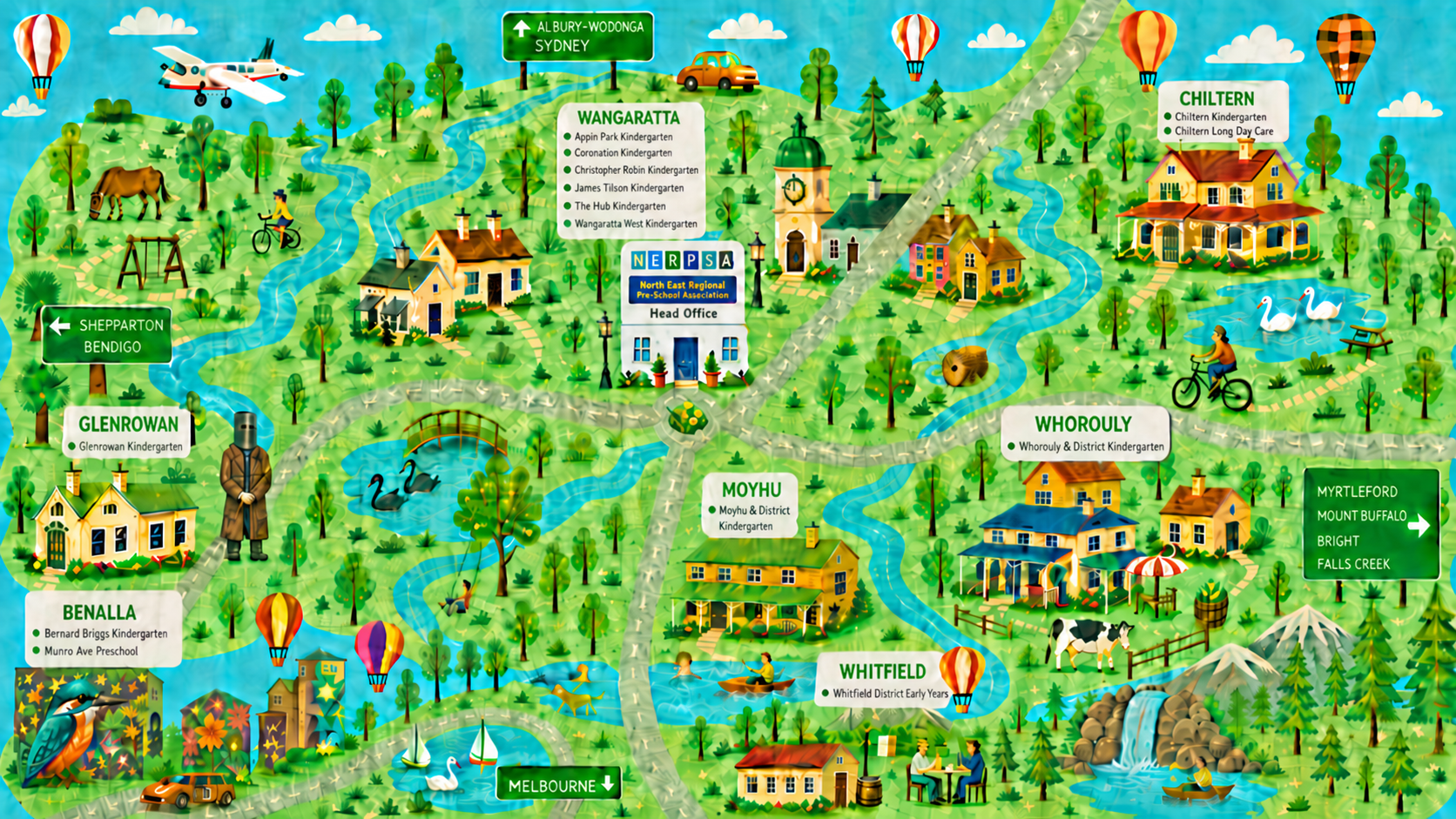
NERPSA in practice
NERPSA is more than one workplace. Our services sit across Wangaratta and surrounding North East Victorian communities, each with its own team, families, routines, and local character.
What connects us is a shared commitment to children’s safety, belonging, play-based learning, inclusion, and high-quality early childhood education and care.
Required Induction Activity
Connect with your local community
Think about the community connected to your service. Identify one local place, event, relationship, landmark, family connection, cultural connection, or community feature that could help children feel a stronger sense of belonging in the program.
This might be something connected to Country, local history, the natural environment, community events, family knowledge, local work, shared places, or something children regularly notice and talk about.
Optional community extension activities
- Create a short community connection idea for your service. This could be a local walk, family invitation, local story, photo display, map, seasonal event, community visitor, or project idea that helps children connect with place and community.
- Think more deeply about how local identity influences curriculum. Consider how children’s learning may be strengthened when educators understand local history, Country, families, community relationships, local industries, natural environments, and shared community events.
- Reflect on one child or family connection that could help make the program feel more meaningful and familiar for children. How could educators include this respectfully?
- Think about how Aboriginal Country and local community identity can be reflected in everyday practice, not only in special events or displays.
Our mission
Supporting skilled staff
NERPSA’s mission is to support skilled staff to deliver quality, inclusive, play-based education for the children in our care.
Our vision
Supporting every child
NERPSA aspires to create a nurturing environment where every child is empowered to reach their full potential.
Mission and vision in practice
Play-based learning
Why play matters
NERPSA believes that play is essential for children’s development and learning. We are committed to curriculum and learning environments that are engaging, meaningful, inclusive, and responsive to children’s strengths, interests, and needs.
Strong foundations
Lifelong learning
High-quality early childhood education and care supports children’s cognitive, social, emotional, and physical development. These formative years help lay the foundation for lifelong learning, wellbeing, and participation.
Our approach
Thoughtful teaching and engaging environments
Through thoughtful teaching practices, engaging environments, and a strong focus on individual needs, NERPSA strives to inspire a love of learning in every child.
Professional practice
Early childhood education: what it is and what it is not
Early childhood education and care is professional, intentional work. It is grounded in relationships, play, safety, wellbeing, inclusion, and thoughtful teaching.
At NERPSA, early childhood education is not about rushing children into formal schooling. It is about creating safe, responsive, engaging, and inclusive environments where children can build confidence, curiosity, communication, relationships, identity, independence, and a love of learning.
High-quality early childhood practice looks warm and natural, but it is not accidental. Educators make many professional decisions throughout the day about the environment, routines, relationships, supervision, children’s interests, learning opportunities, behaviour guidance, safety, inclusion, family partnerships, and each child’s individual needs.
| Early childhood education is… | Early childhood education is not… |
|---|---|
| Play-based, intentional, and responsive. | Babysitting or simply keeping children occupied. |
| Built on strong relationships with children and families. | A one-size-fits-all program. |
| Focused on children’s safety, wellbeing, dignity, rights, and belonging. | Just preparing children to sit still, follow instructions, or start school. |
| Guided by professional judgement, observation, reflection, and planning. | Random activities without purpose or connection to children’s learning. |
| Inclusive of children’s cultures, identities, strengths, interests, abilities, and needs. | Expecting every child to learn, behave, communicate, or participate in the same way. |
| Rich in language, movement, creativity, problem-solving, relationships, and exploration. | Only about worksheets, formal lessons, or adult-directed tasks. |
| Grounded in respectful guidance, co-regulation, and developmentally appropriate expectations. | Control, fear, shame, punishment, humiliation, or adult power. |
| Informed, reflective, and responsive to children, families, evidence, and current frameworks. | Repeating routines, rules, or activities simply because “we have always done it that way.” |
| Supported by the approved learning frameworks, the National Quality Framework, NERPSA policies, and child safe practice. | Separate from safety, supervision, care, routines, or relationships. |
| A partnership with children, families, colleagues, and communities. | Something educators do alone without listening to children and families. |
| Professional work that requires humility, reflection, and accountability. | A place for personal ego, favouritism, adult convenience, or “because I said so” practice. |
Play is not separate from learning
In early childhood, play is one of the main ways children explore, communicate, practise, test ideas, build relationships, regulate emotions, solve problems, and make sense of the world.
Play with purpose
Play is not separate from learning. In early childhood, play is one of the main ways children explore, communicate, practise, test ideas, build relationships, regulate emotions, solve problems, and make sense of the world.
An educator’s role is to notice what children are showing, saying, wondering, and trying to understand. Educators support learning by creating safe environments, joining play thoughtfully, extending ideas, asking questions, introducing language, offering resources, supporting relationships, and helping children feel safe, capable, and included.
What this means for staff
Staff contribute to early childhood education by:
- building respectful and trusting relationships with children;
- keeping children safe through active supervision and thoughtful routines;
- supporting play, curiosity, communication, and participation;
- noticing children’s strengths, interests, needs, and ways of learning;
- using guidance, boundaries, and routines in ways that protect dignity and support development;
- checking their own reactions, assumptions, and power in the adult-child relationship;
- thinking about why practices are used, whether they are still safe and meaningful, and whether they reflect current expectations, evidence, and children’s needs;
- working respectfully with families and colleagues;
- following NERPSA policies and procedures;
- reflecting on practice and asking questions when something is unclear.
Early childhood education is both caring and educational. Care, safety, relationships, routines, play, and learning are connected. At NERPSA, they work together to support each child’s safety, wellbeing, belonging, and development.
Governance and shared expectations
Governance
One Approved Provider
NERPSA is an Early Years Manager, Approved Provider, and employer. NERPSA is governed by a Board and supported by organisational leadership, service leaders, and staff across our services.
As the Approved Provider, NERPSA is responsible for governance, policy, systems, staffing, compliance, and quality improvement across its services.
Shared practice
Different services, shared responsibilities
Nominated Supervisors, Responsible Persons, persons in day-to-day charge, Educational Leaders, teachers, educators, and other staff all contribute to implementing NERPSA expectations in daily practice.
Services may look and feel different because their communities are different, but child safety, quality practice, professional conduct, inclusion, and employment expectations are shared across NERPSA.
Our values in practice
Respect
We treat people with dignity and respect, including children, families, staff, and community members.
Responsiveness
We respond thoughtfully to the needs of children, families, staff, and services.
Integrity
We act with honesty, transparency, and professionalism.
Impartiality
We support fair and inclusive opportunities for children and families.
Accountability
We are accountable to children, families, staff, communities, and the early childhood framework.
Leadership
We support staff and services to build safe, inclusive, and high-quality learning environments.
Human Rights
We uphold human rights, children’s rights, cultural safety, equity, and social justice.
Our strategic goals
NERPSA’s work is guided by strategic priorities that support quality, sustainability, and positive outcomes for children and families.
Access and participation
Highly skilled, collaborative workforce
Quality education and care
Strong partnerships
Governance and sustainability
Required Induction Activity
Why this work matters to you
Early childhood education is relational, reflective, and purposeful work. Take a moment to think about why you chose this profession, or why you continue to work in it.
- What do you believe children deserve from the adults who educate and care for them?
- What part of early childhood education feels most meaningful to you?
- Which part of NERPSA’s approach — safety, play, inclusion, relationships, community, child voice, dignity, or lifelong learning — connects most strongly with your own values?
- How do you want children to feel when they are with you?
- What kind of professional do you want to keep becoming?
You do not need to have a perfect answer. This reflection is about connecting your values with your professional role.
Optional extension activities
If you would like to think more deeply, you may choose one or more of the following:
- What experiences, values, or people have shaped the way you see children and childhood?
- Think about an educator, teacher, family member, colleague, or leader who positively shaped your understanding of children. What did they model that you want to carry into your own practice?
- Choose one phrase from the table above that challenges you or makes you think more deeply. Reflect on how that idea might show up in everyday routines, such as transitions, mealtimes, toileting, group times, outdoor play, or supporting big emotions.
- Write a short professional statement that begins with: “As an early childhood education professional, I want children to experience…”
- Consider the difference between guidance and control. What might a child feel in each situation? What might an educator do differently when they are focused on dignity, connection, and learning rather than adult control?
- What is one practice you have seen in early childhood that is worth keeping because it is meaningful, safe, and child-centred?
- What is one practice that may need to be questioned or adjusted because “we have always done it that way” is not enough?
- Choose one everyday routine, such as transitions, mealtimes, rest time, group time, packing up, toileting, or outdoor play. Reflect on whether the routine is guided by children’s needs, safety, dignity, learning, and current practice expectations — or whether parts of it happen mainly because they have always been done that way.
Every service is part of a bigger network
Each NERPSA service has its own local identity, while also being part of a shared organisation with common values, systems, responsibilities, and commitment to children, families, staff, and communities.